Xuelian Zhang, Daoshun Wu, Yu Tian, Xiangdong Chen, Jin Lan, Fei Wei, Ye Li, Yun Luo, Xiaobo Sun
{"title":"<i>Ganoderma lucidum</i> polysaccharides ameliorate lipopolysaccharide-induced acute pneumonia via inhibiting NRP1-mediated inflammation.","authors":"Xuelian Zhang, Daoshun Wu, Yu Tian, Xiangdong Chen, Jin Lan, Fei Wei, Ye Li, Yun Luo, Xiaobo Sun","doi":"10.1080/13880209.2022.2142615","DOIUrl":null,"url":null,"abstract":"<p><strong>Context: </strong><i>Ganoderma lucidum</i> polysaccharides (GLP), from <i>Ganoderma lucidum</i> (Leyss. ex Fr.) Karst. (Ganodermataceae), are reported to have anti-inflammatory effects, including anti-neuroinflammation and anti-colitis. Nevertheless, the role of GLP in acute pneumonia is unknown.</p><p><strong>Objective: </strong>To explore the protective role of GLP against LPS-induced acute pneumonia and investigate possible mechanisms.</p><p><strong>Materials and methods: </strong>GLP were extracted and used for high-performance liquid chromatography (HPLC) analysis after acid hydrolysis and PMP derivatization. Sixty C57BL/6N male mice were randomly divided into six groups: Sham, Model, LPS + GLP (25, 50 and 100 mg/kg/d administered intragastrically for two weeks) and LPS + dexamethasone (6 mg/kg/d injected intraperitoneally for one week). Acute pneumonia mouse models were established by intratracheal injection of LPS. Haematoxylin and eosin (H&E) staining was examined to evaluate lung lesions. ELISA and quantitative real-time PCR were employed to assess inflammatory factors expression. Western blots were carried out to measure Neuropilin-1 expression and proteins related to apoptosis and autophagy.</p><p><strong>Results: </strong>GLP suppressed inflammatory cell infiltration. In BALF, cell counts were 1.1 × 10<sup>6</sup> (model) and 7.1 × 10<sup>5</sup> (100 mg/kg). Release of GM-CSF and IL-6 was reduced with GLP (25, 50 and 100 mg/kg) treatment. The expression of genes IL-1β, IL-6, TNF-α and Saa3 was reduced. GLP treatment also suppressed the activation of Neuropilin-1 (NRP1), upregulated the levels of Bcl2/Bax and LC3 and led to downregulation of the ratio C-Caspase 3/Caspase 3 and P62 expression.</p><p><strong>Discussion and conclusions: </strong>GLP could protect against LPS-induced acute pneumonia through multiple mechanisms: blocking the infiltration of inflammatory cells, inhibiting cytokine secretion, suppressing NRP1 activation and regulating pneumonocyte apoptosis and autophagy.</p>","PeriodicalId":19942,"journal":{"name":"Pharmaceutical Biology","volume":" ","pages":"2201-2209"},"PeriodicalIF":4.8000,"publicationDate":"2022-12-01","publicationTypes":"Journal Article","fieldsOfStudy":null,"isOpenAccess":false,"openAccessPdf":"https://www.ncbi.nlm.nih.gov/pmc/articles/PMC9665083/pdf/","citationCount":"0","resultStr":null,"platform":"Semanticscholar","paperid":null,"PeriodicalName":"Pharmaceutical Biology","FirstCategoryId":"3","ListUrlMain":"https://doi.org/10.1080/13880209.2022.2142615","RegionNum":3,"RegionCategory":"医学","ArticlePicture":[],"TitleCN":null,"AbstractTextCN":null,"PMCID":null,"EPubDate":"","PubModel":"","JCR":"Q1","JCRName":"MEDICAL LABORATORY TECHNOLOGY","Score":null,"Total":0}
引用次数: 0
Abstract
Context: Ganoderma lucidum polysaccharides (GLP), from Ganoderma lucidum (Leyss. ex Fr.) Karst. (Ganodermataceae), are reported to have anti-inflammatory effects, including anti-neuroinflammation and anti-colitis. Nevertheless, the role of GLP in acute pneumonia is unknown.
Objective: To explore the protective role of GLP against LPS-induced acute pneumonia and investigate possible mechanisms.
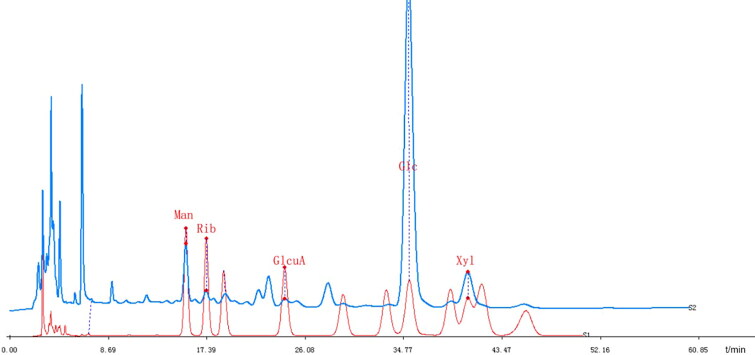
Materials and methods: GLP were extracted and used for high-performance liquid chromatography (HPLC) analysis after acid hydrolysis and PMP derivatization. Sixty C57BL/6N male mice were randomly divided into six groups: Sham, Model, LPS + GLP (25, 50 and 100 mg/kg/d administered intragastrically for two weeks) and LPS + dexamethasone (6 mg/kg/d injected intraperitoneally for one week). Acute pneumonia mouse models were established by intratracheal injection of LPS. Haematoxylin and eosin (H&E) staining was examined to evaluate lung lesions. ELISA and quantitative real-time PCR were employed to assess inflammatory factors expression. Western blots were carried out to measure Neuropilin-1 expression and proteins related to apoptosis and autophagy.
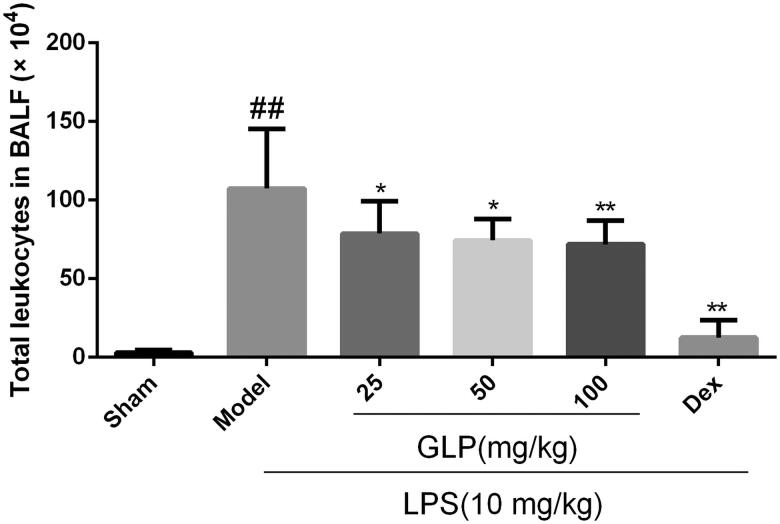
Results: GLP suppressed inflammatory cell infiltration. In BALF, cell counts were 1.1 × 10⁶ (model) and 7.1 × 10⁵ (100 mg/kg). Release of GM-CSF and IL-6 was reduced with GLP (25, 50 and 100 mg/kg) treatment. The expression of genes IL-1β, IL-6, TNF-α and Saa3 was reduced. GLP treatment also suppressed the activation of Neuropilin-1 (NRP1), upregulated the levels of Bcl2/Bax and LC3 and led to downregulation of the ratio C-Caspase 3/Caspase 3 and P62 expression.
Discussion and conclusions: GLP could protect against LPS-induced acute pneumonia through multiple mechanisms: blocking the infiltration of inflammatory cells, inhibiting cytokine secretion, suppressing NRP1 activation and regulating pneumonocyte apoptosis and autophagy.
期刊介绍:
Pharmaceutical Biology will publish manuscripts describing the discovery, methods for discovery, description, analysis characterization, and production/isolation (including sources and surveys) of biologically-active chemicals or other substances, drugs, pharmaceutical products, or preparations utilized in systems of traditional medicine.
Topics may generally encompass any facet of natural product research related to pharmaceutical biology. Papers dealing with agents or topics related to natural product drugs are also appropriate (e.g., semi-synthetic derivatives). Manuscripts will be published as reviews, perspectives, regular research articles, and short communications. The primary criteria for acceptance and publication are scientific rigor and potential to advance the field.



 京公网安备 11010802042870号
京ICP备2023020795号-1
京公网安备 11010802042870号
京ICP备2023020795号-1

 分享
分享
 求助内容:
求助内容: 应助结果提醒方式:
 扫码关注我们
