{"title":"Multi-scale Fisher's independence test for multivariate dependence.","authors":"S Gorsky, L Ma","doi":"10.1093/biomet/asac013","DOIUrl":null,"url":null,"abstract":"<p><p>Identifying dependency in multivariate data is a common inference task that arises in numerous applications. However, existing nonparametric independence tests typically require computation that scales at least quadratically with the sample size, making it difficult to apply them in the presence of massive sample sizes. Moreover, resampling is usually necessary to evaluate the statistical significance of the resulting test statistics at finite sample sizes, further worsening the computational burden. We introduce a scalable, resampling-free approach to testing the independence between two random vectors by breaking down the task into simple univariate tests of independence on a collection of 2 × 2 contingency tables constructed through sequential coarse-to-fine discretization of the sample space, transforming the inference task into a multiple testing problem that can be completed with almost linear complexity with respect to the sample size. To address increasing dimensionality, we introduce a coarse-to-fine sequential adaptive procedure that exploits the spatial features of dependency structures. We derive a finite-sample theory that guarantees the inferential validity of our adaptive procedure at any given sample size. We show that our approach can achieve strong control of the level of the testing procedure at any sample size without resampling or asymptotic approximation and establish its large-sample consistency. We demonstrate through an extensive simulation study its substantial computational advantage in comparison to existing approaches while achieving robust statistical power under various dependency scenarios, and illustrate how its divide-and-conquer nature can be exploited to not just test independence, but to learn the nature of the underlying dependency. Finally, we demonstrate the use of our method through analysing a dataset from a flow cytometry experiment.</p>","PeriodicalId":2,"journal":{"name":"ACS Applied Bio Materials","volume":" ","pages":"569-587"},"PeriodicalIF":4.7000,"publicationDate":"2022-09-01","publicationTypes":"Journal Article","fieldsOfStudy":null,"isOpenAccess":false,"openAccessPdf":"https://www.ncbi.nlm.nih.gov/pmc/articles/PMC9648765/pdf/","citationCount":"0","resultStr":null,"platform":"Semanticscholar","paperid":null,"PeriodicalName":"ACS Applied Bio Materials","FirstCategoryId":"100","ListUrlMain":"https://doi.org/10.1093/biomet/asac013","RegionNum":0,"RegionCategory":null,"ArticlePicture":[],"TitleCN":null,"AbstractTextCN":null,"PMCID":null,"EPubDate":"2022/2/21 0:00:00","PubModel":"Epub","JCR":"Q2","JCRName":"MATERIALS SCIENCE, BIOMATERIALS","Score":null,"Total":0}
引用次数: 0
Abstract
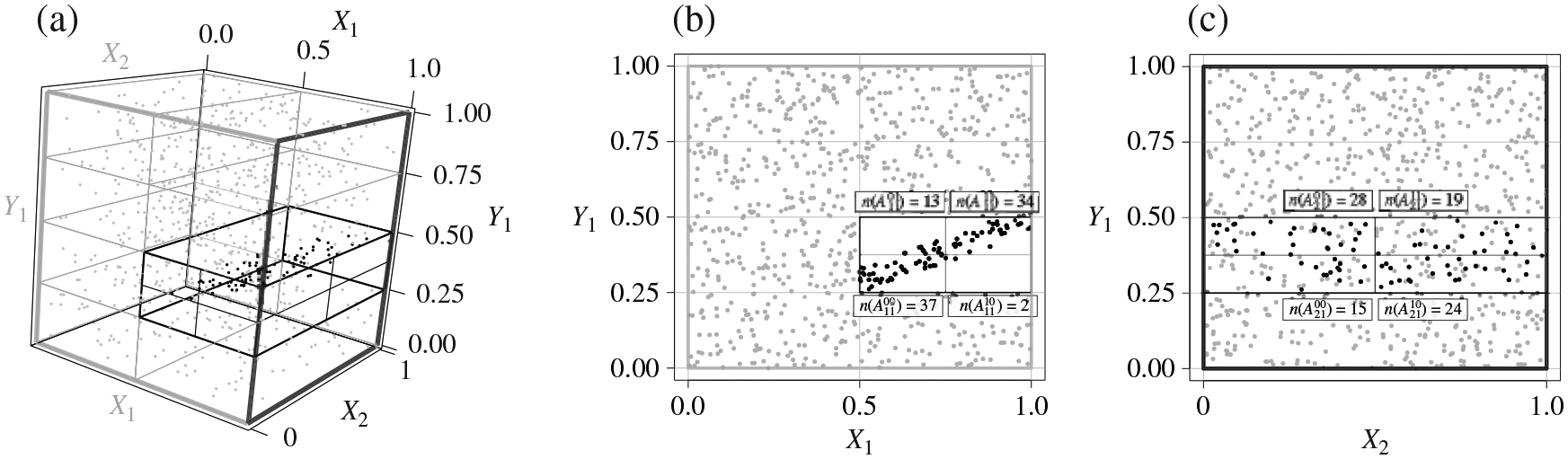
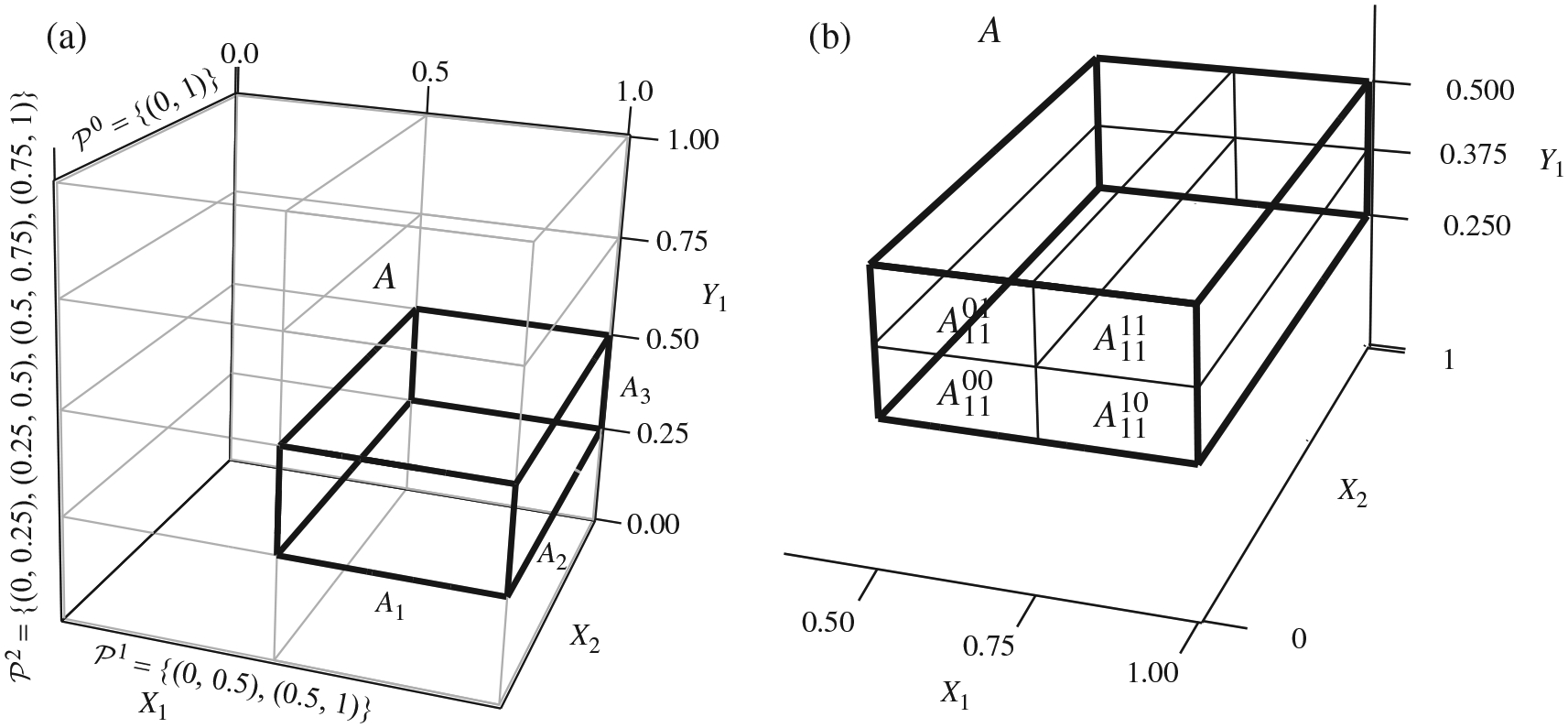
Identifying dependency in multivariate data is a common inference task that arises in numerous applications. However, existing nonparametric independence tests typically require computation that scales at least quadratically with the sample size, making it difficult to apply them in the presence of massive sample sizes. Moreover, resampling is usually necessary to evaluate the statistical significance of the resulting test statistics at finite sample sizes, further worsening the computational burden. We introduce a scalable, resampling-free approach to testing the independence between two random vectors by breaking down the task into simple univariate tests of independence on a collection of 2 × 2 contingency tables constructed through sequential coarse-to-fine discretization of the sample space, transforming the inference task into a multiple testing problem that can be completed with almost linear complexity with respect to the sample size. To address increasing dimensionality, we introduce a coarse-to-fine sequential adaptive procedure that exploits the spatial features of dependency structures. We derive a finite-sample theory that guarantees the inferential validity of our adaptive procedure at any given sample size. We show that our approach can achieve strong control of the level of the testing procedure at any sample size without resampling or asymptotic approximation and establish its large-sample consistency. We demonstrate through an extensive simulation study its substantial computational advantage in comparison to existing approaches while achieving robust statistical power under various dependency scenarios, and illustrate how its divide-and-conquer nature can be exploited to not just test independence, but to learn the nature of the underlying dependency. Finally, we demonstrate the use of our method through analysing a dataset from a flow cytometry experiment.
期刊介绍:
ACS Applied Bio Materials is an interdisciplinary journal publishing original research covering all aspects of biomaterials and biointerfaces including and beyond the traditional biosensing, biomedical and therapeutic applications.
The journal is devoted to reports of new and original experimental and theoretical research of an applied nature that integrates knowledge in the areas of materials, engineering, physics, bioscience, and chemistry into important bio applications. The journal is specifically interested in work that addresses the relationship between structure and function and assesses the stability and degradation of materials under relevant environmental and biological conditions.





 京公网安备 11010802042870号
京ICP备2023020795号-1
京公网安备 11010802042870号
京ICP备2023020795号-1

 分享
分享
 求助内容:
求助内容: 应助结果提醒方式:
 扫码关注我们
