Takehiro Watanabe, Koji Otani, Miho Sekiguchi, Shin-Ichi Konno
{"title":"Relationship between lumbar disc degeneration on MRI and low back pain: A cross-sectional community study.","authors":"Takehiro Watanabe, Koji Otani, Miho Sekiguchi, Shin-Ichi Konno","doi":"10.5387/fms.2022-17","DOIUrl":null,"url":null,"abstract":"<p><strong>Purpose: </strong>Although an association has been suggested between disc degeneration (DD) and low back pain (LBP), some DD is thought to be an age-related change unrelated to symptoms. Age-inappropriate DD, however, may be associated with LBP. The purpose of this study was to investigate whether there is a difference in LBP and LBP-related quality of life between age-appropriate and age-inappropriate DD, as assessed by magnetic resonance imaging (MRI).</p><p><strong>Participants and methods: </strong>In this cross-sectional study, degenerative change in the lumbar intervertebral discs of 382 subjects (age range, 27-82 years) was evaluated by MRI. Degenerative Disc Disease (DDD) scores were assigned using the Schneiderman classification, as the sum of grades for all intervertebral levels (0-15). We classified subjects into three groups according to age and DDD score: Low DD (mild DD relative to age), Appropriate (age-appropriate DD), and High DD (severe DD relative to age). We compared the three groups in terms of LBP prevalence, LBP intensity, LBP-specific quality of life (QOL) according to the Roland-Morris Disability Questionnaire (RDQ), and the Short Form-36 Item Health Survey (SF-36).</p><p><strong>Results: </strong>Of 382 subjects, there were 35% in the Low DD group, 54% in the Appropriate group, and 11% in the High DD group. There were no significant differences among the groups in terms of prevalence of LBP, LBP intensity, RDQ score, or SF-36 score.</p><p><strong>Conclusion: </strong>No association was found between age-inappropriate DD (Low or High DD group) and age-appropriate DD (Appropriate group) in terms of prevalence of LBP, LBP intensity, RDQ, or SF-36.</p>","PeriodicalId":44831,"journal":{"name":"Fukushima Journal of Medical Science","volume":" ","pages":"97-107"},"PeriodicalIF":0.9000,"publicationDate":"2022-08-18","publicationTypes":"Journal Article","fieldsOfStudy":null,"isOpenAccess":false,"openAccessPdf":"https://ftp.ncbi.nlm.nih.gov/pub/pmc/oa_pdf/8b/c2/2185-4610-68-097.PMC9493335.pdf","citationCount":"1","resultStr":null,"platform":"Semanticscholar","paperid":null,"PeriodicalName":"Fukushima Journal of Medical Science","FirstCategoryId":"1085","ListUrlMain":"https://doi.org/10.5387/fms.2022-17","RegionNum":0,"RegionCategory":null,"ArticlePicture":[],"TitleCN":null,"AbstractTextCN":null,"PMCID":null,"EPubDate":"2022/8/3 0:00:00","PubModel":"Epub","JCR":"Q3","JCRName":"MEDICINE, GENERAL & INTERNAL","Score":null,"Total":0}
引用次数: 1
Abstract
Purpose: Although an association has been suggested between disc degeneration (DD) and low back pain (LBP), some DD is thought to be an age-related change unrelated to symptoms. Age-inappropriate DD, however, may be associated with LBP. The purpose of this study was to investigate whether there is a difference in LBP and LBP-related quality of life between age-appropriate and age-inappropriate DD, as assessed by magnetic resonance imaging (MRI).
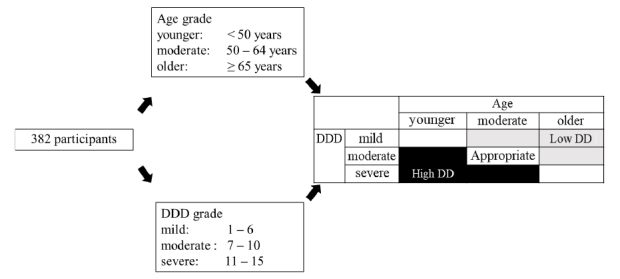
Participants and methods: In this cross-sectional study, degenerative change in the lumbar intervertebral discs of 382 subjects (age range, 27-82 years) was evaluated by MRI. Degenerative Disc Disease (DDD) scores were assigned using the Schneiderman classification, as the sum of grades for all intervertebral levels (0-15). We classified subjects into three groups according to age and DDD score: Low DD (mild DD relative to age), Appropriate (age-appropriate DD), and High DD (severe DD relative to age). We compared the three groups in terms of LBP prevalence, LBP intensity, LBP-specific quality of life (QOL) according to the Roland-Morris Disability Questionnaire (RDQ), and the Short Form-36 Item Health Survey (SF-36).
Results: Of 382 subjects, there were 35% in the Low DD group, 54% in the Appropriate group, and 11% in the High DD group. There were no significant differences among the groups in terms of prevalence of LBP, LBP intensity, RDQ score, or SF-36 score.
Conclusion: No association was found between age-inappropriate DD (Low or High DD group) and age-appropriate DD (Appropriate group) in terms of prevalence of LBP, LBP intensity, RDQ, or SF-36.




 京公网安备 11010802042870号
京ICP备2023020795号-1
京公网安备 11010802042870号
京ICP备2023020795号-1

 分享
分享
 求助内容:
求助内容: 应助结果提醒方式:
 扫码关注我们
