Armando Armas-Salazar, Noe Téllez-León, Ana Isabel García-Jerónimo, Francisco Alberto Villegas-López, José Luis Navarro-Olvera, José Damián Carrillo-Ruiz
{"title":"Neuropathic Pain Relief after Surgical Neurolysis in Patients with Traumatic Brachial Plexus Injuries: A Preliminary Report.","authors":"Armando Armas-Salazar, Noe Téllez-León, Ana Isabel García-Jerónimo, Francisco Alberto Villegas-López, José Luis Navarro-Olvera, José Damián Carrillo-Ruiz","doi":"10.1155/2022/5660462","DOIUrl":null,"url":null,"abstract":"<p><strong>Objective: </strong>To evaluate the usefulness of surgical neurolysis for neuropathic pain relief in patients with posttraumatic brachial plexus injury (BPI).</p><p><strong>Methods: </strong>A prospective, longitudinal, nonrandomized, self-controlled before and after study was performed to evaluate the pain changes according to their intensity using the Visual Analogue Scale (VAS), and the sensory recovery after surgery using the British Medical Research Council (BMRC) scale for sensory recovery. To establish significant changes, a paired <i>T</i>-test was performed, and in order to determine the magnitude of these changes, an effect size was measured. <i>α</i> = 0.05.</p><p><strong>Results: </strong>Ten patients were included with an average follow-up of 61.9 ± 53.62 months. The main mechanism of injury was vehicular trauma (70%). A significant decrease in pain after the surgical intervention was observed resulting from an average preoperative state according to VAS of 8.4 ± 1.58, to a postoperative state of 3.4 ± 3.27 (59.52%, <i>p</i> = 0.005, Δ = 1.572), added to a mean sensory improvement (25%) from 2.8 ± 1.62 to 3.5 ± 0.97 after surgery according to BMRC, without statistically significant changes (<i>p</i>=0.062), showing a moderate effect size (Δ = 0.413). Almost all patients showed improvement in the continuous and paroxysmal pattern of pain. No postoperative complications were observed. <i>Discussion</i>. These results suggest that in cases of BPI that originates from a compressive syndrome secondary to the posttraumatic fibrosis that surrounds the nerve structures causing strangulation and inducing hypernociception, the use of surgical neurolysis is an appropriate alternative for patients with medically refractory neuropathic pain.</p>","PeriodicalId":2,"journal":{"name":"ACS Applied Bio Materials","volume":" ","pages":"5660462"},"PeriodicalIF":4.7000,"publicationDate":"2022-08-02","publicationTypes":"Journal Article","fieldsOfStudy":null,"isOpenAccess":false,"openAccessPdf":"https://www.ncbi.nlm.nih.gov/pmc/articles/PMC9363225/pdf/","citationCount":"0","resultStr":null,"platform":"Semanticscholar","paperid":null,"PeriodicalName":"ACS Applied Bio Materials","FirstCategoryId":"1085","ListUrlMain":"https://doi.org/10.1155/2022/5660462","RegionNum":0,"RegionCategory":null,"ArticlePicture":[],"TitleCN":null,"AbstractTextCN":null,"PMCID":null,"EPubDate":"2022/1/1 0:00:00","PubModel":"eCollection","JCR":"Q2","JCRName":"MATERIALS SCIENCE, BIOMATERIALS","Score":null,"Total":0}
引用次数: 0
Abstract
Objective: To evaluate the usefulness of surgical neurolysis for neuropathic pain relief in patients with posttraumatic brachial plexus injury (BPI).
Methods: A prospective, longitudinal, nonrandomized, self-controlled before and after study was performed to evaluate the pain changes according to their intensity using the Visual Analogue Scale (VAS), and the sensory recovery after surgery using the British Medical Research Council (BMRC) scale for sensory recovery. To establish significant changes, a paired T-test was performed, and in order to determine the magnitude of these changes, an effect size was measured. α = 0.05.
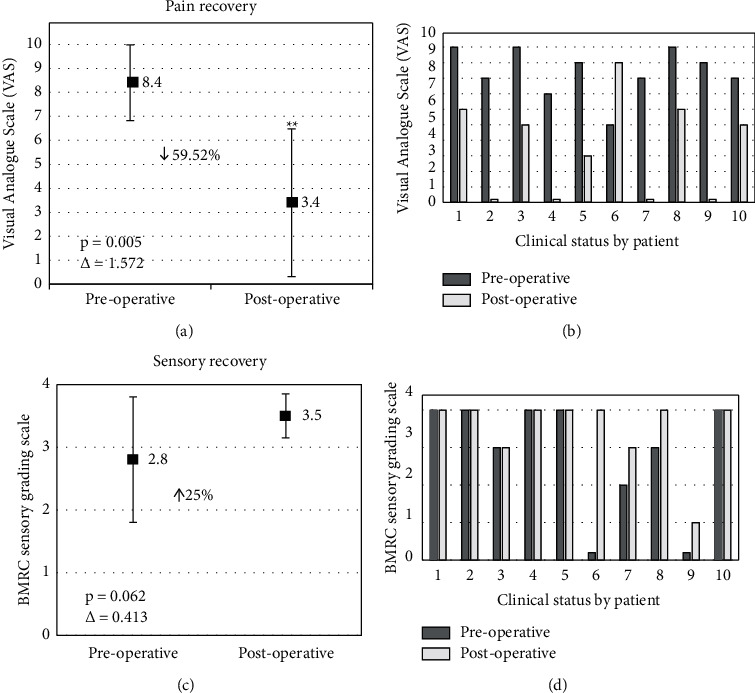
Results: Ten patients were included with an average follow-up of 61.9 ± 53.62 months. The main mechanism of injury was vehicular trauma (70%). A significant decrease in pain after the surgical intervention was observed resulting from an average preoperative state according to VAS of 8.4 ± 1.58, to a postoperative state of 3.4 ± 3.27 (59.52%, p = 0.005, Δ = 1.572), added to a mean sensory improvement (25%) from 2.8 ± 1.62 to 3.5 ± 0.97 after surgery according to BMRC, without statistically significant changes (p=0.062), showing a moderate effect size (Δ = 0.413). Almost all patients showed improvement in the continuous and paroxysmal pattern of pain. No postoperative complications were observed. Discussion. These results suggest that in cases of BPI that originates from a compressive syndrome secondary to the posttraumatic fibrosis that surrounds the nerve structures causing strangulation and inducing hypernociception, the use of surgical neurolysis is an appropriate alternative for patients with medically refractory neuropathic pain.
期刊介绍:
ACS Applied Bio Materials is an interdisciplinary journal publishing original research covering all aspects of biomaterials and biointerfaces including and beyond the traditional biosensing, biomedical and therapeutic applications.
The journal is devoted to reports of new and original experimental and theoretical research of an applied nature that integrates knowledge in the areas of materials, engineering, physics, bioscience, and chemistry into important bio applications. The journal is specifically interested in work that addresses the relationship between structure and function and assesses the stability and degradation of materials under relevant environmental and biological conditions.





 京公网安备 11010802042870号
京ICP备2023020795号-1
京公网安备 11010802042870号
京ICP备2023020795号-1

 分享
分享
 求助内容:
求助内容: 应助结果提醒方式:
 扫码关注我们
