{"title":"Prognostic Role of the Platelet-Lymphocyte Ratio in Acute Ischemic Stroke Patients Undergoing Reperfusion Therapy: A Meta-Analysis.","authors":"Divyansh Sharma, Sonu M M Bhaskar","doi":"10.1177/11795735221110373","DOIUrl":null,"url":null,"abstract":"<p><strong>Background: </strong>Both inflammation and thrombotic/hemostatic mechanisms may play a role in acute ischemic stroke (AIS) pathogenesis, and a biomarker, such as the platelet-to-lymphocyte ratio (PLR), considering both mechanisms may be of clinical utility.</p><p><strong>Objectives: </strong>This meta-analysis sought to examine the effect of PLR on functional outcomes, early neurological changes, bleeding complications, mortality, and adverse outcomes in AIS patients treated with reperfusion therapy (RT).</p><p><strong>Design: </strong>Systematic Review and Meta-Analysis.</p><p><strong>Data sources and methods: </strong>Individual studies were retrieved from the PubMed/Medline, EMBASE and Cochrane databases. References thereof were also consulted. Data were extracted using a standardised data sheet, and systematic reviews and meta-analyses on the association of admission (pre-RT) or delayed (post-RT) PLR with defined clinical and safety outcomes were conducted. In the case of multiple delayed PLR timepoints, the timepoint closest to 24 hours was selected.</p><p><strong>Results: </strong>Eighteen studies (n=4878) were identified for the systematic review, of which 14 (n=4413) were included in the meta-analyses. PLR collected at admission was significantly negatively associated with 90-day good functional outcomes (SMD=-.32; 95% CI = -.58 to -.05; P=.020; z=-2.328), as was PLR collected at delayed timepoints (SMD=-.43; 95% CI = -.54 to -.32; P<.0001; z=-7.454). PLR at delayed timepoints was also significantly negatively associated with ENI (SMD=-.18; 95% CI = -.29 to -.08; P=.001. Conversely, the study suggested that a higher PLR at delayed timepoints may be associated with radiological bleeding and mortality. The results varied based on the type of RT administered.</p><p><strong>Conclusions: </strong>A higher PLR is associated with worse outcomes after stroke in terms of morbidity, mortality, and safety outcomes after stroke.</p>","PeriodicalId":2,"journal":{"name":"ACS Applied Bio Materials","volume":" ","pages":"11795735221110373"},"PeriodicalIF":4.7000,"publicationDate":"2022-07-15","publicationTypes":"Journal Article","fieldsOfStudy":null,"isOpenAccess":false,"openAccessPdf":"https://ftp.ncbi.nlm.nih.gov/pub/pmc/oa_pdf/52/c7/10.1177_11795735221110373.PMC9290168.pdf","citationCount":"0","resultStr":null,"platform":"Semanticscholar","paperid":null,"PeriodicalName":"ACS Applied Bio Materials","FirstCategoryId":"1085","ListUrlMain":"https://doi.org/10.1177/11795735221110373","RegionNum":0,"RegionCategory":null,"ArticlePicture":[],"TitleCN":null,"AbstractTextCN":null,"PMCID":null,"EPubDate":"2022/1/1 0:00:00","PubModel":"eCollection","JCR":"Q2","JCRName":"MATERIALS SCIENCE, BIOMATERIALS","Score":null,"Total":0}
引用次数: 0
Abstract
Background: Both inflammation and thrombotic/hemostatic mechanisms may play a role in acute ischemic stroke (AIS) pathogenesis, and a biomarker, such as the platelet-to-lymphocyte ratio (PLR), considering both mechanisms may be of clinical utility.
Objectives: This meta-analysis sought to examine the effect of PLR on functional outcomes, early neurological changes, bleeding complications, mortality, and adverse outcomes in AIS patients treated with reperfusion therapy (RT).
Design: Systematic Review and Meta-Analysis.
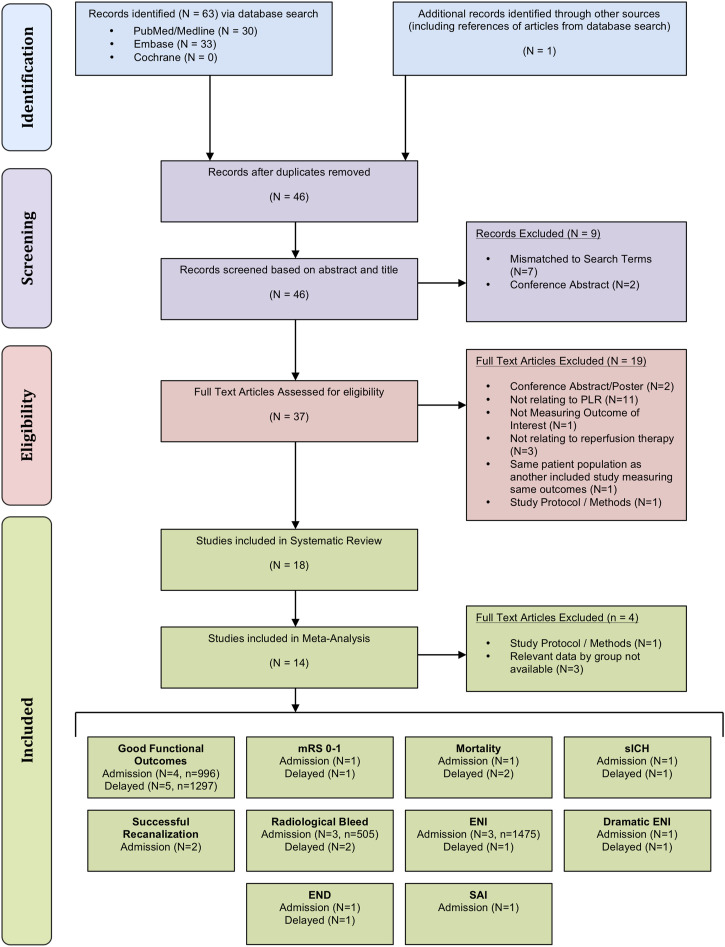
Data sources and methods: Individual studies were retrieved from the PubMed/Medline, EMBASE and Cochrane databases. References thereof were also consulted. Data were extracted using a standardised data sheet, and systematic reviews and meta-analyses on the association of admission (pre-RT) or delayed (post-RT) PLR with defined clinical and safety outcomes were conducted. In the case of multiple delayed PLR timepoints, the timepoint closest to 24 hours was selected.
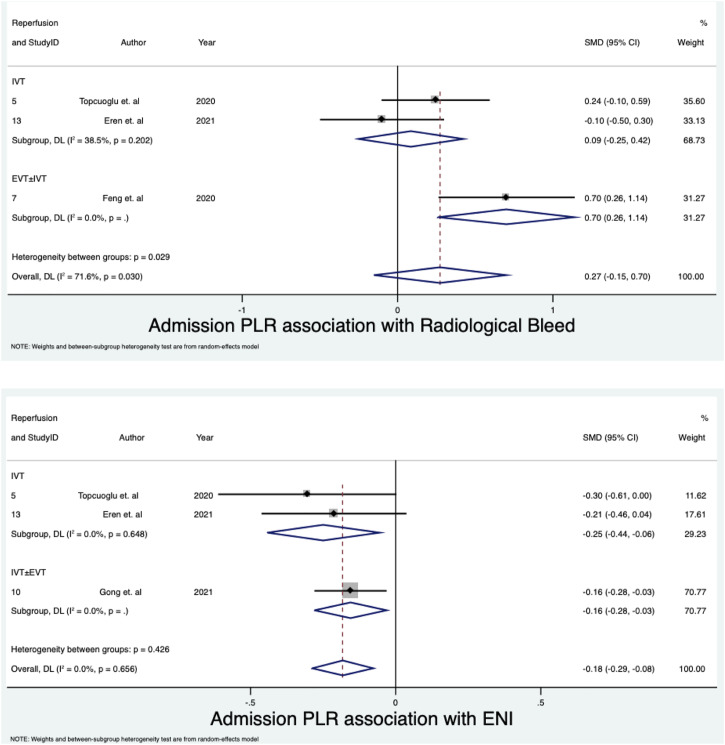
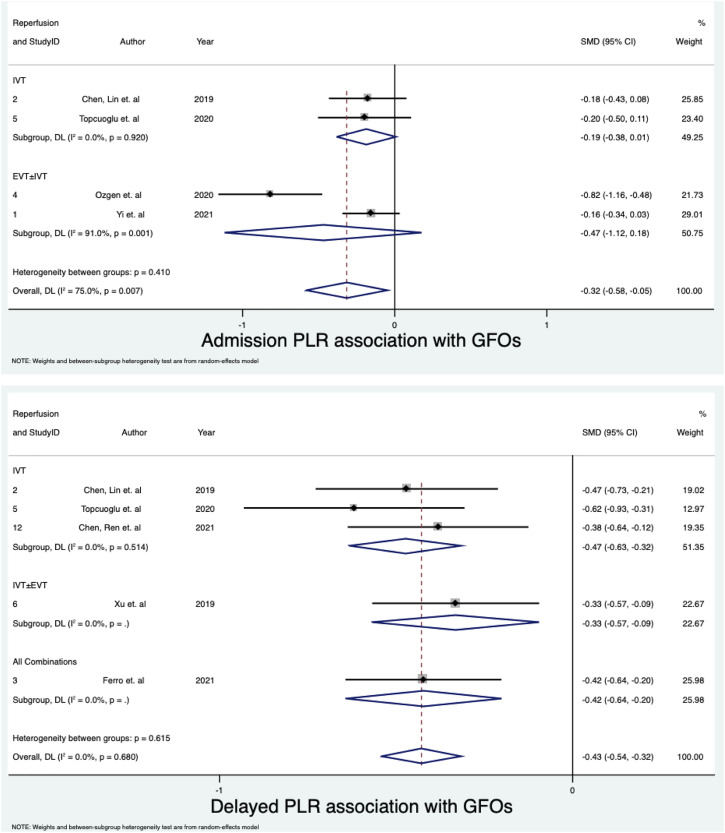
Results: Eighteen studies (n=4878) were identified for the systematic review, of which 14 (n=4413) were included in the meta-analyses. PLR collected at admission was significantly negatively associated with 90-day good functional outcomes (SMD=-.32; 95% CI = -.58 to -.05; P=.020; z=-2.328), as was PLR collected at delayed timepoints (SMD=-.43; 95% CI = -.54 to -.32; P<.0001; z=-7.454). PLR at delayed timepoints was also significantly negatively associated with ENI (SMD=-.18; 95% CI = -.29 to -.08; P=.001. Conversely, the study suggested that a higher PLR at delayed timepoints may be associated with radiological bleeding and mortality. The results varied based on the type of RT administered.
Conclusions: A higher PLR is associated with worse outcomes after stroke in terms of morbidity, mortality, and safety outcomes after stroke.
期刊介绍:
ACS Applied Bio Materials is an interdisciplinary journal publishing original research covering all aspects of biomaterials and biointerfaces including and beyond the traditional biosensing, biomedical and therapeutic applications.
The journal is devoted to reports of new and original experimental and theoretical research of an applied nature that integrates knowledge in the areas of materials, engineering, physics, bioscience, and chemistry into important bio applications. The journal is specifically interested in work that addresses the relationship between structure and function and assesses the stability and degradation of materials under relevant environmental and biological conditions.




 京公网安备 11010802042870号
京ICP备2023020795号-1
京公网安备 11010802042870号
京ICP备2023020795号-1

 分享
分享
 求助内容:
求助内容: 应助结果提醒方式:
 扫码关注我们
