Michael Freiberger, Dieter Grass, Michael Kuhn, Andrea Seidl, Stefan Wrzaczek
{"title":"Chasing up and locking down the virus: Optimal pandemic interventions within a network","authors":"Michael Freiberger, Dieter Grass, Michael Kuhn, Andrea Seidl, Stefan Wrzaczek","doi":"10.1111/jpet.12604","DOIUrl":null,"url":null,"abstract":"<p>During the COVID-19 pandemic countries invested significant amounts of resources into its containment. In early stages of the pandemic most of the (nonpharmaceutical) interventions can be classified into two groups: (i) testing and identification of infected individuals, (ii) social distancing measures to reduce the transmission probabilities. Furthermore, both groups of measures may, in principle, be targeted at certain subgroups of a networked population. To study such a problem, we propose an extension of the SIR model with additional compartments for quarantine and different courses of the disease across several network nodes. We develop the structure of the optimal allocation and study a numerical example of three symmetric regions that are subject to an asymmetric progression of the disease (starting from an initial hotspot). Key findings include that (i) for our calibrations policies are chosen in a “flattening-the-curve,” avoiding hospital congestion; (ii) policies shift from containing spillovers from the hotspot initially to establishing a symmetric pattern of the disease; and (iii) testing that can be effectively targeted allows to reduce substantially the duration of the disease, hospital congestion and the total cost, both in terms of lives lost and economic costs.</p>","PeriodicalId":47024,"journal":{"name":"Journal of Public Economic Theory","volume":"24 5","pages":"1182-1217"},"PeriodicalIF":0.9000,"publicationDate":"2022-06-29","publicationTypes":"Journal Article","fieldsOfStudy":null,"isOpenAccess":false,"openAccessPdf":"https://www.ncbi.nlm.nih.gov/pmc/articles/PMC9350112/pdf/JPET-9999-0.pdf","citationCount":"8","resultStr":null,"platform":"Semanticscholar","paperid":null,"PeriodicalName":"Journal of Public Economic Theory","FirstCategoryId":"96","ListUrlMain":"https://onlinelibrary.wiley.com/doi/10.1111/jpet.12604","RegionNum":4,"RegionCategory":"经济学","ArticlePicture":[],"TitleCN":null,"AbstractTextCN":null,"PMCID":null,"EPubDate":"","PubModel":"","JCR":"Q3","JCRName":"ECONOMICS","Score":null,"Total":0}
引用次数: 8
Abstract
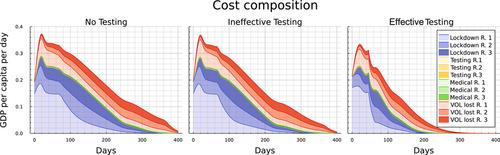
During the COVID-19 pandemic countries invested significant amounts of resources into its containment. In early stages of the pandemic most of the (nonpharmaceutical) interventions can be classified into two groups: (i) testing and identification of infected individuals, (ii) social distancing measures to reduce the transmission probabilities. Furthermore, both groups of measures may, in principle, be targeted at certain subgroups of a networked population. To study such a problem, we propose an extension of the SIR model with additional compartments for quarantine and different courses of the disease across several network nodes. We develop the structure of the optimal allocation and study a numerical example of three symmetric regions that are subject to an asymmetric progression of the disease (starting from an initial hotspot). Key findings include that (i) for our calibrations policies are chosen in a “flattening-the-curve,” avoiding hospital congestion; (ii) policies shift from containing spillovers from the hotspot initially to establishing a symmetric pattern of the disease; and (iii) testing that can be effectively targeted allows to reduce substantially the duration of the disease, hospital congestion and the total cost, both in terms of lives lost and economic costs.
期刊介绍:
As the official journal of the Association of Public Economic Theory, Journal of Public Economic Theory (JPET) is dedicated to stimulating research in the rapidly growing field of public economics. Submissions are judged on the basis of their creativity and rigor, and the Journal imposes neither upper nor lower boundary on the complexity of the techniques employed. This journal focuses on such topics as public goods, local public goods, club economies, externalities, taxation, growth, public choice, social and public decision making, voting, market failure, regulation, project evaluation, equity, and political systems.




 京公网安备 11010802042870号
京ICP备2023020795号-1
京公网安备 11010802042870号
京ICP备2023020795号-1

 分享
分享
 求助内容:
求助内容: 应助结果提醒方式:
 扫码关注我们
