Muhammad Farooque Lanjwani, Mustafa Tuzen, Muhammad Yar Khuhawar, Mohammad Reza Afshar Mogaddam, Mir Ali Farajzadeh
{"title":"Deep Eutectic Solvents for Extraction and Preconcentration of Organic and Inorganic Species in Water and Food Samples: A Review.","authors":"Muhammad Farooque Lanjwani, Mustafa Tuzen, Muhammad Yar Khuhawar, Mohammad Reza Afshar Mogaddam, Mir Ali Farajzadeh","doi":"10.1080/10408347.2022.2111655","DOIUrl":null,"url":null,"abstract":"<p><p>Deep eutectic solvents (DESs) have been developed as green solvents and these are capable as alternatives to conventional solvents used for the extraction of organic and inorganic species from food and water samples. The continuous generation of contaminated waste and increasing concern for the human health and environment have compelled the scientific community to investigate more ecological schemes. In this concern, the use of DESs have developed in one of the chief approach in the field of chemistry. These solvents have appeared as a capable substitute to conventional hazardous solvents and ionic liquids. The DESs has distinctive properties, easy preparation and components availability. It is not only used in scienctific fields but also used in quotidian life. There are many advantages of DESs in analytical chemistry, they are largely used for extraction and determination of inorganic and organic compounds from different samples. In previous a few years, several advanced researches have been focused on the separation and preconcentration of low level of pollutants using DESs as the extractants. This review summarizes the use of DESs in the separation and preconcentration of organic and inorganic species from water and food samples using various microextraction processes.</p>","PeriodicalId":4,"journal":{"name":"ACS Applied Energy Materials","volume":" ","pages":"1290-1303"},"PeriodicalIF":5.5000,"publicationDate":"2024-08-01","publicationTypes":"Journal Article","fieldsOfStudy":null,"isOpenAccess":false,"openAccessPdf":"","citationCount":"0","resultStr":null,"platform":"Semanticscholar","paperid":null,"PeriodicalName":"ACS Applied Energy Materials","FirstCategoryId":"92","ListUrlMain":"https://doi.org/10.1080/10408347.2022.2111655","RegionNum":3,"RegionCategory":"材料科学","ArticlePicture":[],"TitleCN":null,"AbstractTextCN":null,"PMCID":null,"EPubDate":"2022/8/18 0:00:00","PubModel":"Epub","JCR":"Q2","JCRName":"CHEMISTRY, PHYSICAL","Score":null,"Total":0}
引用次数: 0
Abstract
Deep eutectic solvents (DESs) have been developed as green solvents and these are capable as alternatives to conventional solvents used for the extraction of organic and inorganic species from food and water samples. The continuous generation of contaminated waste and increasing concern for the human health and environment have compelled the scientific community to investigate more ecological schemes. In this concern, the use of DESs have developed in one of the chief approach in the field of chemistry. These solvents have appeared as a capable substitute to conventional hazardous solvents and ionic liquids. The DESs has distinctive properties, easy preparation and components availability. It is not only used in scienctific fields but also used in quotidian life. There are many advantages of DESs in analytical chemistry, they are largely used for extraction and determination of inorganic and organic compounds from different samples. In previous a few years, several advanced researches have been focused on the separation and preconcentration of low level of pollutants using DESs as the extractants. This review summarizes the use of DESs in the separation and preconcentration of organic and inorganic species from water and food samples using various microextraction processes.
深共晶溶剂(DES)是作为绿色溶剂开发出来的,可以替代用于从食品和水样中提取有机和无机物的传统溶剂。污染废物的不断产生以及对人类健康和环境的日益关注,迫使科学界研究更多的生态方案。在这种情况下,DES 的使用已成为化学领域的主要方法之一。这些溶剂可以替代传统的有害溶剂和离子液体。DESs 具有与众不同的特性,易于制备,成分容易获得。它不仅应用于科学领域,还应用于日常生活。DESs 在分析化学中具有许多优势,主要用于从不同样品中萃取和测定无机和有机化合物。在过去几年中,一些先进的研究主要集中在使用 DESs 作为萃取剂对低浓度污染物进行分离和预浓缩。本综述总结了利用各种微萃取工艺从水和食品样品中分离和预浓缩有机和无机物的 DESs 应用。
期刊介绍:
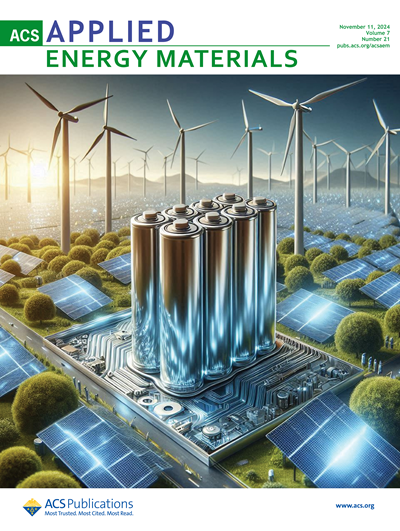
ACS Applied Energy Materials is an interdisciplinary journal publishing original research covering all aspects of materials, engineering, chemistry, physics and biology relevant to energy conversion and storage. The journal is devoted to reports of new and original experimental and theoretical research of an applied nature that integrate knowledge in the areas of materials, engineering, physics, bioscience, and chemistry into important energy applications.



 京公网安备 11010802042870号
京ICP备2023020795号-1
京公网安备 11010802042870号
京ICP备2023020795号-1

 分享
分享
 求助内容:
求助内容: 应助结果提醒方式:
 扫码关注我们
