{"title":"Clinical Performance of a \"No Wait\" Universal Adhesive in Noncarious Cervical Lesions: A Two-year Randomized Controlled Clinical Trial.","authors":"Fatma Dilsad Oz, Meltem Nermin Dursun, Esra Ergin","doi":"10.3290/j.jad.b3240675","DOIUrl":null,"url":null,"abstract":"<p><strong>Purpose: </strong>To evaluate the 24-month clinical performance of a \"no wait\" universal adhesive with different application modes in comparison with an etch-and-rinsew and two-step self-etch adhesive in non-carious cervical lesions (NCCLs).</p><p><strong>Materials and methods: </strong>A total of 234 non-carious cervical lesions in 34 patients were restored following 5 different adhesive approaches: 1. Clearfil Universal Bond Quick, self-etch mode (CUQ-SE); 2. Clearfil Universal Bond Quick, selective etch mode (CUQ-SLE); 3. Clearfil Universal Bond Quick, etch-and-rinse mode (CUQ-ER); 4. Clearfil SE Bond (self-etch adhesive) (CSEB); 5. Tetric N-Bond Universal, etch-and-rinse mode (TBU-ER). All NCCLs were restored with a nanohybrid composite (Tetric N-Ceram). The restorations were evaluated at baseline, 6, 12, and 24months of clinical service regarding retention, marginal adaptation, marginal discoloration, secondary caries, post-operative sensitivity, color match, surface texture using modified United States Public Health Service (USPHS) criteria.</p><p><strong>Results: </strong>The patient recall rate at 24 months was 73.5%. Eleven restorations, 6 of the CUQ-SE group, 4 of the CSEB group and 1 of the TBU-ER group, were clinically unacceptable due to retention loss. Regarding marginal adaptation and discoloration, CUQ-SE and CSEB groups exhibited higher bravo scores than other groups after 24 months (p < 0.05). At the end of 24-month examinations, no significant differences were detected among the groups regarding secondary caries, post-operative sensitivity, color match and surface texture.</p><p><strong>Conclusion: </strong>The clinical survival rates of the \"no wait\" universal adhesive at self-etch mode after 24 months were not acceptable. The \"no wait\" universal adhesive showed clinically acceptable performance in selective-etch and etch-and-rinse mode according to the evaluated USPHS criteria.</p>","PeriodicalId":2,"journal":{"name":"ACS Applied Bio Materials","volume":" ","pages":"313-323"},"PeriodicalIF":4.7000,"publicationDate":"2022-08-18","publicationTypes":"Journal Article","fieldsOfStudy":null,"isOpenAccess":false,"openAccessPdf":"https://www.ncbi.nlm.nih.gov/pmc/articles/PMC11734260/pdf/","citationCount":"0","resultStr":null,"platform":"Semanticscholar","paperid":null,"PeriodicalName":"ACS Applied Bio Materials","FirstCategoryId":"1085","ListUrlMain":"https://doi.org/10.3290/j.jad.b3240675","RegionNum":0,"RegionCategory":null,"ArticlePicture":[],"TitleCN":null,"AbstractTextCN":null,"PMCID":null,"EPubDate":"","PubModel":"","JCR":"Q2","JCRName":"MATERIALS SCIENCE, BIOMATERIALS","Score":null,"Total":0}
引用次数: 0
Abstract
Purpose: To evaluate the 24-month clinical performance of a "no wait" universal adhesive with different application modes in comparison with an etch-and-rinsew and two-step self-etch adhesive in non-carious cervical lesions (NCCLs).
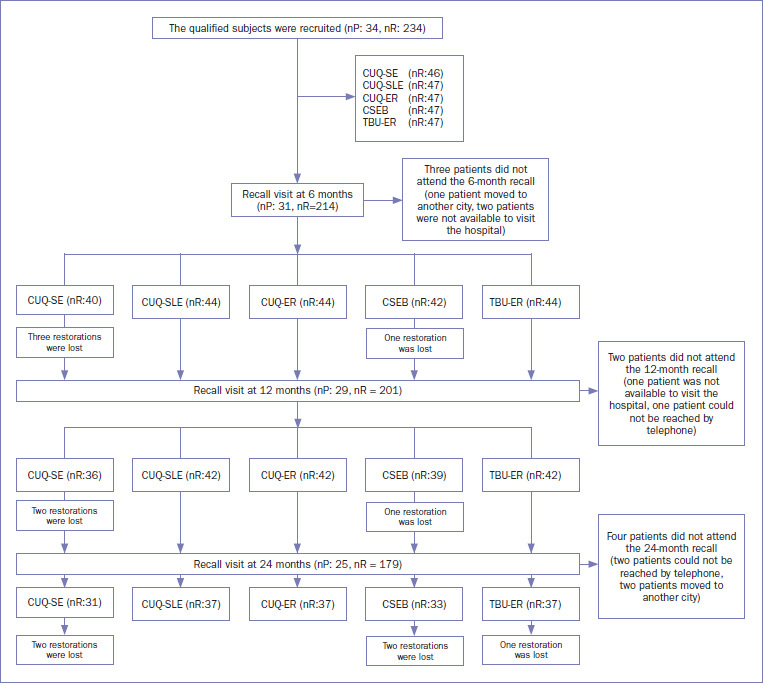
Materials and methods: A total of 234 non-carious cervical lesions in 34 patients were restored following 5 different adhesive approaches: 1. Clearfil Universal Bond Quick, self-etch mode (CUQ-SE); 2. Clearfil Universal Bond Quick, selective etch mode (CUQ-SLE); 3. Clearfil Universal Bond Quick, etch-and-rinse mode (CUQ-ER); 4. Clearfil SE Bond (self-etch adhesive) (CSEB); 5. Tetric N-Bond Universal, etch-and-rinse mode (TBU-ER). All NCCLs were restored with a nanohybrid composite (Tetric N-Ceram). The restorations were evaluated at baseline, 6, 12, and 24months of clinical service regarding retention, marginal adaptation, marginal discoloration, secondary caries, post-operative sensitivity, color match, surface texture using modified United States Public Health Service (USPHS) criteria.
Results: The patient recall rate at 24 months was 73.5%. Eleven restorations, 6 of the CUQ-SE group, 4 of the CSEB group and 1 of the TBU-ER group, were clinically unacceptable due to retention loss. Regarding marginal adaptation and discoloration, CUQ-SE and CSEB groups exhibited higher bravo scores than other groups after 24 months (p < 0.05). At the end of 24-month examinations, no significant differences were detected among the groups regarding secondary caries, post-operative sensitivity, color match and surface texture.
Conclusion: The clinical survival rates of the "no wait" universal adhesive at self-etch mode after 24 months were not acceptable. The "no wait" universal adhesive showed clinically acceptable performance in selective-etch and etch-and-rinse mode according to the evaluated USPHS criteria.
期刊介绍:
ACS Applied Bio Materials is an interdisciplinary journal publishing original research covering all aspects of biomaterials and biointerfaces including and beyond the traditional biosensing, biomedical and therapeutic applications.
The journal is devoted to reports of new and original experimental and theoretical research of an applied nature that integrates knowledge in the areas of materials, engineering, physics, bioscience, and chemistry into important bio applications. The journal is specifically interested in work that addresses the relationship between structure and function and assesses the stability and degradation of materials under relevant environmental and biological conditions.





 京公网安备 11010802042870号
京ICP备2023020795号-1
京公网安备 11010802042870号
京ICP备2023020795号-1

 分享
分享
 求助内容:
求助内容: 应助结果提醒方式:
 扫码关注我们
