{"title":"User perspectives on the future of mobility assistive devices: Understanding users' assistive device experiences and needs.","authors":"Leah Morris, Mary Cramp, Ailie Turton","doi":"10.1177/20556683221114790","DOIUrl":null,"url":null,"abstract":"<p><strong>Introduction: </strong>Current assistive devices are inadequate in addressing the needs of some people living with impaired mobility. This study explored the experiences of living with impaired mobility in relation to how wearable assistive adaptive and rehabilitative technologies may improve their quality of life.</p><p><strong>Methods: </strong>A cross-case study approach was adopted; the case being defined as the experience of impaired mobility. Semi-structured interviews were utilised. The sample (<i>n</i> = 8) was purposefully selected to have impaired mobility due to stroke, age-related frailty, or lower limb amputation. From the interview transcripts, in-depth case illustrations were written to provide personal stories and thematic analysis was carried out to provide a cross-case analysis.</p><p><strong>Results: </strong>There were two overarching themes: lifestyle changes; and wishes and desires for assistive devices. There were shared experiences across participant groups, such as falls and fear of falling. All participants identified a wish for increased speed of walking. However, the reasons for their difficulties differed depending on personal factors and their condition. Participants wanted devices to be adjustable to their perceived ability on a day-to-day basis.</p><p><strong>Conclusions: </strong>Although common concerns and impacts of living with impaired mobility were apparent, individuals have unique requirements that should inform the design of assistive technology devices.</p>","PeriodicalId":2,"journal":{"name":"ACS Applied Bio Materials","volume":" ","pages":"20556683221114790"},"PeriodicalIF":4.7000,"publicationDate":"2022-08-10","publicationTypes":"Journal Article","fieldsOfStudy":null,"isOpenAccess":false,"openAccessPdf":"https://www.ncbi.nlm.nih.gov/pmc/articles/PMC9380214/pdf/","citationCount":"0","resultStr":null,"platform":"Semanticscholar","paperid":null,"PeriodicalName":"ACS Applied Bio Materials","FirstCategoryId":"1085","ListUrlMain":"https://doi.org/10.1177/20556683221114790","RegionNum":0,"RegionCategory":null,"ArticlePicture":[],"TitleCN":null,"AbstractTextCN":null,"PMCID":null,"EPubDate":"2022/1/1 0:00:00","PubModel":"eCollection","JCR":"Q2","JCRName":"MATERIALS SCIENCE, BIOMATERIALS","Score":null,"Total":0}
引用次数: 0
Abstract
Introduction: Current assistive devices are inadequate in addressing the needs of some people living with impaired mobility. This study explored the experiences of living with impaired mobility in relation to how wearable assistive adaptive and rehabilitative technologies may improve their quality of life.
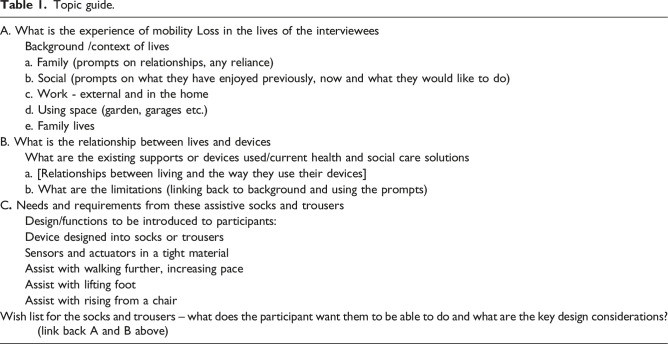
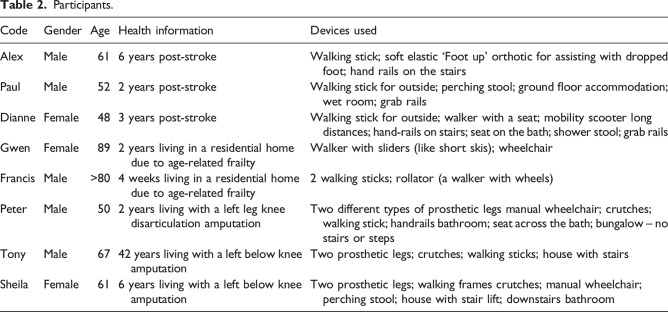
Methods: A cross-case study approach was adopted; the case being defined as the experience of impaired mobility. Semi-structured interviews were utilised. The sample (n = 8) was purposefully selected to have impaired mobility due to stroke, age-related frailty, or lower limb amputation. From the interview transcripts, in-depth case illustrations were written to provide personal stories and thematic analysis was carried out to provide a cross-case analysis.
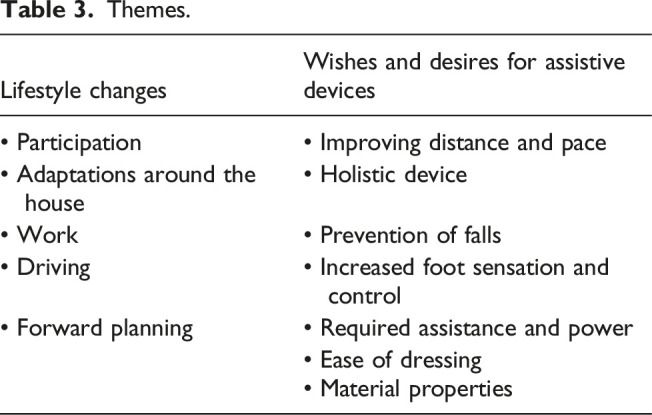
Results: There were two overarching themes: lifestyle changes; and wishes and desires for assistive devices. There were shared experiences across participant groups, such as falls and fear of falling. All participants identified a wish for increased speed of walking. However, the reasons for their difficulties differed depending on personal factors and their condition. Participants wanted devices to be adjustable to their perceived ability on a day-to-day basis.
Conclusions: Although common concerns and impacts of living with impaired mobility were apparent, individuals have unique requirements that should inform the design of assistive technology devices.
期刊介绍:
ACS Applied Bio Materials is an interdisciplinary journal publishing original research covering all aspects of biomaterials and biointerfaces including and beyond the traditional biosensing, biomedical and therapeutic applications.
The journal is devoted to reports of new and original experimental and theoretical research of an applied nature that integrates knowledge in the areas of materials, engineering, physics, bioscience, and chemistry into important bio applications. The journal is specifically interested in work that addresses the relationship between structure and function and assesses the stability and degradation of materials under relevant environmental and biological conditions.




 京公网安备 11010802042870号
京ICP备2023020795号-1
京公网安备 11010802042870号
京ICP备2023020795号-1

 分享
分享
 求助内容:
求助内容: 应助结果提醒方式:
 扫码关注我们
