{"title":"A Case of TAV-in-SAV in a Patient with Structural Valve Deterioration after Surgical Aortic Valve Replacement with the INSPIRIS RESILIA Valve.","authors":"Masaru Matsuda, Koichi Maeda, Kazuo Shimamura, Kizuku Yamashita, Ai Kawamura, Daisuke Yoshioka, Shigeru Miyagawa","doi":"10.5761/atcs.cr.22-00083","DOIUrl":null,"url":null,"abstract":"<p><p>The INSPIRIS RESILIA valve is designed to dilate its valve annulus in transcatheter aortic valve-in-surgical aortic valve (TAV-in-SAV), a catheter therapy for biological valve deterioration. RESILIA tissue has improved anti-calcification properties. An 83-year-old man on hemodialysis undergoing surgical aortic valve replacement (SAVR) with a 25-mm INSPIRIS for severe aortic stenosis 22 months ago presented with general malaise. Transthoracic echocardiography revealed severe bioprosthetic stenosis (peak velocity: 3.5 m/s, mean pressure gradient: 32 mmHg, and effective orifice area: 0.45 cm<sup>2</sup>) and severely reduced left ventricular function (ejection fraction: 17%). Because redo-SAVR was extremely risky (society of thoracic surgeons [STS] risk score: 31%), the patient underwent transfemoral-TAV-in-SAV using a 26-mm SAPIEN 3️. Pre- and postoperative computed tomography showed that the internal diameter of the INSPIRIS had expanded from 22.2 mm to 24.2 mm. This case demonstrated the dilatable design of INSPIRIS but not the durability of RESILIA tissue.</p>","PeriodicalId":1,"journal":{"name":"Accounts of Chemical Research","volume":" ","pages":""},"PeriodicalIF":17.7000,"publicationDate":"2024-01-25","publicationTypes":"Journal Article","fieldsOfStudy":null,"isOpenAccess":false,"openAccessPdf":"https://www.ncbi.nlm.nih.gov/pmc/articles/PMC10851443/pdf/","citationCount":"0","resultStr":null,"platform":"Semanticscholar","paperid":null,"PeriodicalName":"Accounts of Chemical Research","FirstCategoryId":"3","ListUrlMain":"https://doi.org/10.5761/atcs.cr.22-00083","RegionNum":1,"RegionCategory":"化学","ArticlePicture":[],"TitleCN":null,"AbstractTextCN":null,"PMCID":null,"EPubDate":"2022/8/23 0:00:00","PubModel":"Epub","JCR":"Q1","JCRName":"CHEMISTRY, MULTIDISCIPLINARY","Score":null,"Total":0}
引用次数: 0
Abstract
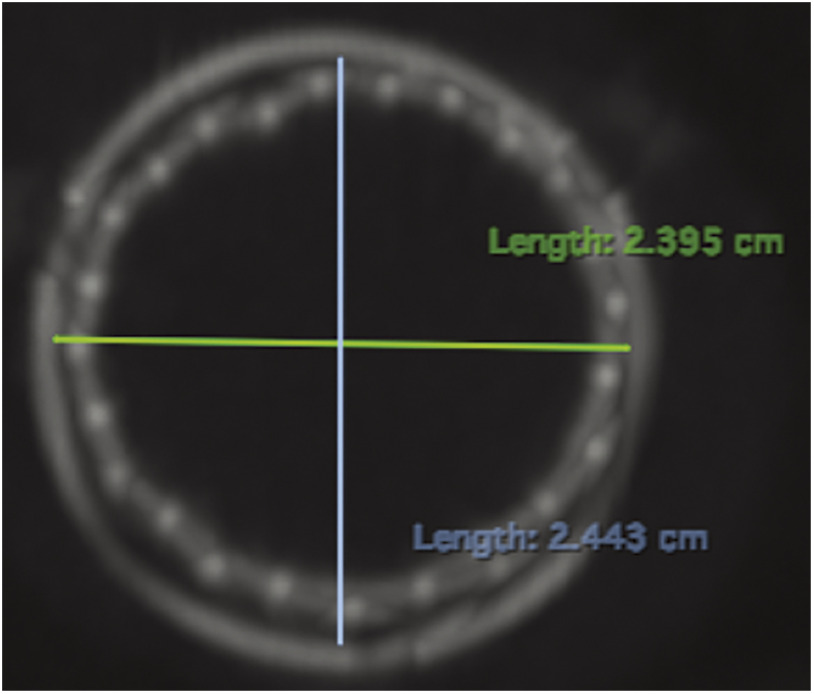
The INSPIRIS RESILIA valve is designed to dilate its valve annulus in transcatheter aortic valve-in-surgical aortic valve (TAV-in-SAV), a catheter therapy for biological valve deterioration. RESILIA tissue has improved anti-calcification properties. An 83-year-old man on hemodialysis undergoing surgical aortic valve replacement (SAVR) with a 25-mm INSPIRIS for severe aortic stenosis 22 months ago presented with general malaise. Transthoracic echocardiography revealed severe bioprosthetic stenosis (peak velocity: 3.5 m/s, mean pressure gradient: 32 mmHg, and effective orifice area: 0.45 cm2) and severely reduced left ventricular function (ejection fraction: 17%). Because redo-SAVR was extremely risky (society of thoracic surgeons [STS] risk score: 31%), the patient underwent transfemoral-TAV-in-SAV using a 26-mm SAPIEN 3️. Pre- and postoperative computed tomography showed that the internal diameter of the INSPIRIS had expanded from 22.2 mm to 24.2 mm. This case demonstrated the dilatable design of INSPIRIS but not the durability of RESILIA tissue.
期刊介绍:
Accounts of Chemical Research presents short, concise and critical articles offering easy-to-read overviews of basic research and applications in all areas of chemistry and biochemistry. These short reviews focus on research from the author’s own laboratory and are designed to teach the reader about a research project. In addition, Accounts of Chemical Research publishes commentaries that give an informed opinion on a current research problem. Special Issues online are devoted to a single topic of unusual activity and significance.
Accounts of Chemical Research replaces the traditional article abstract with an article "Conspectus." These entries synopsize the research affording the reader a closer look at the content and significance of an article. Through this provision of a more detailed description of the article contents, the Conspectus enhances the article's discoverability by search engines and the exposure for the research.






 京公网安备 11010802042870号
京ICP备2023020795号-1
京公网安备 11010802042870号
京ICP备2023020795号-1

 分享
分享
 求助内容:
求助内容: 应助结果提醒方式:
 扫码关注我们
