Lipid Profiling of Pacific Abalone (Haliotis discus hannai) at Different Developmental Stages Using Ultrahigh Performance Liquid Chromatography-Tandem Mass Spectrometry.
Hey Gene Lee, MinJoong Joo, Jong-Moon Park, Mi Ae Kim, JeongHun Mok, Seong-Hyeon Cho, Young Chang Sohn, Hookeun Lee
{"title":"Lipid Profiling of Pacific Abalone (<i>Haliotis discus hannai</i>) at Different Developmental Stages Using Ultrahigh Performance Liquid Chromatography-Tandem Mass Spectrometry.","authors":"Hey Gene Lee, MinJoong Joo, Jong-Moon Park, Mi Ae Kim, JeongHun Mok, Seong-Hyeon Cho, Young Chang Sohn, Hookeun Lee","doi":"10.1155/2022/5822562","DOIUrl":null,"url":null,"abstract":"<p><p>Pacific abalone (<i>Haliotis discus hannai</i>) is a commercially important mollusk; therefore, improvement of its growth performance and quality has been emphasized. During embryonic development, abalones undergo a series of distinct larval stages, including swimming veliger larvae, juveniles, and mature individuals, and their biomolecular composition varies depending on the developmental stage. Therefore, in the present study, we performed untargeted lipid profiling of abalone tissues at different developmental stages as well as the hemolymph of mature female and male abalones using ultrahigh-performance liquid chromatography-tandem mass spectrometry. These profiles can provide meaningful information to understand compositional changes in lipids through abalone metamorphosis and development. A total of 132 lipids belonging to 15 classes were identified from abalone tissues at different developmental stages. Moreover, 21 lipids belonging to 8 classes were identified from the hemolymph of mature abalones. All data were processed following strict criteria to provide accurate information. Triglycerides and phosphatidylcholines were the major lipid components identified in both tissues and hemolymph, accounting for, respectively, 27% and 15% of all lipids in tissues and, respectively, 24% and 38% of all lipids in the hemolymph. Of note, lysophosphatidylcholine was only detected in the tissues of mature abalones, paving the way for further analyses of abalone lipids based on developmental stages. The present findings offer novel insights into the lipidome of abalone tissues and hemolymph at different developmental stages, building a foundation for improving the efficiency and quality of abalone aquaculture.</p>","PeriodicalId":2,"journal":{"name":"ACS Applied Bio Materials","volume":" ","pages":"5822562"},"PeriodicalIF":4.7000,"publicationDate":"2022-10-17","publicationTypes":"Journal Article","fieldsOfStudy":null,"isOpenAccess":false,"openAccessPdf":"https://www.ncbi.nlm.nih.gov/pmc/articles/PMC9592233/pdf/","citationCount":"0","resultStr":null,"platform":"Semanticscholar","paperid":null,"PeriodicalName":"ACS Applied Bio Materials","FirstCategoryId":"92","ListUrlMain":"https://doi.org/10.1155/2022/5822562","RegionNum":0,"RegionCategory":null,"ArticlePicture":[],"TitleCN":null,"AbstractTextCN":null,"PMCID":null,"EPubDate":"2022/1/1 0:00:00","PubModel":"eCollection","JCR":"Q2","JCRName":"MATERIALS SCIENCE, BIOMATERIALS","Score":null,"Total":0}
引用次数: 0
Abstract
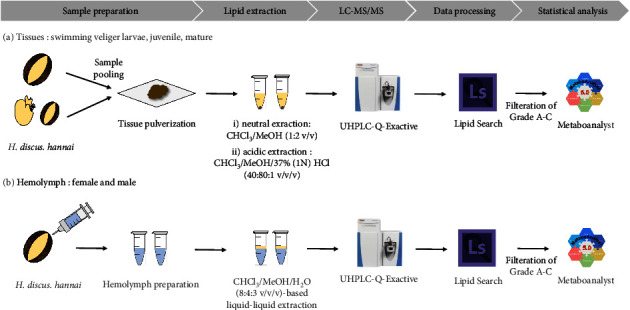
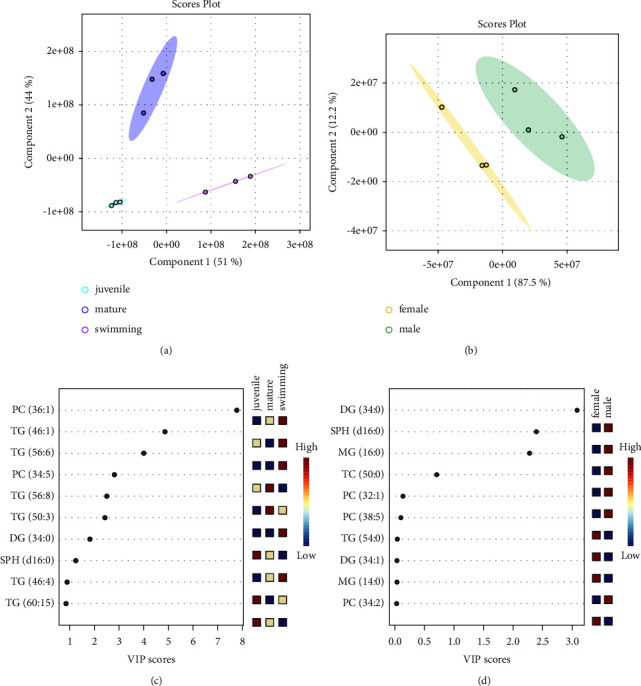
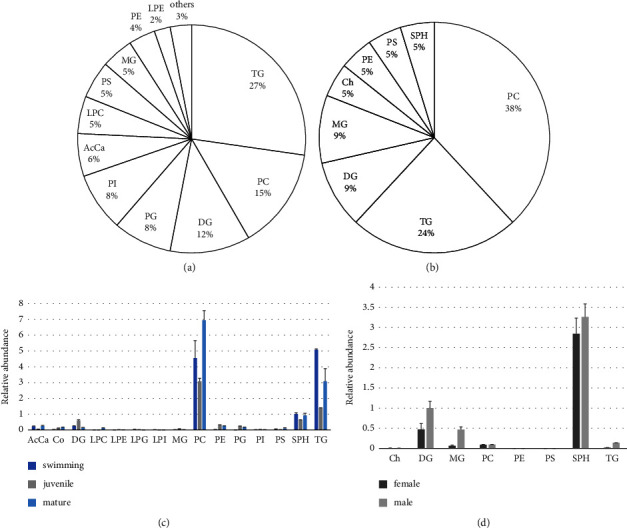
Pacific abalone (Haliotis discus hannai) is a commercially important mollusk; therefore, improvement of its growth performance and quality has been emphasized. During embryonic development, abalones undergo a series of distinct larval stages, including swimming veliger larvae, juveniles, and mature individuals, and their biomolecular composition varies depending on the developmental stage. Therefore, in the present study, we performed untargeted lipid profiling of abalone tissues at different developmental stages as well as the hemolymph of mature female and male abalones using ultrahigh-performance liquid chromatography-tandem mass spectrometry. These profiles can provide meaningful information to understand compositional changes in lipids through abalone metamorphosis and development. A total of 132 lipids belonging to 15 classes were identified from abalone tissues at different developmental stages. Moreover, 21 lipids belonging to 8 classes were identified from the hemolymph of mature abalones. All data were processed following strict criteria to provide accurate information. Triglycerides and phosphatidylcholines were the major lipid components identified in both tissues and hemolymph, accounting for, respectively, 27% and 15% of all lipids in tissues and, respectively, 24% and 38% of all lipids in the hemolymph. Of note, lysophosphatidylcholine was only detected in the tissues of mature abalones, paving the way for further analyses of abalone lipids based on developmental stages. The present findings offer novel insights into the lipidome of abalone tissues and hemolymph at different developmental stages, building a foundation for improving the efficiency and quality of abalone aquaculture.
期刊介绍:
ACS Applied Bio Materials is an interdisciplinary journal publishing original research covering all aspects of biomaterials and biointerfaces including and beyond the traditional biosensing, biomedical and therapeutic applications.
The journal is devoted to reports of new and original experimental and theoretical research of an applied nature that integrates knowledge in the areas of materials, engineering, physics, bioscience, and chemistry into important bio applications. The journal is specifically interested in work that addresses the relationship between structure and function and assesses the stability and degradation of materials under relevant environmental and biological conditions.




 京公网安备 11010802042870号
京ICP备2023020795号-1
京公网安备 11010802042870号
京ICP备2023020795号-1

 分享
分享
 求助内容:
求助内容: 应助结果提醒方式:
 扫码关注我们
