{"title":"Qushi Huayu decoction attenuated hepatic lipid accumulation via JAK2/STAT3/CPT-1A-related fatty acid β-oxidation in mice with non-alcoholic steatohepatitis.","authors":"QinMei Sun, Xin Wang, Xin Xin, ZiMing An, YiYang Hu, Qin Feng","doi":"10.1080/13880209.2022.2134898","DOIUrl":null,"url":null,"abstract":"<p><strong>Context: </strong>Qushi Huayu decoction (QHD) has been clinically used for treating non-alcoholic steatohepatits (NASH). However, little is known about the effect of QHD on fatty acid β-oxidation (FAO)-dependent lipid consumption.</p><p><strong>Objective: </strong>To investigate the mechanism of QHD on FAO-related hepatic lipid accumulation.</p><p><strong>Materials and methods: </strong>Male C57BL/6J mice were randomly divided into 5 groups (<i>n</i> = 8): normal diet and drinking water (CON), high-fat and high-carbohydrate diet (HFHC), QHD-L (2.875 g/kg), QHD-H (11.5 g/kg) and obeticholic acid (OCA) (10 mg/kg/day) groups. All mice freely consumed an appropriate diet for 18 weeks, and QHD was orally administered in the last 6 weeks. Measurements of general condition, hepatic histopathology, and JAK2/STAT3 signalling pathway were taken.</p><p><strong>Results: </strong>QHD significantly improved NASH in mice, as reflected by improving serum glucolipid metabolism, decreasing enzymes activities, reducing hepatic triglyceride (HFHC: 70.07 ± 2.81 mg/g; QHD-H: 34.06 ± 5.74 mg/g) and ameliorating hepatic steatosis, inflammation in pathology. Further, both the mRNA and protein level of hepatic CPT-1A (<i>p</i> < 0.05), a rate-limiting enzyme of FAO, increased drastically following QHD treatment. Meanwhile, the content of hepatic ATP (<i>p</i> < 0.05) increased significantly after treatment with QHD. Further mechanistic results revealed that both the total protein and nuclear p-STAT3 in the liver were significantly down-regulated after QHD treatment. The protein level of hepatic p-JAK2 was significantly inhibited by QHD (<i>p</i> < 0.05 or <i>p</i> < 0.01).</p><p><strong>Conclusions: </strong>QHD could attenuate lipid accumulation by increasing JAK2/STAT3/CPT-1A-related FAO, which provides a scientific basis for the clinical application of QHD in treating NASH.</p>","PeriodicalId":19942,"journal":{"name":"Pharmaceutical Biology","volume":" ","pages":"2124-2133"},"PeriodicalIF":4.8000,"publicationDate":"2022-12-01","publicationTypes":"Journal Article","fieldsOfStudy":null,"isOpenAccess":false,"openAccessPdf":"https://www.ncbi.nlm.nih.gov/pmc/articles/PMC9629123/pdf/","citationCount":"1","resultStr":null,"platform":"Semanticscholar","paperid":null,"PeriodicalName":"Pharmaceutical Biology","FirstCategoryId":"3","ListUrlMain":"https://doi.org/10.1080/13880209.2022.2134898","RegionNum":3,"RegionCategory":"医学","ArticlePicture":[],"TitleCN":null,"AbstractTextCN":null,"PMCID":null,"EPubDate":"","PubModel":"","JCR":"Q1","JCRName":"MEDICAL LABORATORY TECHNOLOGY","Score":null,"Total":0}
引用次数: 1
Abstract
Context: Qushi Huayu decoction (QHD) has been clinically used for treating non-alcoholic steatohepatits (NASH). However, little is known about the effect of QHD on fatty acid β-oxidation (FAO)-dependent lipid consumption.
Objective: To investigate the mechanism of QHD on FAO-related hepatic lipid accumulation.
Materials and methods: Male C57BL/6J mice were randomly divided into 5 groups (n = 8): normal diet and drinking water (CON), high-fat and high-carbohydrate diet (HFHC), QHD-L (2.875 g/kg), QHD-H (11.5 g/kg) and obeticholic acid (OCA) (10 mg/kg/day) groups. All mice freely consumed an appropriate diet for 18 weeks, and QHD was orally administered in the last 6 weeks. Measurements of general condition, hepatic histopathology, and JAK2/STAT3 signalling pathway were taken.
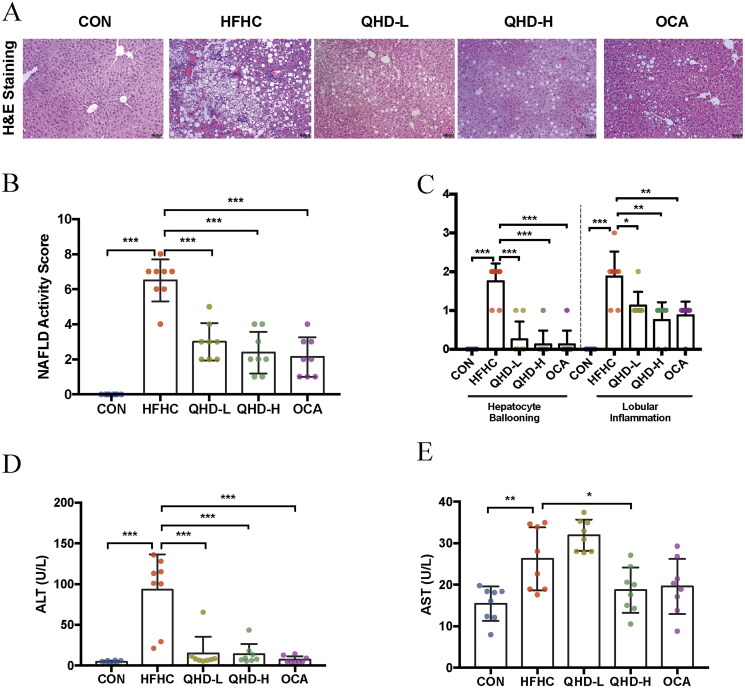
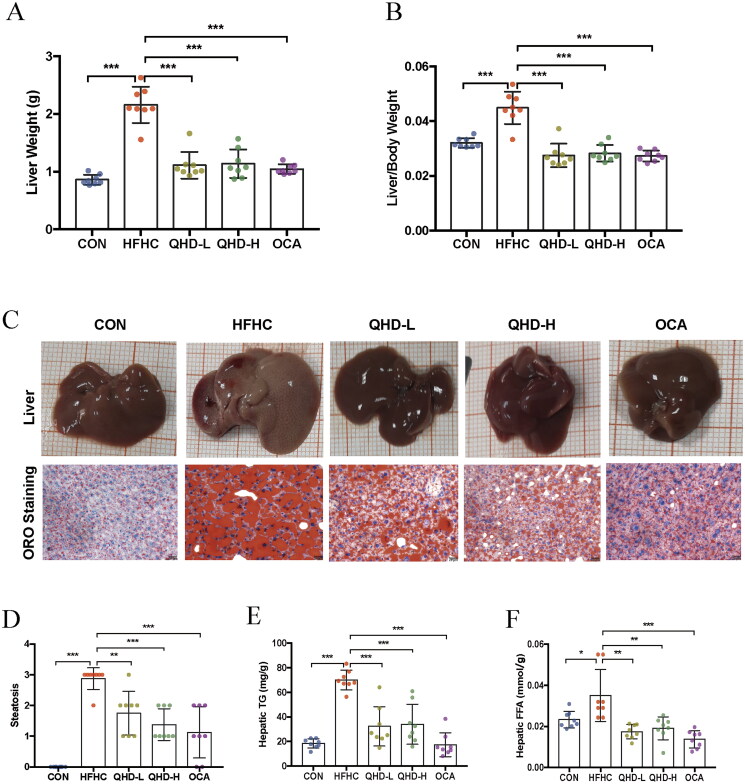
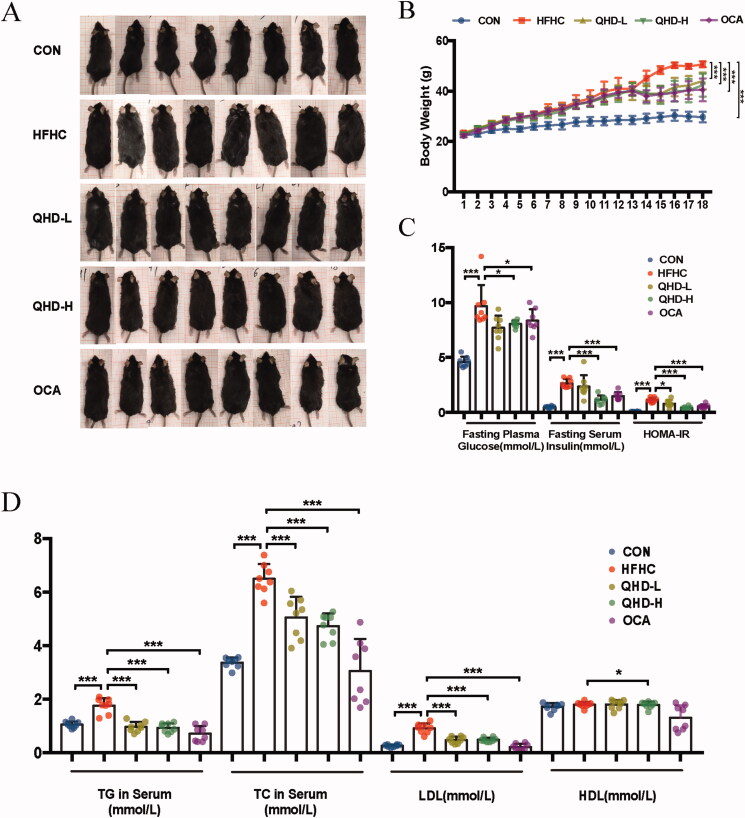
Results: QHD significantly improved NASH in mice, as reflected by improving serum glucolipid metabolism, decreasing enzymes activities, reducing hepatic triglyceride (HFHC: 70.07 ± 2.81 mg/g; QHD-H: 34.06 ± 5.74 mg/g) and ameliorating hepatic steatosis, inflammation in pathology. Further, both the mRNA and protein level of hepatic CPT-1A (p < 0.05), a rate-limiting enzyme of FAO, increased drastically following QHD treatment. Meanwhile, the content of hepatic ATP (p < 0.05) increased significantly after treatment with QHD. Further mechanistic results revealed that both the total protein and nuclear p-STAT3 in the liver were significantly down-regulated after QHD treatment. The protein level of hepatic p-JAK2 was significantly inhibited by QHD (p < 0.05 or p < 0.01).
Conclusions: QHD could attenuate lipid accumulation by increasing JAK2/STAT3/CPT-1A-related FAO, which provides a scientific basis for the clinical application of QHD in treating NASH.
期刊介绍:
Pharmaceutical Biology will publish manuscripts describing the discovery, methods for discovery, description, analysis characterization, and production/isolation (including sources and surveys) of biologically-active chemicals or other substances, drugs, pharmaceutical products, or preparations utilized in systems of traditional medicine.
Topics may generally encompass any facet of natural product research related to pharmaceutical biology. Papers dealing with agents or topics related to natural product drugs are also appropriate (e.g., semi-synthetic derivatives). Manuscripts will be published as reviews, perspectives, regular research articles, and short communications. The primary criteria for acceptance and publication are scientific rigor and potential to advance the field.



 京公网安备 11010802042870号
京ICP备2023020795号-1
京公网安备 11010802042870号
京ICP备2023020795号-1

 分享
分享
 求助内容:
求助内容: 应助结果提醒方式:
 扫码关注我们
