Carl Llor, Gloria Cordoba, Sandi Michele de Oliveira, Lars Bjerrum, Ana Moragas
{"title":"Antibiotic deprescribing: Spanish general practitioners' views on a new strategy to reduce inappropriate use of antibiotics in primary care.","authors":"Carl Llor, Gloria Cordoba, Sandi Michele de Oliveira, Lars Bjerrum, Ana Moragas","doi":"10.1080/13814788.2022.2130887","DOIUrl":null,"url":null,"abstract":"<p><strong>Background: </strong>A doctor may recommend that a patient stop an antibiotic course before its scheduled completion time if further treatment may cause more harm than benefit.</p><p><strong>Objectives: </strong>This study explores general practitioners' (GP) opinions about the use of antibiotic deprescribing (AD) in general practice.</p><p><strong>Methods: </strong>A cross-sectional, questionnaire-based study answered from February to March 2022. GPs (<i>n</i> = 6,083) affiliated with the largest Spanish scientific society of primary care were invited to participate. The survey included two statements related to use and fourteen views about AD rated by GPs using a 5-item Likert scale.</p><p><strong>Results: </strong>Eleven hundred and seven doctors completed the surveys (18.2%), of whom 92.5% (95% confidence interval [CI] 90.8-94%) reported having used the AD strategy in their practice at least once. GPs felt very confident in using a deprescribing strategy in patients with common cold and influenza (97.6% and 93.5%, respectively) but less with acute bronchitis (45.5%); 12.1% (95% CI, 10.2-14.2%) considered this practice harmful to patients. Respondents reported using AD more frequently when they initiated the antibiotic course (96.8%; 95% CI, 95.5-97.7) than when the treatment was initiated by another doctor (52.3%; 95% CI, 49.3-55.3%). However, doctors aged >60 years were more prone to use AD compared with younger colleagues (64.5% vs. 50%; <i>p</i> < 0.005).</p><p><strong>Conclusion: </strong>The GPs in this study employ the strategy of AD. Nonetheless, essential differences lie in their views of the way the strategy is used. Further studies are warranted to explore the beliefs behind these perceptions and promote wider use of AD by GPs.</p>","PeriodicalId":2,"journal":{"name":"ACS Applied Bio Materials","volume":" ","pages":"217-223"},"PeriodicalIF":4.7000,"publicationDate":"2022-12-01","publicationTypes":"Journal Article","fieldsOfStudy":null,"isOpenAccess":false,"openAccessPdf":"https://www.ncbi.nlm.nih.gov/pmc/articles/PMC9629099/pdf/","citationCount":"0","resultStr":null,"platform":"Semanticscholar","paperid":null,"PeriodicalName":"ACS Applied Bio Materials","FirstCategoryId":"3","ListUrlMain":"https://doi.org/10.1080/13814788.2022.2130887","RegionNum":0,"RegionCategory":null,"ArticlePicture":[],"TitleCN":null,"AbstractTextCN":null,"PMCID":null,"EPubDate":"","PubModel":"","JCR":"Q2","JCRName":"MATERIALS SCIENCE, BIOMATERIALS","Score":null,"Total":0}
引用次数: 0
Abstract
Background: A doctor may recommend that a patient stop an antibiotic course before its scheduled completion time if further treatment may cause more harm than benefit.
Objectives: This study explores general practitioners' (GP) opinions about the use of antibiotic deprescribing (AD) in general practice.
Methods: A cross-sectional, questionnaire-based study answered from February to March 2022. GPs (n = 6,083) affiliated with the largest Spanish scientific society of primary care were invited to participate. The survey included two statements related to use and fourteen views about AD rated by GPs using a 5-item Likert scale.
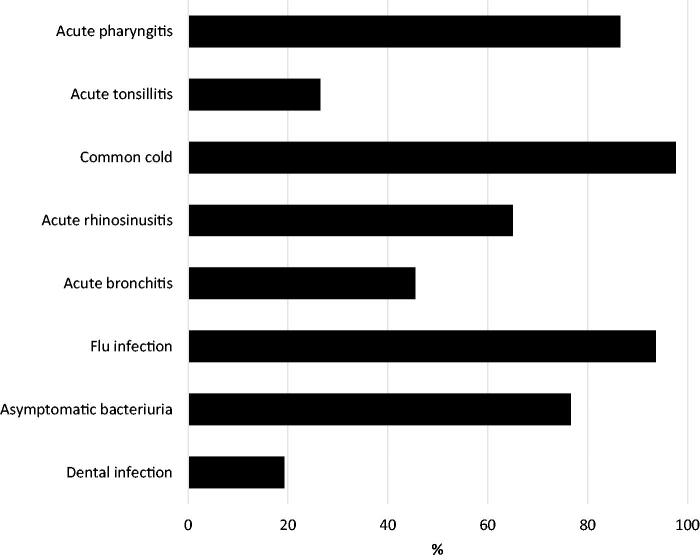
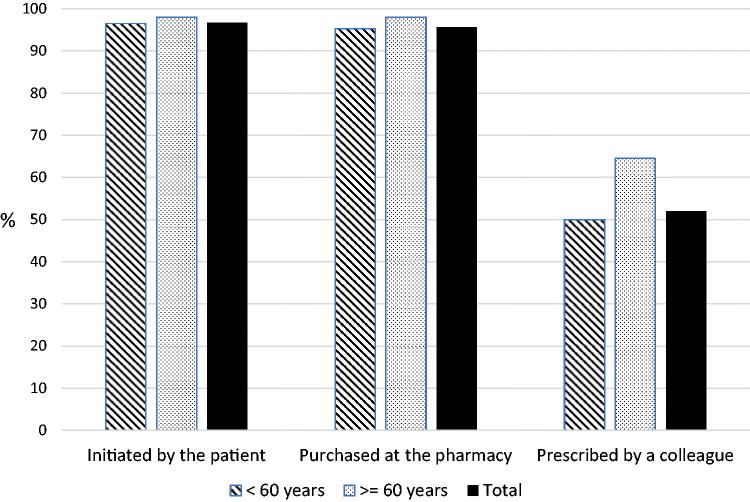
Results: Eleven hundred and seven doctors completed the surveys (18.2%), of whom 92.5% (95% confidence interval [CI] 90.8-94%) reported having used the AD strategy in their practice at least once. GPs felt very confident in using a deprescribing strategy in patients with common cold and influenza (97.6% and 93.5%, respectively) but less with acute bronchitis (45.5%); 12.1% (95% CI, 10.2-14.2%) considered this practice harmful to patients. Respondents reported using AD more frequently when they initiated the antibiotic course (96.8%; 95% CI, 95.5-97.7) than when the treatment was initiated by another doctor (52.3%; 95% CI, 49.3-55.3%). However, doctors aged >60 years were more prone to use AD compared with younger colleagues (64.5% vs. 50%; p < 0.005).
Conclusion: The GPs in this study employ the strategy of AD. Nonetheless, essential differences lie in their views of the way the strategy is used. Further studies are warranted to explore the beliefs behind these perceptions and promote wider use of AD by GPs.
期刊介绍:
ACS Applied Bio Materials is an interdisciplinary journal publishing original research covering all aspects of biomaterials and biointerfaces including and beyond the traditional biosensing, biomedical and therapeutic applications.
The journal is devoted to reports of new and original experimental and theoretical research of an applied nature that integrates knowledge in the areas of materials, engineering, physics, bioscience, and chemistry into important bio applications. The journal is specifically interested in work that addresses the relationship between structure and function and assesses the stability and degradation of materials under relevant environmental and biological conditions.




 京公网安备 11010802042870号
京ICP备2023020795号-1
京公网安备 11010802042870号
京ICP备2023020795号-1

 分享
分享
 求助内容:
求助内容: 应助结果提醒方式:
 扫码关注我们
