{"title":"The Effect of Thermally Robust Ballistic Mechanisms on Climatic Niche in Salamanders.","authors":"Sarah T Friedman, Martha M Muñoz","doi":"10.1093/iob/obac020","DOIUrl":null,"url":null,"abstract":"<p><p>Many organismal functions are temperature-dependent due to the contractile properties of muscle. Spring-based mechanisms offer a thermally robust alternative to temperature-sensitive muscular movements and may correspondingly expand a species' climatic niche by partially decoupling the relationship between temperature and performance. Using the ballistic tongues of salamanders as a case study, we explore whether the thermal robustness of elastic feeding mechanisms increases climatic niche breadth, expands geographic range size, and alters the dynamics of niche evolution. Combining phylogenetic comparative methods with global climate data, we find that the feeding mechanism imparts no discernable signal on either climatic niche properties or the evolutionary dynamics of most climatic niche parameters. Although biomechanical innovation in feeding influences many features of whole-organism performance, it does not appear to drive macro-climatic niche evolution in salamanders. We recommend that future work incorporate micro-scale environmental data to better capture the conditions that salamanders experience, and we discuss a few outstanding questions in this regard. Overall, this study lays the groundwork for an investigation into the evolutionary relationships between climatic niche and biomechanical traits in ectotherms.</p>","PeriodicalId":2,"journal":{"name":"ACS Applied Bio Materials","volume":" ","pages":"obac020"},"PeriodicalIF":4.7000,"publicationDate":"2022-08-13","publicationTypes":"Journal Article","fieldsOfStudy":null,"isOpenAccess":false,"openAccessPdf":"https://www.ncbi.nlm.nih.gov/pmc/articles/PMC9375770/pdf/","citationCount":"0","resultStr":null,"platform":"Semanticscholar","paperid":null,"PeriodicalName":"ACS Applied Bio Materials","FirstCategoryId":"99","ListUrlMain":"https://doi.org/10.1093/iob/obac020","RegionNum":0,"RegionCategory":null,"ArticlePicture":[],"TitleCN":null,"AbstractTextCN":null,"PMCID":null,"EPubDate":"2022/1/1 0:00:00","PubModel":"eCollection","JCR":"Q2","JCRName":"MATERIALS SCIENCE, BIOMATERIALS","Score":null,"Total":0}
引用次数: 0
Abstract
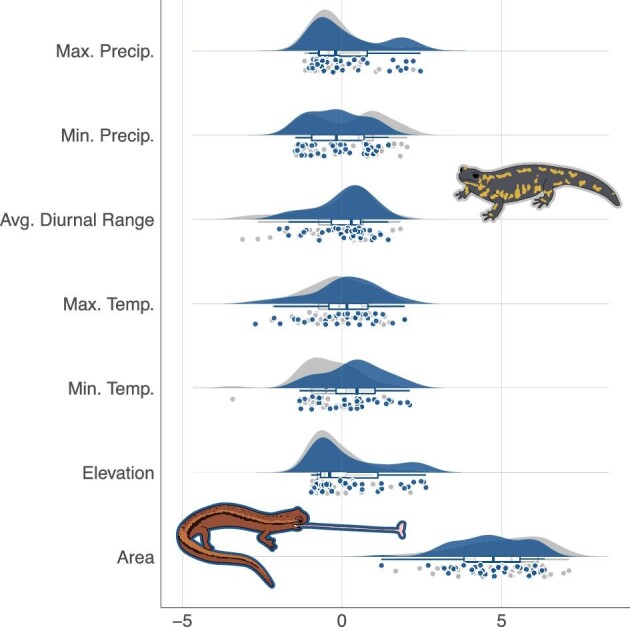
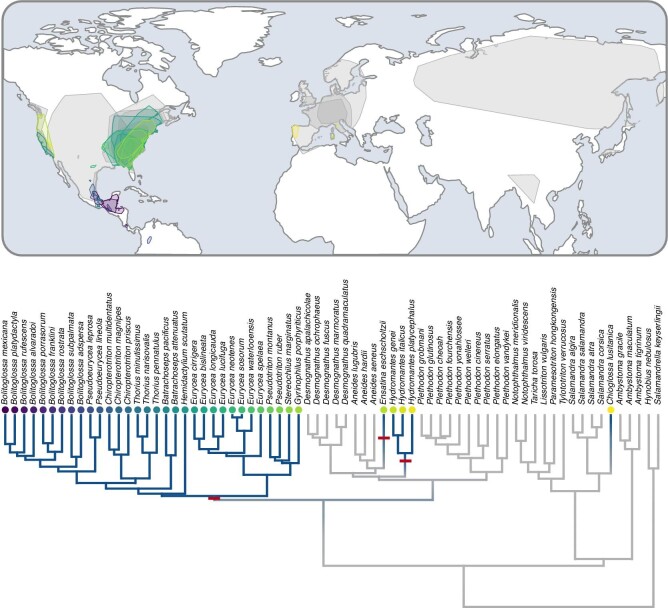
Many organismal functions are temperature-dependent due to the contractile properties of muscle. Spring-based mechanisms offer a thermally robust alternative to temperature-sensitive muscular movements and may correspondingly expand a species' climatic niche by partially decoupling the relationship between temperature and performance. Using the ballistic tongues of salamanders as a case study, we explore whether the thermal robustness of elastic feeding mechanisms increases climatic niche breadth, expands geographic range size, and alters the dynamics of niche evolution. Combining phylogenetic comparative methods with global climate data, we find that the feeding mechanism imparts no discernable signal on either climatic niche properties or the evolutionary dynamics of most climatic niche parameters. Although biomechanical innovation in feeding influences many features of whole-organism performance, it does not appear to drive macro-climatic niche evolution in salamanders. We recommend that future work incorporate micro-scale environmental data to better capture the conditions that salamanders experience, and we discuss a few outstanding questions in this regard. Overall, this study lays the groundwork for an investigation into the evolutionary relationships between climatic niche and biomechanical traits in ectotherms.
期刊介绍:
ACS Applied Bio Materials is an interdisciplinary journal publishing original research covering all aspects of biomaterials and biointerfaces including and beyond the traditional biosensing, biomedical and therapeutic applications.
The journal is devoted to reports of new and original experimental and theoretical research of an applied nature that integrates knowledge in the areas of materials, engineering, physics, bioscience, and chemistry into important bio applications. The journal is specifically interested in work that addresses the relationship between structure and function and assesses the stability and degradation of materials under relevant environmental and biological conditions.




 京公网安备 11010802042870号
京ICP备2023020795号-1
京公网安备 11010802042870号
京ICP备2023020795号-1

 分享
分享
 求助内容:
求助内容: 应助结果提醒方式:
 扫码关注我们
