Comparative Analysis of Bond Strength Durability of 10-Methacryloyloxydecyl Dihydrogen Phosphate-Containing Adhesives on a Low-Viscosity Bulk-Fill Composite Surface.
Renáta Martos, Melinda Szalóki, József Gáll, Attila Csík, Csaba Hegedűs
{"title":"Comparative Analysis of Bond Strength Durability of 10-Methacryloyloxydecyl Dihydrogen Phosphate-Containing Adhesives on a Low-Viscosity Bulk-Fill Composite Surface.","authors":"Renáta Martos, Melinda Szalóki, József Gáll, Attila Csík, Csaba Hegedűs","doi":"10.3290/j.jad.b3608775","DOIUrl":null,"url":null,"abstract":"<p><strong>Purpose: </strong>To compare the bond durability of adhesives with 10-methacryloyloxydecyl dihydrogen phosphate (10-MDP) to low-viscosity bulk-fill composite.</p><p><strong>Materials and methods: </strong>Four 10-MDP-containing adhesives (Tokuyama Bond Force II [TBF II], Tokuyama; Scotchbond Universal [SU], 3M Oral Care; Clearfil Universal Bond Quick [CL], Kuraray Noritake; and G-Premio Bond [GP], GC) and one 10-MDP-free adhesive (Heliobond [HB] Ivoclar Vivadent) as a control were applied to polished, air-abraded surfaces of randomly assigned SureFil SDR flow low-viscosity bulk-fill composite blocks. The application of the adhesives was followed by applying Tetric EvoCeram universal nanohybrid composite in layers. Each layered composite block was sliced into stick specimens with a hard-tissue microtome. Half of the groups were randomly selected and tested for microtensile bond strength (immediate group); the other groups were aged in a thermocyling machine for 5000 cycles, followed by testing microtensile bond strength (aged group). The adhesive interface was evaluated with scanning electron microscopy (SEM). Failure modes were observed using light microscopy. The results were evaluated with Levene's test, ANOVA, Welch's ANOVA, Tukey's test and the Z-test as appropriate (significance: p < 0.05).</p><p><strong>Results: </strong>There was a significant difference in the bond strength between 10-MDP-containing adhesives and the 10-MDP-free adhesive in all groups. Aging significantly decreased the bond strength in all adhesive groups. There was no significant difference in the bond strength durability among the 10-MDP-containing adhesives.</p><p><strong>Conclusion: </strong>Application of 10-MDP-containing adhesives has an advantageous effect on the air-abraded SDR composite surface compared with 10-MDP-free adhesive. The composition of 10-MDP-containing adhesives did not influence the bond strength. Aging diminishes the bond strength durability of 10-MDP-containing adhesives.</p>","PeriodicalId":2,"journal":{"name":"ACS Applied Bio Materials","volume":" ","pages":"427-434"},"PeriodicalIF":4.7000,"publicationDate":"2022-11-28","publicationTypes":"Journal Article","fieldsOfStudy":null,"isOpenAccess":false,"openAccessPdf":"https://www.ncbi.nlm.nih.gov/pmc/articles/PMC11734245/pdf/","citationCount":"0","resultStr":null,"platform":"Semanticscholar","paperid":null,"PeriodicalName":"ACS Applied Bio Materials","FirstCategoryId":"1085","ListUrlMain":"https://doi.org/10.3290/j.jad.b3608775","RegionNum":0,"RegionCategory":null,"ArticlePicture":[],"TitleCN":null,"AbstractTextCN":null,"PMCID":null,"EPubDate":"","PubModel":"","JCR":"Q2","JCRName":"MATERIALS SCIENCE, BIOMATERIALS","Score":null,"Total":0}
引用次数: 0
Abstract
Purpose: To compare the bond durability of adhesives with 10-methacryloyloxydecyl dihydrogen phosphate (10-MDP) to low-viscosity bulk-fill composite.
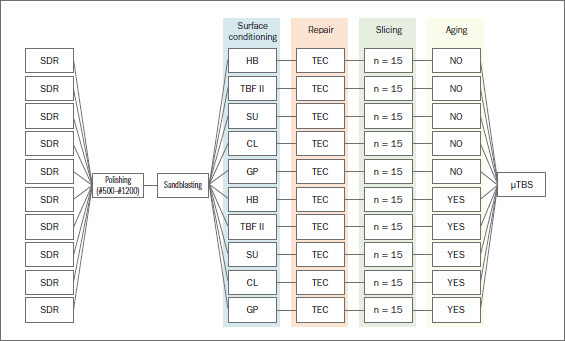
Materials and methods: Four 10-MDP-containing adhesives (Tokuyama Bond Force II [TBF II], Tokuyama; Scotchbond Universal [SU], 3M Oral Care; Clearfil Universal Bond Quick [CL], Kuraray Noritake; and G-Premio Bond [GP], GC) and one 10-MDP-free adhesive (Heliobond [HB] Ivoclar Vivadent) as a control were applied to polished, air-abraded surfaces of randomly assigned SureFil SDR flow low-viscosity bulk-fill composite blocks. The application of the adhesives was followed by applying Tetric EvoCeram universal nanohybrid composite in layers. Each layered composite block was sliced into stick specimens with a hard-tissue microtome. Half of the groups were randomly selected and tested for microtensile bond strength (immediate group); the other groups were aged in a thermocyling machine for 5000 cycles, followed by testing microtensile bond strength (aged group). The adhesive interface was evaluated with scanning electron microscopy (SEM). Failure modes were observed using light microscopy. The results were evaluated with Levene's test, ANOVA, Welch's ANOVA, Tukey's test and the Z-test as appropriate (significance: p < 0.05).
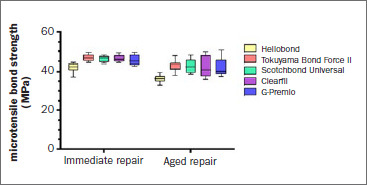
Results: There was a significant difference in the bond strength between 10-MDP-containing adhesives and the 10-MDP-free adhesive in all groups. Aging significantly decreased the bond strength in all adhesive groups. There was no significant difference in the bond strength durability among the 10-MDP-containing adhesives.
Conclusion: Application of 10-MDP-containing adhesives has an advantageous effect on the air-abraded SDR composite surface compared with 10-MDP-free adhesive. The composition of 10-MDP-containing adhesives did not influence the bond strength. Aging diminishes the bond strength durability of 10-MDP-containing adhesives.
期刊介绍:
ACS Applied Bio Materials is an interdisciplinary journal publishing original research covering all aspects of biomaterials and biointerfaces including and beyond the traditional biosensing, biomedical and therapeutic applications.
The journal is devoted to reports of new and original experimental and theoretical research of an applied nature that integrates knowledge in the areas of materials, engineering, physics, bioscience, and chemistry into important bio applications. The journal is specifically interested in work that addresses the relationship between structure and function and assesses the stability and degradation of materials under relevant environmental and biological conditions.




 京公网安备 11010802042870号
京ICP备2023020795号-1
京公网安备 11010802042870号
京ICP备2023020795号-1

 分享
分享
 求助内容:
求助内容: 应助结果提醒方式:
 扫码关注我们
