{"title":"Remote Work and Post-Bureaucracy: Unintended Consequences of Work Design for Gender Inequality.","authors":"Kim de Laat","doi":"10.1177/00197939221076134","DOIUrl":null,"url":null,"abstract":"<p><p>In-depth interviews with IT employees (<i>N</i> = 84) working under two types of work design-a post-bureaucratic work design labeled \"agile,\" and a bureaucratic work design labeled \"waterfall\"-are used to examine gendered patterns in the adoption of remote work. Interviews reveal an unintended consequence of the agile model: It promotes a physical orientation that induces on-site work. Agile is gender-inegalitarian, with more women than men working remotely despite its perceived unacceptability, and low numbers of employees working remotely overall. By contrast, workers within a waterfall work design express a digital orientation to work and feel empowered to work remotely. The waterfall model is associated with gender egalitarianism; most employees opt to work remotely, and men and women do so in even numbers. Findings suggest that when compared to the post-bureaucratic work design, the bureaucratic work design provides more flexibility. This article refines our understanding of barriers to remote work and provides a lens on the gender dynamics underlying work design.</p>","PeriodicalId":2,"journal":{"name":"ACS Applied Bio Materials","volume":" ","pages":"135-159"},"PeriodicalIF":4.7000,"publicationDate":"2023-01-01","publicationTypes":"Journal Article","fieldsOfStudy":null,"isOpenAccess":false,"openAccessPdf":"https://ftp.ncbi.nlm.nih.gov/pub/pmc/oa_pdf/15/82/10.1177_00197939221076134.PMC9693892.pdf","citationCount":"0","resultStr":null,"platform":"Semanticscholar","paperid":null,"PeriodicalName":"ACS Applied Bio Materials","FirstCategoryId":"91","ListUrlMain":"https://doi.org/10.1177/00197939221076134","RegionNum":0,"RegionCategory":null,"ArticlePicture":[],"TitleCN":null,"AbstractTextCN":null,"PMCID":null,"EPubDate":"2022/2/14 0:00:00","PubModel":"Epub","JCR":"Q2","JCRName":"MATERIALS SCIENCE, BIOMATERIALS","Score":null,"Total":0}
引用次数: 0
Abstract
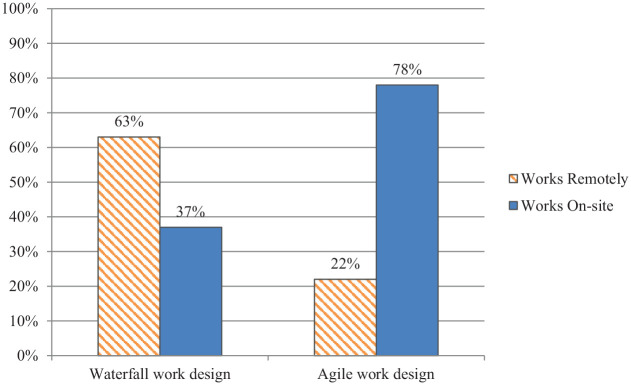
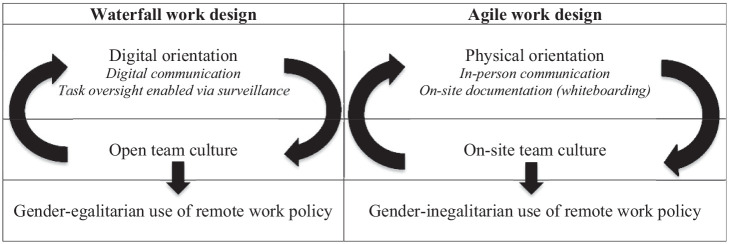
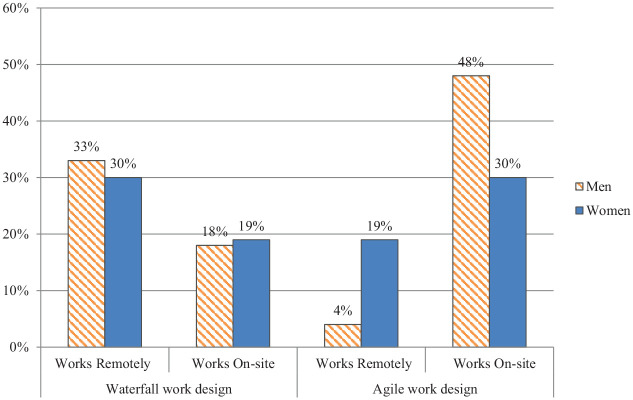
In-depth interviews with IT employees (N = 84) working under two types of work design-a post-bureaucratic work design labeled "agile," and a bureaucratic work design labeled "waterfall"-are used to examine gendered patterns in the adoption of remote work. Interviews reveal an unintended consequence of the agile model: It promotes a physical orientation that induces on-site work. Agile is gender-inegalitarian, with more women than men working remotely despite its perceived unacceptability, and low numbers of employees working remotely overall. By contrast, workers within a waterfall work design express a digital orientation to work and feel empowered to work remotely. The waterfall model is associated with gender egalitarianism; most employees opt to work remotely, and men and women do so in even numbers. Findings suggest that when compared to the post-bureaucratic work design, the bureaucratic work design provides more flexibility. This article refines our understanding of barriers to remote work and provides a lens on the gender dynamics underlying work design.
期刊介绍:
ACS Applied Bio Materials is an interdisciplinary journal publishing original research covering all aspects of biomaterials and biointerfaces including and beyond the traditional biosensing, biomedical and therapeutic applications.
The journal is devoted to reports of new and original experimental and theoretical research of an applied nature that integrates knowledge in the areas of materials, engineering, physics, bioscience, and chemistry into important bio applications. The journal is specifically interested in work that addresses the relationship between structure and function and assesses the stability and degradation of materials under relevant environmental and biological conditions.




 京公网安备 11010802042870号
京ICP备2023020795号-1
京公网安备 11010802042870号
京ICP备2023020795号-1

 分享
分享
 求助内容:
求助内容: 应助结果提醒方式:
 扫码关注我们
