Dong Jae Lee, Jin A Lee, Dae-Han Chae, Hwi-Seo Jang, Young-Joon Choi, Dalsoo Kim
{"title":"Multiplex TaqMan qPCR Assay for Detection, Identification, and Quantification of Three <i>Sclerotinia</i> Species.","authors":"Dong Jae Lee, Jin A Lee, Dae-Han Chae, Hwi-Seo Jang, Young-Joon Choi, Dalsoo Kim","doi":"10.1080/12298093.2022.2131999","DOIUrl":null,"url":null,"abstract":"<p><p>White mold (or Sclerotinia stem rot), caused by <i>Sclerotinia</i> species, is a major air, soil, or seed-transmitted disease affecting numerous crops and wild plants. Microscopic or culture-based methods currently available for their detection and identification are time-consuming, laborious, and often erroneous. Therefore, we developed a multiplex quantitative PCR (qPCR) assay for the discrimination, detection, and quantification of DNA collected from each of the three economically relevant <i>Sclerotinia</i> species, namely, <i>S. sclerotiorum</i>, <i>S. minor</i>, and <i>S. nivalis</i>. TaqMan primer/probe combinations specific for each <i>Sclerotinia</i> species were designed based on the gene sequences encoding aspartyl protease. High specificity and sensitivity of each probe were confirmed for sclerotium and soil samples, as well as pure cultures, using simplex and multiplex qPCRs. This multiplex assay could be helpful in detecting and quantifying specific species of <i>Sclerotinia</i>, and therefore, may be valuable for disease diagnosis, forecasting, and management.</p>","PeriodicalId":18825,"journal":{"name":"Mycobiology","volume":"50 5","pages":"382-388"},"PeriodicalIF":2.0000,"publicationDate":"2022-10-28","publicationTypes":"Journal Article","fieldsOfStudy":null,"isOpenAccess":false,"openAccessPdf":"https://ftp.ncbi.nlm.nih.gov/pub/pmc/oa_pdf/45/a9/TMYB_50_2131999.PMC9645266.pdf","citationCount":"0","resultStr":null,"platform":"Semanticscholar","paperid":null,"PeriodicalName":"Mycobiology","FirstCategoryId":"99","ListUrlMain":"https://doi.org/10.1080/12298093.2022.2131999","RegionNum":4,"RegionCategory":"生物学","ArticlePicture":[],"TitleCN":null,"AbstractTextCN":null,"PMCID":null,"EPubDate":"2022/1/1 0:00:00","PubModel":"eCollection","JCR":"Q2","JCRName":"AGRONOMY","Score":null,"Total":0}
引用次数: 0
Abstract
White mold (or Sclerotinia stem rot), caused by Sclerotinia species, is a major air, soil, or seed-transmitted disease affecting numerous crops and wild plants. Microscopic or culture-based methods currently available for their detection and identification are time-consuming, laborious, and often erroneous. Therefore, we developed a multiplex quantitative PCR (qPCR) assay for the discrimination, detection, and quantification of DNA collected from each of the three economically relevant Sclerotinia species, namely, S. sclerotiorum, S. minor, and S. nivalis. TaqMan primer/probe combinations specific for each Sclerotinia species were designed based on the gene sequences encoding aspartyl protease. High specificity and sensitivity of each probe were confirmed for sclerotium and soil samples, as well as pure cultures, using simplex and multiplex qPCRs. This multiplex assay could be helpful in detecting and quantifying specific species of Sclerotinia, and therefore, may be valuable for disease diagnosis, forecasting, and management.
期刊介绍:
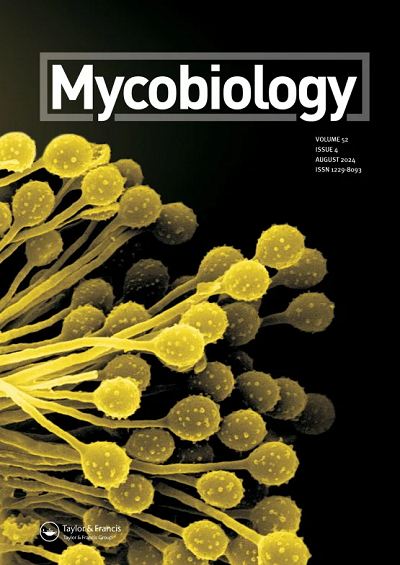
Mycobiology is an international journal devoted to the publication of fundamental and applied investigations on all aspects of mycology and their traditional allies. It is published quarterly and is the official publication of the Korean Society of Mycology. Mycobiology publishes reports of basic research on fungi and fungus-like organisms, including yeasts, filamentous fungi, lichen fungi, oomycetes, moulds, and mushroom. Topics also include molecular and cellular biology, biochemistry, metabolism, developmental biology, environmental mycology, evolution, ecology, taxonomy and systematics, genetics/genomics, fungal pathogen and disease control, physiology, and industrial biotechnology using fungi.





 京公网安备 11010802042870号
京ICP备2023020795号-1
京公网安备 11010802042870号
京ICP备2023020795号-1

 分享
分享
 求助内容:
求助内容: 应助结果提醒方式:
 扫码关注我们
