Biological Control of Oomycete Soilborne Diseases Caused by Phytophthora capsici, Phytophthora infestans, and Phytophthora nicotianae in Solanaceous Crops.
{"title":"Biological Control of Oomycete Soilborne Diseases Caused by <i>Phytophthora capsici, Phytophthora infestans</i>, and <i>Phytophthora nicotianae</i> in Solanaceous Crops.","authors":"Elena Volynchikova, Ki Deok Kim","doi":"10.1080/12298093.2022.2136333","DOIUrl":null,"url":null,"abstract":"<p><p>Oomycete pathogens that belong to the genus <i>Phytophthora</i> cause devastating diseases in solanaceous crops such as pepper, potato, and tobacco, resulting in crop production losses worldwide. Although the application of fungicides efficiently controls these diseases, it has been shown to trigger negative side effects such as environmental pollution, phytotoxicity, and fungicide resistance in plant pathogens. Therefore, biological control of <i>Phytophthora</i>-induced diseases was proposed as an environmentally sound alternative to conventional chemical control. In this review, progress on biological control of the soilborne oomycete plant pathogens, <i>Phytophthora capsici, Phytophthora infestans</i>, and <i>Phytophthora nicotianae</i>, infecting pepper, potato, and tobacco is described. Bacterial (e.g., <i>Acinetobacter, Bacillus, Chryseobacterium, Paenibacillus, Pseudomonas,</i> and <i>Streptomyces</i>) and fungal (e.g., <i>Trichoderma</i> and arbuscular mycorrhizal fungi) agents, and yeasts (e.g., <i>Aureobasidium</i>, <i>Curvibasidium</i>, and <i>Metschnikowia</i>) have been reported as successful biocontrol agents of <i>Phytophthora</i> pathogens. These microorganisms antagonize <i>Phytophthora</i> spp. <i>via</i> antimicrobial compounds with inhibitory activities against mycelial growth, sporulation, and zoospore germination. They also trigger plant immunity-inducing systemic resistance <i>via</i> several pathways, resulting in enhanced defense responses in their hosts. Along with plant protection, some of the microorganisms promote plant growth, thereby enhancing their beneficial relations with host plants. Although the beneficial effects of the biocontrol microorganisms are acceptable, single applications of antagonistic microorganisms tend to lack consistent efficacy compared with chemical analogues. Therefore, strategies to improve the biocontrol performance of these prominent antagonists are also discussed in this review.</p>","PeriodicalId":18825,"journal":{"name":"Mycobiology","volume":"50 5","pages":"269-293"},"PeriodicalIF":2.0000,"publicationDate":"2022-11-02","publicationTypes":"Journal Article","fieldsOfStudy":null,"isOpenAccess":false,"openAccessPdf":"https://ftp.ncbi.nlm.nih.gov/pub/pmc/oa_pdf/bb/fc/TMYB_50_2136333.PMC9645277.pdf","citationCount":"7","resultStr":null,"platform":"Semanticscholar","paperid":null,"PeriodicalName":"Mycobiology","FirstCategoryId":"99","ListUrlMain":"https://doi.org/10.1080/12298093.2022.2136333","RegionNum":4,"RegionCategory":"生物学","ArticlePicture":[],"TitleCN":null,"AbstractTextCN":null,"PMCID":null,"EPubDate":"2022/1/1 0:00:00","PubModel":"eCollection","JCR":"Q2","JCRName":"AGRONOMY","Score":null,"Total":0}
引用次数: 7
Abstract
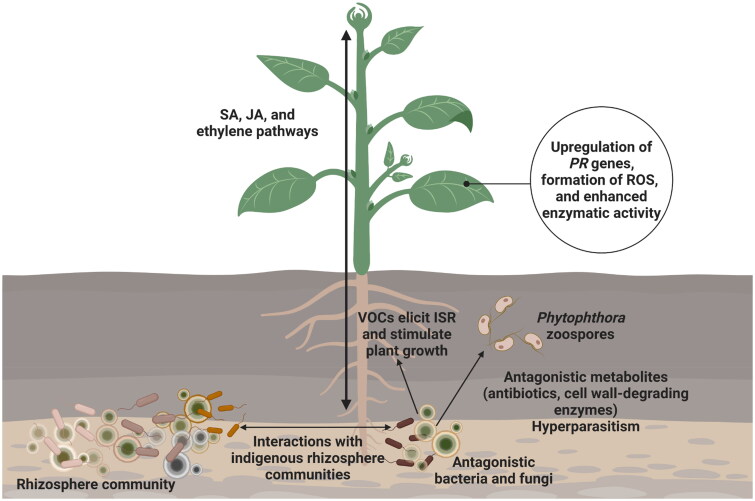
Oomycete pathogens that belong to the genus Phytophthora cause devastating diseases in solanaceous crops such as pepper, potato, and tobacco, resulting in crop production losses worldwide. Although the application of fungicides efficiently controls these diseases, it has been shown to trigger negative side effects such as environmental pollution, phytotoxicity, and fungicide resistance in plant pathogens. Therefore, biological control of Phytophthora-induced diseases was proposed as an environmentally sound alternative to conventional chemical control. In this review, progress on biological control of the soilborne oomycete plant pathogens, Phytophthora capsici, Phytophthora infestans, and Phytophthora nicotianae, infecting pepper, potato, and tobacco is described. Bacterial (e.g., Acinetobacter, Bacillus, Chryseobacterium, Paenibacillus, Pseudomonas, and Streptomyces) and fungal (e.g., Trichoderma and arbuscular mycorrhizal fungi) agents, and yeasts (e.g., Aureobasidium, Curvibasidium, and Metschnikowia) have been reported as successful biocontrol agents of Phytophthora pathogens. These microorganisms antagonize Phytophthora spp. via antimicrobial compounds with inhibitory activities against mycelial growth, sporulation, and zoospore germination. They also trigger plant immunity-inducing systemic resistance via several pathways, resulting in enhanced defense responses in their hosts. Along with plant protection, some of the microorganisms promote plant growth, thereby enhancing their beneficial relations with host plants. Although the beneficial effects of the biocontrol microorganisms are acceptable, single applications of antagonistic microorganisms tend to lack consistent efficacy compared with chemical analogues. Therefore, strategies to improve the biocontrol performance of these prominent antagonists are also discussed in this review.
期刊介绍:
Mycobiology is an international journal devoted to the publication of fundamental and applied investigations on all aspects of mycology and their traditional allies. It is published quarterly and is the official publication of the Korean Society of Mycology. Mycobiology publishes reports of basic research on fungi and fungus-like organisms, including yeasts, filamentous fungi, lichen fungi, oomycetes, moulds, and mushroom. Topics also include molecular and cellular biology, biochemistry, metabolism, developmental biology, environmental mycology, evolution, ecology, taxonomy and systematics, genetics/genomics, fungal pathogen and disease control, physiology, and industrial biotechnology using fungi.



 京公网安备 11010802042870号
京ICP备2023020795号-1
京公网安备 11010802042870号
京ICP备2023020795号-1

 分享
分享
 求助内容:
求助内容: 应助结果提醒方式:
 扫码关注我们
