{"title":"Strigol induces germination of the facultative parasitic plant <i>Phtheirospermum japonicum</i> in the absence of nitrate ions.","authors":"Satoshi Ogawa, Ken Shirasu","doi":"10.1080/15592324.2022.2114647","DOIUrl":null,"url":null,"abstract":"<p><p>Root parasitic plants in the family Orobanchaceae, such as <i>Striga</i> and <i>Orobanche</i> spp., infest major crops worldwide, leading to a multibillion-dollar loss annually. Host-derived strigolactones (SLs), recognized by a group of α/β hydrolase receptors (KAI2d) in these parasites, are important determinants for germinating root parasitic plants near the roots of host plants. <i>Phtheirospermum japonicum</i>, a facultative hemiparasitic Orobanchaceae plant, can germinate and grow in the presence or absence of the host and can also exhibit root chemotropism to host-derived SLs that are perceived via KAI2d. However, the importance of SLs in <i>P. japonicum</i> germination remains unclear. In this study, we found that germination of <i>P. japonicum</i> was suppressed in the absence of nitrate ions and that germination of <i>P. japonicum</i> was promoted by exogenous strigol, an SL, under such conditions. We propose a model in which <i>P. japonicum</i> may select either independent living or parasitism in response to ambient nitrogen conditions and host presence.</p>","PeriodicalId":2,"journal":{"name":"ACS Applied Bio Materials","volume":" ","pages":"2114647"},"PeriodicalIF":4.7000,"publicationDate":"2022-12-31","publicationTypes":"Journal Article","fieldsOfStudy":null,"isOpenAccess":false,"openAccessPdf":"https://www.ncbi.nlm.nih.gov/pmc/articles/PMC9397475/pdf/","citationCount":"0","resultStr":null,"platform":"Semanticscholar","paperid":null,"PeriodicalName":"ACS Applied Bio Materials","FirstCategoryId":"99","ListUrlMain":"https://doi.org/10.1080/15592324.2022.2114647","RegionNum":0,"RegionCategory":null,"ArticlePicture":[],"TitleCN":null,"AbstractTextCN":null,"PMCID":null,"EPubDate":"","PubModel":"","JCR":"Q2","JCRName":"MATERIALS SCIENCE, BIOMATERIALS","Score":null,"Total":0}
引用次数: 0
Abstract
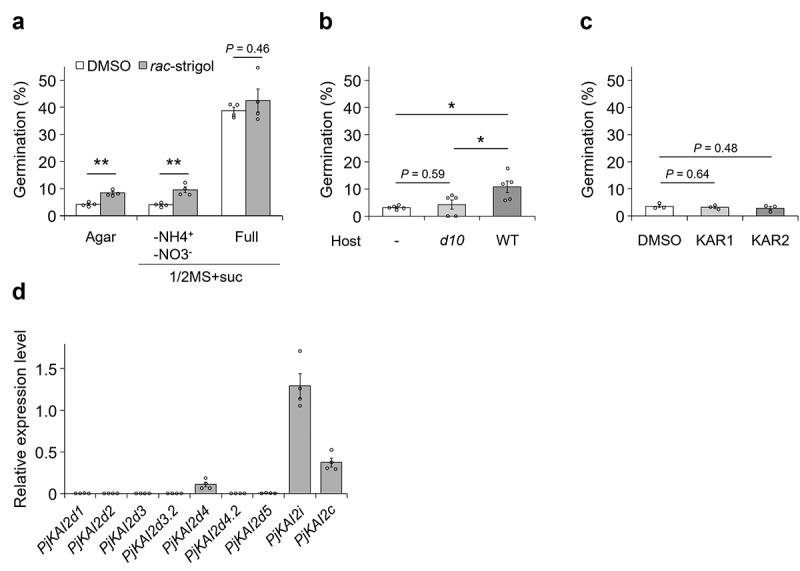
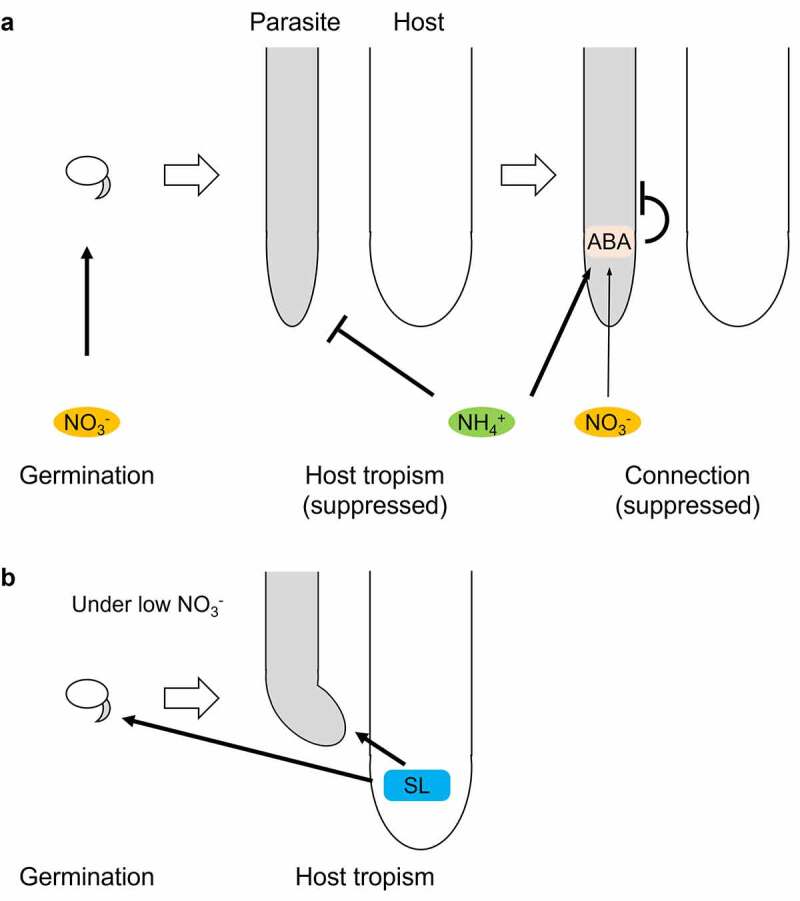
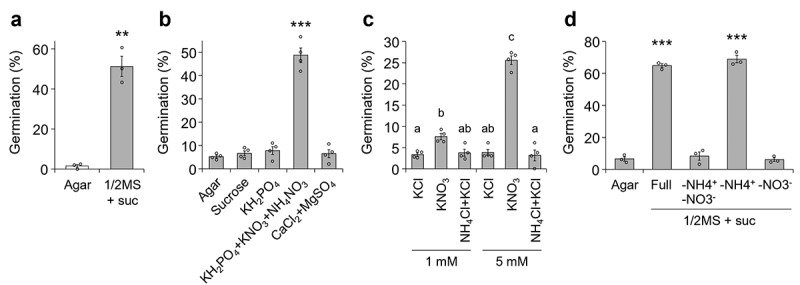
Root parasitic plants in the family Orobanchaceae, such as Striga and Orobanche spp., infest major crops worldwide, leading to a multibillion-dollar loss annually. Host-derived strigolactones (SLs), recognized by a group of α/β hydrolase receptors (KAI2d) in these parasites, are important determinants for germinating root parasitic plants near the roots of host plants. Phtheirospermum japonicum, a facultative hemiparasitic Orobanchaceae plant, can germinate and grow in the presence or absence of the host and can also exhibit root chemotropism to host-derived SLs that are perceived via KAI2d. However, the importance of SLs in P. japonicum germination remains unclear. In this study, we found that germination of P. japonicum was suppressed in the absence of nitrate ions and that germination of P. japonicum was promoted by exogenous strigol, an SL, under such conditions. We propose a model in which P. japonicum may select either independent living or parasitism in response to ambient nitrogen conditions and host presence.
期刊介绍:
ACS Applied Bio Materials is an interdisciplinary journal publishing original research covering all aspects of biomaterials and biointerfaces including and beyond the traditional biosensing, biomedical and therapeutic applications.
The journal is devoted to reports of new and original experimental and theoretical research of an applied nature that integrates knowledge in the areas of materials, engineering, physics, bioscience, and chemistry into important bio applications. The journal is specifically interested in work that addresses the relationship between structure and function and assesses the stability and degradation of materials under relevant environmental and biological conditions.




 京公网安备 11010802042870号
京ICP备2023020795号-1
京公网安备 11010802042870号
京ICP备2023020795号-1

 分享
分享
 求助内容:
求助内容: 应助结果提醒方式:
 扫码关注我们
