{"title":"The Toutatis (4179) Boulders: Shallow Slope in Size Distribution and Shape Statistics","authors":"Yuan Li, YuHui Zhao","doi":"10.1134/S0038094623050088","DOIUrl":null,"url":null,"abstract":"<p>Asteroid surface boulders contain important information about the origin and geological evolution of asteroids. Previous insights into boulders on the surface of Toutatis are based on direct measurements from two-dimensional images, the accuracy of these measurements needs to be further improved. Therefore, this study uses radar shape models to correct the dimensions of those Toutatis boulders with well-defined contours. 22 boulders are corrected and their distributions before correction have similar statistics to those boulders (222 in total) in Jiang et al. (2015). We re-examine the size and shape distributions of these corrected boulders and results show that the power-law index of boulders larger than 40 m, –1.27 ± 0.05, is relatively flatter than that of other asteroids that have been observed by spacecrafts. If this index represents the distribution pattern of boulders larger than a few meters across on the Toutatis surface, it suggests that Toutatis may have undergone fewer and weaker fragmentation processes during its past than other spacecraft-detected NEAs, which further suggests that the boulders on the Toutatis surface are in a unique state of preservation. We also find that these boulders have an apparent axis ratio of 0.7, which predicts that most of the boulders on the Toutatis surface are in a gravitationally stable state. In addition, these larger boulders on the Toutatis surface are mainly distributed at the junction of the body and the head, it is possible that they were produced by sputtering during the low-velocity impact between the head and the body. High-resolution optical images and computer simulations in the future will be of great help in deeply understanding the origin and geological evolution of Toutatis.</p>","PeriodicalId":778,"journal":{"name":"Solar System Research","volume":"57 5","pages":"495 - 504"},"PeriodicalIF":0.8000,"publicationDate":"2023-10-02","publicationTypes":"Journal Article","fieldsOfStudy":null,"isOpenAccess":false,"openAccessPdf":"","citationCount":"0","resultStr":null,"platform":"Semanticscholar","paperid":null,"PeriodicalName":"Solar System Research","FirstCategoryId":"101","ListUrlMain":"https://link.springer.com/article/10.1134/S0038094623050088","RegionNum":4,"RegionCategory":"物理与天体物理","ArticlePicture":[],"TitleCN":null,"AbstractTextCN":null,"PMCID":null,"EPubDate":"","PubModel":"","JCR":"Q4","JCRName":"ASTRONOMY & ASTROPHYSICS","Score":null,"Total":0}
引用次数: 0
Abstract
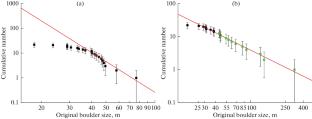
Asteroid surface boulders contain important information about the origin and geological evolution of asteroids. Previous insights into boulders on the surface of Toutatis are based on direct measurements from two-dimensional images, the accuracy of these measurements needs to be further improved. Therefore, this study uses radar shape models to correct the dimensions of those Toutatis boulders with well-defined contours. 22 boulders are corrected and their distributions before correction have similar statistics to those boulders (222 in total) in Jiang et al. (2015). We re-examine the size and shape distributions of these corrected boulders and results show that the power-law index of boulders larger than 40 m, –1.27 ± 0.05, is relatively flatter than that of other asteroids that have been observed by spacecrafts. If this index represents the distribution pattern of boulders larger than a few meters across on the Toutatis surface, it suggests that Toutatis may have undergone fewer and weaker fragmentation processes during its past than other spacecraft-detected NEAs, which further suggests that the boulders on the Toutatis surface are in a unique state of preservation. We also find that these boulders have an apparent axis ratio of 0.7, which predicts that most of the boulders on the Toutatis surface are in a gravitationally stable state. In addition, these larger boulders on the Toutatis surface are mainly distributed at the junction of the body and the head, it is possible that they were produced by sputtering during the low-velocity impact between the head and the body. High-resolution optical images and computer simulations in the future will be of great help in deeply understanding the origin and geological evolution of Toutatis.
期刊介绍:
Solar System Research publishes articles concerning the bodies of the Solar System, i.e., planets and their satellites, asteroids, comets, meteoric substances, and cosmic dust. The articles consider physics, dynamics and composition of these bodies, and techniques of their exploration. The journal addresses the problems of comparative planetology, physics of the planetary atmospheres and interiors, cosmochemistry, as well as planetary plasma environment and heliosphere, specifically those related to solar-planetary interactions. Attention is paid to studies of exoplanets and complex problems of the origin and evolution of planetary systems including the solar system, based on the results of astronomical observations, laboratory studies of meteorites, relevant theoretical approaches and mathematical modeling. Alongside with the original results of experimental and theoretical studies, the journal publishes scientific reviews in the field of planetary exploration, and notes on observational results.



 京公网安备 11010802042870号
京ICP备2023020795号-1
京公网安备 11010802042870号
京ICP备2023020795号-1

 分享
分享
 求助内容:
求助内容: 应助结果提醒方式:
 扫码关注我们
