Implementation of policy and management interventions to improve health and care workforce capacity to address the COVID-19 pandemic response: a systematic review.
Ana Paula Cavalcante de Oliveira, Mariana Lopes Galante, Leila Senna Maia, Isabel Craveiro, Alessandra Pereira da Silva, Ines Fronteira, Raphael Chança, Giorgio Cometto, Paulo Ferrinho, Mario Dal Poz
{"title":"Implementation of policy and management interventions to improve health and care workforce capacity to address the COVID-19 pandemic response: a systematic review.","authors":"Ana Paula Cavalcante de Oliveira, Mariana Lopes Galante, Leila Senna Maia, Isabel Craveiro, Alessandra Pereira da Silva, Ines Fronteira, Raphael Chança, Giorgio Cometto, Paulo Ferrinho, Mario Dal Poz","doi":"10.1186/s12960-023-00856-y","DOIUrl":null,"url":null,"abstract":"<p><strong>Background: </strong>The COVID-19 pandemic highlighted pre-existing weaknesses in health and care systems and services and shortages of health and care workers (HCWs). As a result, policymakers needed to adopt measures to improve the health and care workforce (HCWF) capacity. This review aims to identify countries' range of policies and management interventions implemented to improve HCWs' capacity to address the COVID-19 pandemic response, synthesize their evidence on effectiveness, and identify gaps in the evidence.</p><p><strong>Methods: </strong>The literature was searched in PubMed, Embase, Scopus, LILACS-BVS, WHO's COVID-19 Research Database and the ILO, OECD and HSRM websites for literature and documents published between January 2020 and March 2022. Eligibility criteria were HCWs as participants and policy and management interventions aiming to improve HCWF capacity to address the COVID-19 pandemic response. Risk of bias was assessed with Joanna Briggs Institute (JBI) Critical Appraisal Tools (CAT) and certainty of the evidence in presented outcomes with GRADE.</p><p><strong>Results: </strong>The searches retrieved 3378 documents. A total of 69 were included, but only 8 presented outcomes of interventions implemented. Most of the selected documents described at least one intervention implemented by countries at the organizational environment level to increase the flexibility and capacity of the HCWF to respond to the pandemic, followed by interventions to attract and retain HCWs in safe and decent working environments. There was a lack of studies addressing social protection, human resources for health information systems, and regarding the role of community health workers and other community-based providers. Regarding the risk of bias, most of documents were rated as medium or high quality (JBI's CAT), while the evidence presented for the outcomes of interventions was classified as mostly low-certainty evidence (GRADE).</p><p><strong>Conclusions: </strong>Countries have implemented various interventions, some innovative, in response to the pandemic, and others had their processes started earlier and accelerated by the pandemic. The evidence regarding the impact and efficacy of the strategies used by countries during the pandemic still requires further research.</p>","PeriodicalId":39823,"journal":{"name":"Human Resources for Health","volume":"21 1","pages":"80"},"PeriodicalIF":4.3000,"publicationDate":"2023-10-10","publicationTypes":"Journal Article","fieldsOfStudy":null,"isOpenAccess":false,"openAccessPdf":"https://www.ncbi.nlm.nih.gov/pmc/articles/PMC10563305/pdf/","citationCount":"0","resultStr":null,"platform":"Semanticscholar","paperid":null,"PeriodicalName":"Human Resources for Health","FirstCategoryId":"3","ListUrlMain":"https://doi.org/10.1186/s12960-023-00856-y","RegionNum":2,"RegionCategory":"医学","ArticlePicture":[],"TitleCN":null,"AbstractTextCN":null,"PMCID":null,"EPubDate":"","PubModel":"","JCR":"Q1","JCRName":"HEALTH POLICY & SERVICES","Score":null,"Total":0}
引用次数: 0
Abstract
Background: The COVID-19 pandemic highlighted pre-existing weaknesses in health and care systems and services and shortages of health and care workers (HCWs). As a result, policymakers needed to adopt measures to improve the health and care workforce (HCWF) capacity. This review aims to identify countries' range of policies and management interventions implemented to improve HCWs' capacity to address the COVID-19 pandemic response, synthesize their evidence on effectiveness, and identify gaps in the evidence.
Methods: The literature was searched in PubMed, Embase, Scopus, LILACS-BVS, WHO's COVID-19 Research Database and the ILO, OECD and HSRM websites for literature and documents published between January 2020 and March 2022. Eligibility criteria were HCWs as participants and policy and management interventions aiming to improve HCWF capacity to address the COVID-19 pandemic response. Risk of bias was assessed with Joanna Briggs Institute (JBI) Critical Appraisal Tools (CAT) and certainty of the evidence in presented outcomes with GRADE.
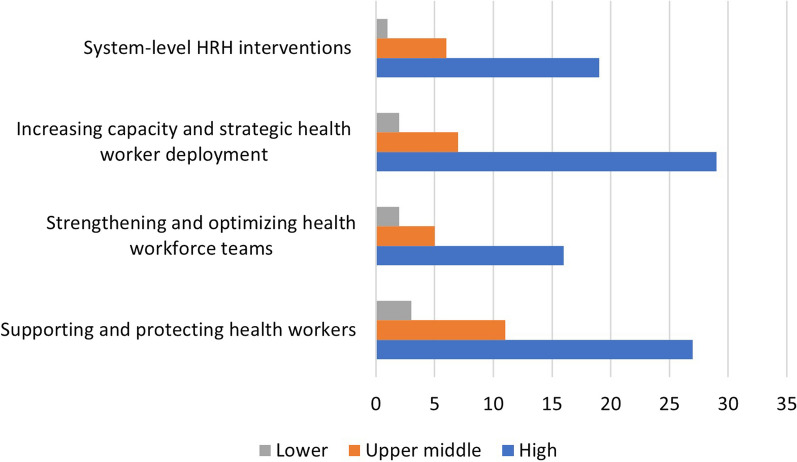
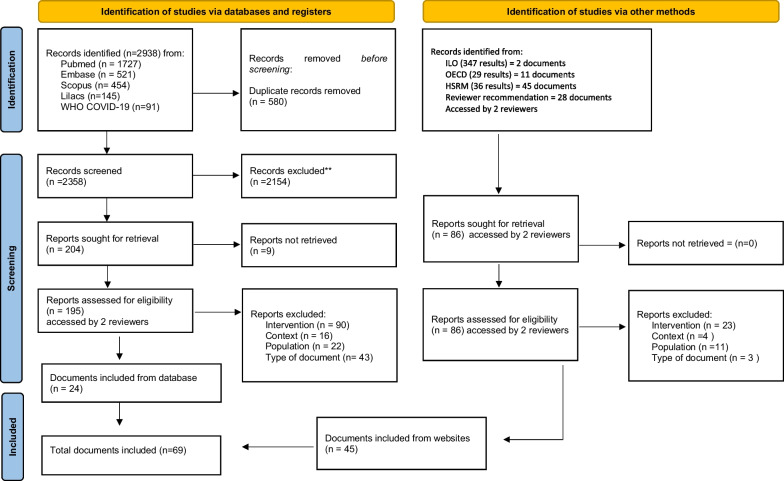
Results: The searches retrieved 3378 documents. A total of 69 were included, but only 8 presented outcomes of interventions implemented. Most of the selected documents described at least one intervention implemented by countries at the organizational environment level to increase the flexibility and capacity of the HCWF to respond to the pandemic, followed by interventions to attract and retain HCWs in safe and decent working environments. There was a lack of studies addressing social protection, human resources for health information systems, and regarding the role of community health workers and other community-based providers. Regarding the risk of bias, most of documents were rated as medium or high quality (JBI's CAT), while the evidence presented for the outcomes of interventions was classified as mostly low-certainty evidence (GRADE).
Conclusions: Countries have implemented various interventions, some innovative, in response to the pandemic, and others had their processes started earlier and accelerated by the pandemic. The evidence regarding the impact and efficacy of the strategies used by countries during the pandemic still requires further research.
期刊介绍:
Human Resources for Health is an open access, peer-reviewed, online journal covering all aspects of planning, producing and managing the health workforce - all those who provide health services worldwide. Human Resources for Health aims to disseminate research on health workforce policy, the health labour market, health workforce practice, development of knowledge tools and implementation mechanisms nationally and internationally; as well as specific features of the health workforce, such as the impact of management of health workers" performance and its link with health outcomes. The journal encourages debate on health sector reforms and their link with human resources issues, a hitherto-neglected area.



 京公网安备 11010802042870号
京ICP备2023020795号-1
京公网安备 11010802042870号
京ICP备2023020795号-1

 分享
分享
 求助内容:
求助内容: 应助结果提醒方式:
 扫码关注我们
