{"title":"Effects of lipoprotein nanoparticles' composition and size on their internalization in plant and mammalian cells","authors":"Ryosuke Fukuda, Misaki Tani, Shiori Shibukawa, Tomohiro Nobeyama, Taiji Nomura, Yasuo Kato, Tatsuya Murakami","doi":"10.1111/gtc.13075","DOIUrl":null,"url":null,"abstract":"<p>The internalization of engineered high-density lipoprotein nanoparticles (engineered lipoproteins [eLPs]) with different lipid and protein compositions, zeta potentials, and/or sizes were analyzed in representative plant and mammalian cells. The impact of the addition of a cell-penetrating peptide to eLPs on the internalization was very small in Bright Yellow (BY)-2 protoplasts compared with HeLa cells. When eLPs were prepared with one of the abundant lipids in BY-2 cells, digalactosyldiacylglycerol (DGDG) (eLP4), its internalization was dramatically increased only in HeLa cells. Such an increase in HeLa cells was also obtained for liposomes containing DGDG in a DGDG content-dependent manner. Increasing the size and zeta potential of eLPs improved their internalization in both HeLa cells and in BY-2 protoplasts but to quite varying degrees. Although eLPs tended to stay at the plasma membrane (PM) in BY-2 protoplasts with much less internalization, the PM-bound eLPs somehow promoted the internalization of coexisting nanobeads in cell culture media. These results provide fundamental insight into the future design of lipid nanoparticles for drug delivery in mammalian and plant cells.</p>","PeriodicalId":12742,"journal":{"name":"Genes to Cells","volume":"28 12","pages":"881-892"},"PeriodicalIF":1.3000,"publicationDate":"2023-10-18","publicationTypes":"Journal Article","fieldsOfStudy":null,"isOpenAccess":false,"openAccessPdf":"","citationCount":"0","resultStr":null,"platform":"Semanticscholar","paperid":null,"PeriodicalName":"Genes to Cells","FirstCategoryId":"99","ListUrlMain":"https://onlinelibrary.wiley.com/doi/10.1111/gtc.13075","RegionNum":4,"RegionCategory":"生物学","ArticlePicture":[],"TitleCN":null,"AbstractTextCN":null,"PMCID":null,"EPubDate":"","PubModel":"","JCR":"Q4","JCRName":"CELL BIOLOGY","Score":null,"Total":0}
引用次数: 0
Abstract
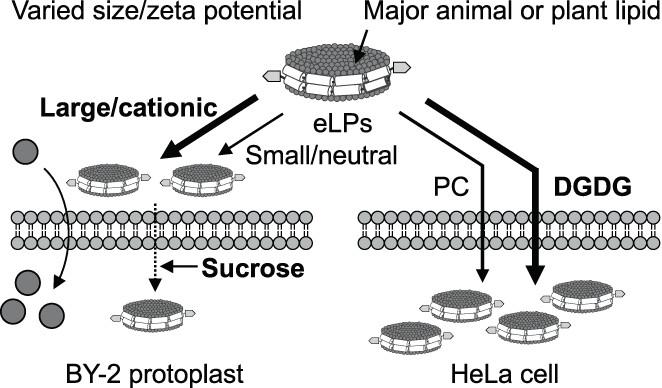
The internalization of engineered high-density lipoprotein nanoparticles (engineered lipoproteins [eLPs]) with different lipid and protein compositions, zeta potentials, and/or sizes were analyzed in representative plant and mammalian cells. The impact of the addition of a cell-penetrating peptide to eLPs on the internalization was very small in Bright Yellow (BY)-2 protoplasts compared with HeLa cells. When eLPs were prepared with one of the abundant lipids in BY-2 cells, digalactosyldiacylglycerol (DGDG) (eLP4), its internalization was dramatically increased only in HeLa cells. Such an increase in HeLa cells was also obtained for liposomes containing DGDG in a DGDG content-dependent manner. Increasing the size and zeta potential of eLPs improved their internalization in both HeLa cells and in BY-2 protoplasts but to quite varying degrees. Although eLPs tended to stay at the plasma membrane (PM) in BY-2 protoplasts with much less internalization, the PM-bound eLPs somehow promoted the internalization of coexisting nanobeads in cell culture media. These results provide fundamental insight into the future design of lipid nanoparticles for drug delivery in mammalian and plant cells.
期刊介绍:
Genes to Cells provides an international forum for the publication of papers describing important aspects of molecular and cellular biology. The journal aims to present papers that provide conceptual advance in the relevant field. Particular emphasis will be placed on work aimed at understanding the basic mechanisms underlying biological events.



 京公网安备 11010802042870号
京ICP备2023020795号-1
京公网安备 11010802042870号
京ICP备2023020795号-1

 分享
分享
 求助内容:
求助内容: 应助结果提醒方式:
 扫码关注我们
