Emma Straton, Hailey Inverso, Hailey Moore, Kashope Anifowoshe, Kendall Washington, Randi Streisand, Karishma Datye, Sarah S Jaser
{"title":"Glycemic and Psychosocial Correlates of Continuous Glucose Monitor Use Among Adolescents With Type 1 Diabetes.","authors":"Emma Straton, Hailey Inverso, Hailey Moore, Kashope Anifowoshe, Kendall Washington, Randi Streisand, Karishma Datye, Sarah S Jaser","doi":"10.1177/19322968231186428","DOIUrl":null,"url":null,"abstract":"<p><strong>Background: </strong>Continuous glucose monitor (CGM) use has been linked with better glycemic outcomes (HbA1c), yet many adolescents with type 1 diabetes (T1D) struggle to maintain optimal CGM use.</p><p><strong>Methods: </strong>This study examined CGM use and its association with HbA1c and psychosocial factors among adolescents with T1D experiencing at least moderate diabetes distress (N = 198). We examined mean differences in HbA1c, diabetes distress, diabetes-related family conflict, and quality of life among CGM user groups (<i>Current Users, Past Users</i>, and <i>Never Users</i>).</p><p><strong>Results: </strong><i>Current Users</i> demonstrated significantly lower HbA1c than <i>Never Users</i> and significantly lower diabetes distress than <i>Past Users</i>. CGM use was not associated with family conflict or quality of life.</p><p><strong>Conclusions: </strong>CGM use was associated with lower HbA1c and diabetes distress but not with other psychosocial outcomes. Longitudinal data may explain why many adolescents do not experience improvements in quality of life with CGM use.</p>","PeriodicalId":15475,"journal":{"name":"Journal of Diabetes Science and Technology","volume":" ","pages":"436-440"},"PeriodicalIF":3.7000,"publicationDate":"2025-03-01","publicationTypes":"Journal Article","fieldsOfStudy":null,"isOpenAccess":false,"openAccessPdf":"https://www.ncbi.nlm.nih.gov/pmc/articles/PMC11874006/pdf/","citationCount":"0","resultStr":null,"platform":"Semanticscholar","paperid":null,"PeriodicalName":"Journal of Diabetes Science and Technology","FirstCategoryId":"1085","ListUrlMain":"https://doi.org/10.1177/19322968231186428","RegionNum":0,"RegionCategory":null,"ArticlePicture":[],"TitleCN":null,"AbstractTextCN":null,"PMCID":null,"EPubDate":"2023/10/17 0:00:00","PubModel":"Epub","JCR":"Q2","JCRName":"ENDOCRINOLOGY & METABOLISM","Score":null,"Total":0}
引用次数: 0
Abstract
Background: Continuous glucose monitor (CGM) use has been linked with better glycemic outcomes (HbA1c), yet many adolescents with type 1 diabetes (T1D) struggle to maintain optimal CGM use.
Methods: This study examined CGM use and its association with HbA1c and psychosocial factors among adolescents with T1D experiencing at least moderate diabetes distress (N = 198). We examined mean differences in HbA1c, diabetes distress, diabetes-related family conflict, and quality of life among CGM user groups (Current Users, Past Users, and Never Users).
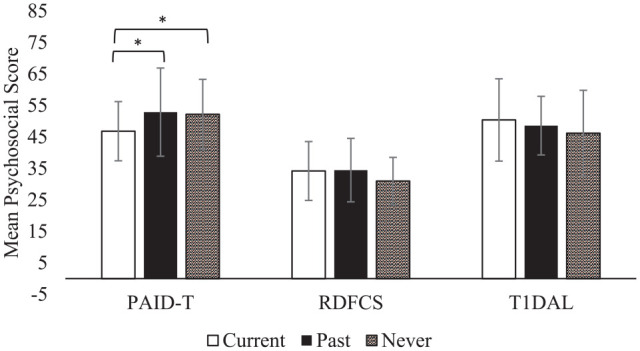
Results: Current Users demonstrated significantly lower HbA1c than Never Users and significantly lower diabetes distress than Past Users. CGM use was not associated with family conflict or quality of life.
Conclusions: CGM use was associated with lower HbA1c and diabetes distress but not with other psychosocial outcomes. Longitudinal data may explain why many adolescents do not experience improvements in quality of life with CGM use.
期刊介绍:
The Journal of Diabetes Science and Technology (JDST) is a bi-monthly, peer-reviewed scientific journal published by the Diabetes Technology Society. JDST covers scientific and clinical aspects of diabetes technology including glucose monitoring, insulin and metabolic peptide delivery, the artificial pancreas, digital health, precision medicine, social media, cybersecurity, software for modeling, physiologic monitoring, technology for managing obesity, and diagnostic tests of glycation. The journal also covers the development and use of mobile applications and wireless communication, as well as bioengineered tools such as MEMS, new biomaterials, and nanotechnology to develop new sensors. Articles in JDST cover both basic research and clinical applications of technologies being developed to help people with diabetes.




 京公网安备 11010802042870号
京ICP备2023020795号-1
京公网安备 11010802042870号
京ICP备2023020795号-1

 分享
分享
 求助内容:
求助内容: 应助结果提醒方式:
 扫码关注我们
