A Rahmani, L Parizadeh, M Baud, Y Francois, A Bazire, S Rodrigues, Y Fleury, H Cuny, E Debosse, J Cabon, L Louboutin, L Bellec, M Danion, T Morin
{"title":"Potential of Marine Strains of Pseudoalteromonas to Improve Resistance of Juvenile Sea Bass to Pathogens and Limit Biofilm Development.","authors":"A Rahmani, L Parizadeh, M Baud, Y Francois, A Bazire, S Rodrigues, Y Fleury, H Cuny, E Debosse, J Cabon, L Louboutin, L Bellec, M Danion, T Morin","doi":"10.1007/s12602-023-10180-5","DOIUrl":null,"url":null,"abstract":"<p><p>The European sea bass (Dicentrarchus labrax), one of the most produced marine fish species in Europe, is acutely vulnerable to multiple infectious hazards. In this study, we investigated the potential probiotic effect of some marine Pseudoalteromonas bacterial strains against two major pathogens of this species, Vibrio harveyi and the nervous necrosis virus (NNV), and examined their antibiofilm effect. Impregnation phase was done by repeated immersion of juvenile's sea bass during 8 to 12 weeks in seawater containing the probiotic candidates at a concentration of 10<sup>6</sup> CFU/mL. Four candidates were tested: (1) a combination of two strains producing antimicrobial compounds, hCg-42 and hOe-125; (2) strain 3J6, with known antibiofilm properties; (3) strain RA15, from the same genus, but with no identified probiotic effect; and (4) a control group without probiotics. At the end of the impregnation phase, fish underwent an infection challenge with V. harveyi or with a pathogenic strain of NNV and mortality was monitored. For the V. harveyi challenge, improved survival rates of 10 and 25% were obtained for the RA15 and the mix hCg-42 + hOe-125-impregnated groups, respectively. For the NNV challenge, no significant benefic effect of the probiotics on infection kinetics or cumulative mortality was observed. At the end of the impregnation phase, the maximal thickness of biofilm was significantly lower in the 3J6, double strain, and RA15 groups, compared with the non-impregnated control group. This study highlights the interesting probiotic potential of marine bacteria to limit mortalities induced by bacterial pathogens as well as biofilm development.</p>","PeriodicalId":20506,"journal":{"name":"Probiotics and Antimicrobial Proteins","volume":" ","pages":"640-654"},"PeriodicalIF":4.4000,"publicationDate":"2025-04-01","publicationTypes":"Journal Article","fieldsOfStudy":null,"isOpenAccess":false,"openAccessPdf":"","citationCount":"0","resultStr":null,"platform":"Semanticscholar","paperid":null,"PeriodicalName":"Probiotics and Antimicrobial Proteins","FirstCategoryId":"5","ListUrlMain":"https://doi.org/10.1007/s12602-023-10180-5","RegionNum":2,"RegionCategory":"生物学","ArticlePicture":[],"TitleCN":null,"AbstractTextCN":null,"PMCID":null,"EPubDate":"2023/10/18 0:00:00","PubModel":"Epub","JCR":"Q1","JCRName":"BIOTECHNOLOGY & APPLIED MICROBIOLOGY","Score":null,"Total":0}
引用次数: 0
Abstract
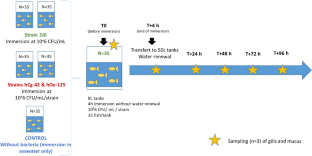
The European sea bass (Dicentrarchus labrax), one of the most produced marine fish species in Europe, is acutely vulnerable to multiple infectious hazards. In this study, we investigated the potential probiotic effect of some marine Pseudoalteromonas bacterial strains against two major pathogens of this species, Vibrio harveyi and the nervous necrosis virus (NNV), and examined their antibiofilm effect. Impregnation phase was done by repeated immersion of juvenile's sea bass during 8 to 12 weeks in seawater containing the probiotic candidates at a concentration of 106 CFU/mL. Four candidates were tested: (1) a combination of two strains producing antimicrobial compounds, hCg-42 and hOe-125; (2) strain 3J6, with known antibiofilm properties; (3) strain RA15, from the same genus, but with no identified probiotic effect; and (4) a control group without probiotics. At the end of the impregnation phase, fish underwent an infection challenge with V. harveyi or with a pathogenic strain of NNV and mortality was monitored. For the V. harveyi challenge, improved survival rates of 10 and 25% were obtained for the RA15 and the mix hCg-42 + hOe-125-impregnated groups, respectively. For the NNV challenge, no significant benefic effect of the probiotics on infection kinetics or cumulative mortality was observed. At the end of the impregnation phase, the maximal thickness of biofilm was significantly lower in the 3J6, double strain, and RA15 groups, compared with the non-impregnated control group. This study highlights the interesting probiotic potential of marine bacteria to limit mortalities induced by bacterial pathogens as well as biofilm development.
期刊介绍:
Probiotics and Antimicrobial Proteins publishes reviews, original articles, letters and short notes and technical/methodological communications aimed at advancing fundamental knowledge and exploration of the applications of probiotics, natural antimicrobial proteins and their derivatives in biomedical, agricultural, veterinary, food, and cosmetic products. The Journal welcomes fundamental research articles and reports on applications of these microorganisms and substances, and encourages structural studies and studies that correlate the structure and functional properties of antimicrobial proteins.



 京公网安备 11010802042870号
京ICP备2023020795号-1
京公网安备 11010802042870号
京ICP备2023020795号-1

 分享
分享
 求助内容:
求助内容: 应助结果提醒方式:
 扫码关注我们
