{"title":"Comprehensive Analysis of TIFY Transcription Factors and Their Expression Profiles under Jasmonic Acid and Abiotic Stresses in Watermelon","authors":"Youxin Yang, Golam Jalal Ahammed, Chunpeng Wan, Haoju Liu, Rongrong Chen, Yong Zhou","doi":"10.1155/2019/6813086","DOIUrl":null,"url":null,"abstract":"<div>\n <p>The <i>TIFY</i> gene family is plant-specific and encodes proteins involved in the regulation of multiple biological processes. Here, we identified 15 <i>TIFY</i> genes in the watermelon genome, which were divided into four subfamilies (eight JAZs, four ZMLs, two TIFYs, and one PPD) in the phylogenetic tree. The <i>ClTIFY</i> genes were unevenly located on eight chromosomes, and three segmental duplication events and one tandem duplication event were identified, suggesting that gene duplication plays a vital role in the expansion of the <i>TIFY</i> gene family in watermelon. Further analysis of the protein architectures, conserved domains, and gene structures provided additional clues for understanding the putative functions of the TIFY family members. Analysis of qRT-PCR and RNA-seq data revealed that the detected <i>ClTIFY</i> genes had preferential expression in specific tissues. qRT-PCR analysis revealed that nine selected <i>TIFY</i> genes were responsive to jasmonic acid (JA) and abiotic stresses including salt and drought. JA activated eight genes and suppressed one gene, among which <i>ClJAZ1</i> and <i>ClJAZ7</i> were the most significantly induced. Salt and drought stress activated nearly all the detected genes to different degrees. These results lay a foundation for further functional characterization of <i>TIFY</i> family genes in <i>Citrullus lanatus</i>.</p>\n </div>","PeriodicalId":55239,"journal":{"name":"Comparative and Functional Genomics","volume":"2019 1","pages":""},"PeriodicalIF":0.0000,"publicationDate":"2019-10-01","publicationTypes":"Journal Article","fieldsOfStudy":null,"isOpenAccess":false,"openAccessPdf":"https://onlinelibrary.wiley.com/doi/epdf/10.1155/2019/6813086","citationCount":"0","resultStr":null,"platform":"Semanticscholar","paperid":null,"PeriodicalName":"Comparative and Functional Genomics","FirstCategoryId":"1085","ListUrlMain":"https://onlinelibrary.wiley.com/doi/10.1155/2019/6813086","RegionNum":0,"RegionCategory":null,"ArticlePicture":[],"TitleCN":null,"AbstractTextCN":null,"PMCID":null,"EPubDate":"","PubModel":"","JCR":"","JCRName":"","Score":null,"Total":0}
引用次数: 0
Abstract
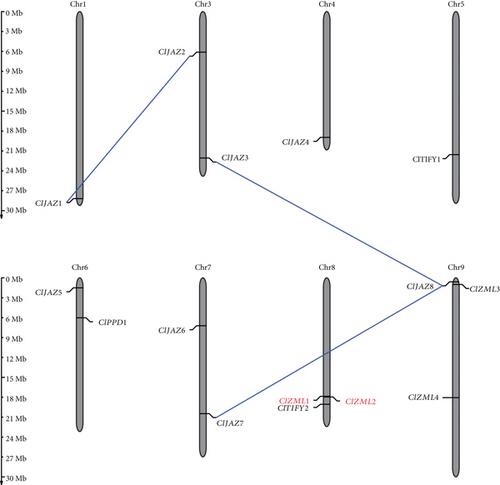
The TIFY gene family is plant-specific and encodes proteins involved in the regulation of multiple biological processes. Here, we identified 15 TIFY genes in the watermelon genome, which were divided into four subfamilies (eight JAZs, four ZMLs, two TIFYs, and one PPD) in the phylogenetic tree. The ClTIFY genes were unevenly located on eight chromosomes, and three segmental duplication events and one tandem duplication event were identified, suggesting that gene duplication plays a vital role in the expansion of the TIFY gene family in watermelon. Further analysis of the protein architectures, conserved domains, and gene structures provided additional clues for understanding the putative functions of the TIFY family members. Analysis of qRT-PCR and RNA-seq data revealed that the detected ClTIFY genes had preferential expression in specific tissues. qRT-PCR analysis revealed that nine selected TIFY genes were responsive to jasmonic acid (JA) and abiotic stresses including salt and drought. JA activated eight genes and suppressed one gene, among which ClJAZ1 and ClJAZ7 were the most significantly induced. Salt and drought stress activated nearly all the detected genes to different degrees. These results lay a foundation for further functional characterization of TIFY family genes in Citrullus lanatus.




 京公网安备 11010802042870号
京ICP备2023020795号-1
京公网安备 11010802042870号
京ICP备2023020795号-1

 分享
分享
 求助内容:
求助内容: 应助结果提醒方式:
 扫码关注我们
