Alla G. Oleinik, Evgeniia I. Bondar, Andrey D. Kukhlevsky, Lubov A. Skurikhina, Natalia E. Kovpak
{"title":"Introgressive hybridization between two phylogenetic lineages of charrs (Salvelinus: Salmonidae) in northeastern Asia","authors":"Alla G. Oleinik, Evgeniia I. Bondar, Andrey D. Kukhlevsky, Lubov A. Skurikhina, Natalia E. Kovpak","doi":"10.1111/jzs.12563","DOIUrl":null,"url":null,"abstract":"<p>Many lacustrine charrs of the genus <i>Salvelinus</i> were described as separate species, and their origin and phylogenetic relationships are still under debate. In this study, we described the genetic variation of charrs from Lake Grand (Elikchan Lake Group, the mainland coast of the Sea of Okhotsk, Russia) and several locations outside of this system based on eight microsatellite (ms) loci and mitochondrial (mt) DNA control region. We tested the hypothesis of the resident charr membership to (a) the Arctic lineage of <i>Salvelinus taranetzi</i> sensu (Oleinik et al., <i>Russian Journal of Genetics</i>, 51, 2015, 55); (b) the Bering lineage of the Northern Dolly Varden <i>Salvelinus malma malma</i>; and (c) the Atlantic lineage of the Arctic charr <i>Salvelinus alpinus</i>. Analysis of phylogenetic relationships based on the mtDNA control region showed that all individuals from Lake Grand grouped with the Bering lineage. Bayesian analysis using msDNA supports the clustering together of charrs from Lake Grand and Arctic lineage, regardless of their mtDNA haplotypes. Incongruence between mtDNA and msDNA markers provided strong evidence of historical mtDNA introgression from <i>S</i>. <i>malma malma</i> to <i>S</i>. <i>taranetzi</i>. Patterns of divergence confirm a postglacial secondary contact of the representatives of Arctic and Bering lineages in the area of the Sea of Okhotsk coast and past hybridization in Lake Grand with the following features: (a) complete fixation of introgressed mtDNA of one species within populations of another and (b) absence of modern population of <i>S</i>. <i>malma malma</i> in the lake.</p>","PeriodicalId":91350,"journal":{"name":"","volume":"59 8","pages":"2119-2133"},"PeriodicalIF":0.0,"publicationDate":"2021-11-24","publicationTypes":"Journal Article","fieldsOfStudy":null,"isOpenAccess":false,"openAccessPdf":"","citationCount":"1","resultStr":null,"platform":"Semanticscholar","paperid":null,"PeriodicalName":"","FirstCategoryId":"99","ListUrlMain":"https://onlinelibrary.wiley.com/doi/10.1111/jzs.12563","RegionNum":0,"RegionCategory":null,"ArticlePicture":[],"TitleCN":null,"AbstractTextCN":null,"PMCID":null,"EPubDate":"","PubModel":"","JCR":"","JCRName":"","Score":null,"Total":0}
引用次数: 1
Abstract
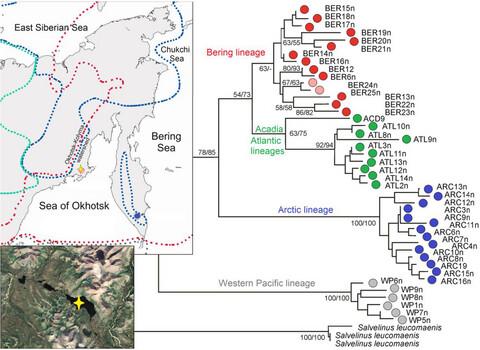
Many lacustrine charrs of the genus Salvelinus were described as separate species, and their origin and phylogenetic relationships are still under debate. In this study, we described the genetic variation of charrs from Lake Grand (Elikchan Lake Group, the mainland coast of the Sea of Okhotsk, Russia) and several locations outside of this system based on eight microsatellite (ms) loci and mitochondrial (mt) DNA control region. We tested the hypothesis of the resident charr membership to (a) the Arctic lineage of Salvelinus taranetzi sensu (Oleinik et al., Russian Journal of Genetics, 51, 2015, 55); (b) the Bering lineage of the Northern Dolly Varden Salvelinus malma malma; and (c) the Atlantic lineage of the Arctic charr Salvelinus alpinus. Analysis of phylogenetic relationships based on the mtDNA control region showed that all individuals from Lake Grand grouped with the Bering lineage. Bayesian analysis using msDNA supports the clustering together of charrs from Lake Grand and Arctic lineage, regardless of their mtDNA haplotypes. Incongruence between mtDNA and msDNA markers provided strong evidence of historical mtDNA introgression from S. malma malma to S. taranetzi. Patterns of divergence confirm a postglacial secondary contact of the representatives of Arctic and Bering lineages in the area of the Sea of Okhotsk coast and past hybridization in Lake Grand with the following features: (a) complete fixation of introgressed mtDNA of one species within populations of another and (b) absence of modern population of S. malma malma in the lake.



 京公网安备 11010802042870号
京ICP备2023020795号-1
京公网安备 11010802042870号
京ICP备2023020795号-1

 分享
分享
 求助内容:
求助内容: 应助结果提醒方式:
 扫码关注我们
