Erick R. S. Santos, José C. B. Dubeux Jr., Cheryl Mackowiak, Lynn E. Sollenberger, Gustavo D. Farias, Bruno G. C. Homem, David M. Jaramillo, Luana Q. S. D. Zagato, Luana M. Dantas Queiroz, David L. Wright, Nicolas DiLorenzo, Martin Ruiz-Moreno
{"title":"Above and belowground litter decomposition of cover crops grazed at different intensities","authors":"Erick R. S. Santos, José C. B. Dubeux Jr., Cheryl Mackowiak, Lynn E. Sollenberger, Gustavo D. Farias, Bruno G. C. Homem, David M. Jaramillo, Luana Q. S. D. Zagato, Luana M. Dantas Queiroz, David L. Wright, Nicolas DiLorenzo, Martin Ruiz-Moreno","doi":"10.1111/gfs.12617","DOIUrl":null,"url":null,"abstract":"<p>Grazing cover crops may increase land-use efficiency while promoting sustainability. We investigated how grazing intensity affects cover crop litter quantity, quality, decomposition, and cotton (<i>Gossypium hirsutum</i> L.) N uptake. Cover crops were a mixture of rye (<i>Secale cereale</i> L.) and oat (<i>Avena sativa</i> L.) managed as follows: no grazing +34 kg N ha<sup>−1</sup> (NG34), no grazing +90 kg N ha<sup>−1</sup> (NG90), heavy grazing (HG), moderate grazing (MG), and light grazing (LG). Grazed treatments received 90 kg N ha<sup>−1</sup>. After cover crop termination, above- and belowground litter was collected and incubated in situ for 0, 4, 8, 16, 32, 64, and 128 days, with cotton plants sampled on the same days to estimate N recovery and synchrony between N release from litter and uptake by cotton. By Day 128, only 13% of initial NG34 aboveground biomass had disappeared, whereas 42% of HG disappeared. Nitrogen retained in aboveground litter of HG was less than NG90 (27 vs. 60 kg N ha<sup>−1</sup>), and aboveground final N stock (at Day 128) of HG was less than NG90 and LG (16, 47, and 41 kg N ha<sup>−1</sup>, respectively). Belowground litter contributed 98 kg N ha<sup>−1</sup> versus 46 for aboveground. Belowground N disappearance from litter bags was greater from NG90 than NG34 (39 vs. 21 kg N ha<sup>−1</sup>). Cotton N uptake by Day 128 was similar across treatments (191 kg N ha<sup>−1</sup>). Grazing cover crops impact aboveground litter quantity, quality, and decomposition rates, and belowground litter plays an important role on the N cycling.</p>","PeriodicalId":12767,"journal":{"name":"Grass and Forage Science","volume":"78 3","pages":"376-389"},"PeriodicalIF":2.9000,"publicationDate":"2023-05-31","publicationTypes":"Journal Article","fieldsOfStudy":null,"isOpenAccess":false,"openAccessPdf":"https://onlinelibrary.wiley.com/doi/epdf/10.1111/gfs.12617","citationCount":"0","resultStr":null,"platform":"Semanticscholar","paperid":null,"PeriodicalName":"Grass and Forage Science","FirstCategoryId":"97","ListUrlMain":"https://onlinelibrary.wiley.com/doi/10.1111/gfs.12617","RegionNum":3,"RegionCategory":"农林科学","ArticlePicture":[],"TitleCN":null,"AbstractTextCN":null,"PMCID":null,"EPubDate":"","PubModel":"","JCR":"Q1","JCRName":"AGRONOMY","Score":null,"Total":0}
引用次数: 0
Abstract
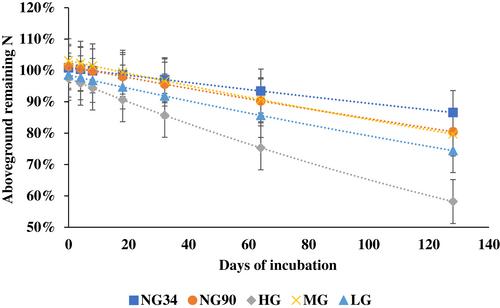
Grazing cover crops may increase land-use efficiency while promoting sustainability. We investigated how grazing intensity affects cover crop litter quantity, quality, decomposition, and cotton (Gossypium hirsutum L.) N uptake. Cover crops were a mixture of rye (Secale cereale L.) and oat (Avena sativa L.) managed as follows: no grazing +34 kg N ha−1 (NG34), no grazing +90 kg N ha−1 (NG90), heavy grazing (HG), moderate grazing (MG), and light grazing (LG). Grazed treatments received 90 kg N ha−1. After cover crop termination, above- and belowground litter was collected and incubated in situ for 0, 4, 8, 16, 32, 64, and 128 days, with cotton plants sampled on the same days to estimate N recovery and synchrony between N release from litter and uptake by cotton. By Day 128, only 13% of initial NG34 aboveground biomass had disappeared, whereas 42% of HG disappeared. Nitrogen retained in aboveground litter of HG was less than NG90 (27 vs. 60 kg N ha−1), and aboveground final N stock (at Day 128) of HG was less than NG90 and LG (16, 47, and 41 kg N ha−1, respectively). Belowground litter contributed 98 kg N ha−1 versus 46 for aboveground. Belowground N disappearance from litter bags was greater from NG90 than NG34 (39 vs. 21 kg N ha−1). Cotton N uptake by Day 128 was similar across treatments (191 kg N ha−1). Grazing cover crops impact aboveground litter quantity, quality, and decomposition rates, and belowground litter plays an important role on the N cycling.
放牧覆盖作物可以提高土地利用效率,同时促进可持续性。研究了放牧强度对覆盖作物凋落物数量、质量、分解和棉花的影响。N吸收。覆盖作物为黑麦(Secale cereale L.)和燕麦(Avena sativa L.)的杂交作物,管理方式为:不放牧+34 kg N ha - 1 (NG34)、不放牧+90 kg N ha - 1 (NG90)、重度放牧(HG)、中度放牧(MG)和轻度放牧(LG)。放牧处理N ha - 1为90 kg。在覆盖作物终止后,收集地上和地下凋落物,原位孵育0、4、8、16、32、64和128 d,并在同一天取样棉花植株,以评估凋落物氮的恢复以及棉花对凋落物氮释放与吸收之间的同步。到第128天,只有13%的初始NG34地上生物量消失,而42%的HG消失。HG处理的地上凋落物中氮保留量小于NG90 (27 vs. 60 kg N ha−1),地上最终氮储量(第128天)小于NG90和LG(分别为16、47和41 kg N ha−1)。地下凋落物贡献98 kg N ha - 1,地上贡献46 kg N ha - 1。NG90处理凋落物袋的地下氮消失量大于NG34处理(39 vs 21 kg N ha−1)。第128天,不同处理的棉花氮素吸收量相似(191 kg N ha - 1)。放牧覆盖作物影响地上凋落物的数量、质量和分解速率,地下凋落物对氮循环起重要作用。
期刊介绍:
Grass and Forage Science is a major English language journal that publishes the results of research and development in all aspects of grass and forage production, management and utilization; reviews of the state of knowledge on relevant topics; and book reviews. Authors are also invited to submit papers on non-agricultural aspects of grassland management such as recreational and amenity use and the environmental implications of all grassland systems. The Journal considers papers from all climatic zones.



 京公网安备 11010802042870号
京ICP备2023020795号-1
京公网安备 11010802042870号
京ICP备2023020795号-1

 分享
分享
 求助内容:
求助内容: 应助结果提醒方式:
 扫码关注我们
