Peter L. Weber, Cecilie Hermansen, Charles Pesch, Per Moldrup, Mogens H. Greve, Natasha H. Blaesbjerg, Gabriela Moreno Romero, Emmanuel Arthur, Lis Wollesen de Jonge
{"title":"Glacial rock flour reduces the hydrophobicity of Greenlandic cultivated soils","authors":"Peter L. Weber, Cecilie Hermansen, Charles Pesch, Per Moldrup, Mogens H. Greve, Natasha H. Blaesbjerg, Gabriela Moreno Romero, Emmanuel Arthur, Lis Wollesen de Jonge","doi":"10.1002/saj2.20505","DOIUrl":null,"url":null,"abstract":"<p>Soil water repellency (WR) is ubiquitous across Greenlandic cultivated fields, which may constrain agricultural production. Fine-grained glacial rock flour (GRF) is available in the surrounding landscape, which could serve as a soil amendment. We tested whether the application of GRF (rates of 0, 50, 100, 300, and 500 ton ha<sup>−1</sup>) reduced the WR across two field trials in South Greenland. The field trials, Upernaviarsuk (UP) and South Igaliku (SI), differed in clay (UP: 0.05–0.11 kg kg<sup>−1</sup>; SI: 0.03–0.05 kg kg<sup>−1</sup>) and organic carbon (OC) contents (UP: 0.04–0.13 kg kg<sup>−1</sup>; SI: 0.01–0.03 kg kg<sup>−1</sup>). We measured WR across gravimetric water contents (W) from oven-dry to the W where WR ceased (W<sub>NON</sub>) to obtain whole WR-W curves. Most soils became hydrophilic around air-dry conditions at application rates of ≥300 ton ha<sup>−1</sup>, likely due to increased clay:OC ratios. Application rates of ≥300 ton ha<sup>−1</sup> generally reduced the trapezoidal integrated area of the WR-W curve (WR<sub>AREA</sub>), W<sub>NON,</sub> and WR after heat treatments at 105°C (WR<sub>105</sub>) and 60°C (WR<sub>60</sub>). The WR<sub>105</sub> was significantly reduced in both fields at 500 ton ha<sup>−1</sup>, while WR<sub>60</sub> was significantly reduced in UP at application rates of ≥300 ton ha<sup>−1</sup>. The GRF effects were masked by texture and OC variations. Normalizing WR<sub>AREA</sub> to the water vapor sorption isotherms (utilizing the Campbell-Shiozawa model) revealed that GRF consistently reduced the normalized WR<sub>AREA</sub>. The SI field showed the largest reduction in the normalized WR<sub>AREA</sub>, likely due to its lower OC and clay contents. Thus, GRF could reduce WR across two Greenlandic field trials.</p>","PeriodicalId":101043,"journal":{"name":"Proceedings - Soil Science Society of America","volume":"87 3","pages":"439-452"},"PeriodicalIF":0.0000,"publicationDate":"2022-11-23","publicationTypes":"Journal Article","fieldsOfStudy":null,"isOpenAccess":false,"openAccessPdf":"https://onlinelibrary.wiley.com/doi/epdf/10.1002/saj2.20505","citationCount":"0","resultStr":null,"platform":"Semanticscholar","paperid":null,"PeriodicalName":"Proceedings - Soil Science Society of America","FirstCategoryId":"1085","ListUrlMain":"https://onlinelibrary.wiley.com/doi/10.1002/saj2.20505","RegionNum":0,"RegionCategory":null,"ArticlePicture":[],"TitleCN":null,"AbstractTextCN":null,"PMCID":null,"EPubDate":"","PubModel":"","JCR":"","JCRName":"","Score":null,"Total":0}
引用次数: 0
Abstract
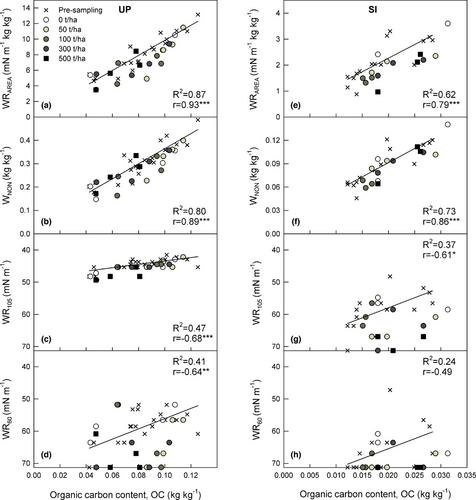
Soil water repellency (WR) is ubiquitous across Greenlandic cultivated fields, which may constrain agricultural production. Fine-grained glacial rock flour (GRF) is available in the surrounding landscape, which could serve as a soil amendment. We tested whether the application of GRF (rates of 0, 50, 100, 300, and 500 ton ha−1) reduced the WR across two field trials in South Greenland. The field trials, Upernaviarsuk (UP) and South Igaliku (SI), differed in clay (UP: 0.05–0.11 kg kg−1; SI: 0.03–0.05 kg kg−1) and organic carbon (OC) contents (UP: 0.04–0.13 kg kg−1; SI: 0.01–0.03 kg kg−1). We measured WR across gravimetric water contents (W) from oven-dry to the W where WR ceased (WNON) to obtain whole WR-W curves. Most soils became hydrophilic around air-dry conditions at application rates of ≥300 ton ha−1, likely due to increased clay:OC ratios. Application rates of ≥300 ton ha−1 generally reduced the trapezoidal integrated area of the WR-W curve (WRAREA), WNON, and WR after heat treatments at 105°C (WR105) and 60°C (WR60). The WR105 was significantly reduced in both fields at 500 ton ha−1, while WR60 was significantly reduced in UP at application rates of ≥300 ton ha−1. The GRF effects were masked by texture and OC variations. Normalizing WRAREA to the water vapor sorption isotherms (utilizing the Campbell-Shiozawa model) revealed that GRF consistently reduced the normalized WRAREA. The SI field showed the largest reduction in the normalized WRAREA, likely due to its lower OC and clay contents. Thus, GRF could reduce WR across two Greenlandic field trials.
土壤拒水现象普遍存在于格陵兰的耕地中,严重制约了农业生产。细粒冰川岩粉(GRF)在周围的景观中可用,可以作为土壤改良剂。我们在南格陵兰岛的两个田间试验中测试了GRF(0、50、100、300和500吨公顷−1)的施用是否降低了WR。田间试验品种Upernaviarsuk (UP)和South Igaliku (SI)的粘土含量不同(UP: 0.05-0.11 kg kg−1;SI: 0.03-0.05 kg kg - 1)和有机碳(OC)含量(UP: 0.04-0.13 kg kg - 1;SI: 0.01 ~ 0.03 kg (kg−1)。我们测量了从烘箱干燥到WR停止(WNON)的重量含水量(W)的WR,以获得整个WR-W曲线。在空气干燥条件下,当施肥量≥300吨ha - 1时,大多数土壤变得亲水,这可能是由于粘土:碳含量比的增加。在105℃(WR105)和60℃(WR60)热处理后,施用量≥300 t ha - 1普遍降低了WR- w曲线的梯形积分面积(WRAREA)、WNON和WR。当施用量为500 t ha - 1时,两个田的WR105显著降低,而当施用量≥300 t ha - 1时,WR60显著降低。GRF效应被纹理和OC的变化所掩盖。将WRAREA归一化到水蒸气吸收等温线(利用Campbell-Shiozawa模式)显示,GRF持续降低归一化WRAREA。SI场的归一化WRAREA减小幅度最大,可能是由于其较低的OC和粘土含量。因此,GRF可以在格陵兰的两个田间试验中降低水比。



 京公网安备 11010802042870号
京ICP备2023020795号-1
京公网安备 11010802042870号
京ICP备2023020795号-1

 分享
分享

 求助内容:
求助内容: 应助结果提醒方式:
 扫码关注我们
