{"title":"Label-free Assessment of the Nascent State of Rat Non-alcoholic Fatty Liver Disease Using Spontaneous Raman Microscopy.","authors":"Masashi Takemura, Kentaro Mochizuki, Yoshinori Harada, Akira Okajima, Michiyo Hayakawa, Ping Dai, Yoshito Itoh, Hideo Tanaka","doi":"10.1267/ahc.22-00013","DOIUrl":null,"url":null,"abstract":"<p><p>Spontaneous Raman microscopy, which can detect molecular vibrations in cells and tissues, could be a useful tool for the label-free assessment of non-alcoholic fatty liver disease (NAFLD). However, it is unclear whether it can be used to evaluate the nascent state of NAFLD. To address this, we analyzed the Raman spectra of rat liver tissues in the nascent state of NAFLD upon excitation at 532 nm. Raman and histochemical analyses were performed of liver tissues from rats fed a high-fat, high-cholesterol diet (HFHCD). Raman microscopic imaging analysis of formalin-fixed thin tissue slices showed hepatic steatosis, as revealed by the Raman band at 2,854 cm<sup>-1</sup>, whereas lipid droplets were not detectable by hematoxylin-eosin staining of images until 3 days after feeding a HFHCD. Raman signals of retinol at 1,588 cm<sup>-1</sup> emitted from hepatic stellate cells were distributed alongside hepatic cords; the retinol content rapidly decreased after feeding a HFHCD, whereas hepatic lipid content increased inversely. Raman microscopic analysis of the surface of fresh <i>ex vivo</i> livers enabled early detection of lipid accumulation after a 1-day feeding a HFHCD. In conclusion, spontaneous Raman microscopy can be applied to the label-free evaluation of the nascent state of NAFLD liver tissues.</p>","PeriodicalId":545,"journal":{"name":"Environmental Science and Pollution Research","volume":"24 27","pages":"57-66"},"PeriodicalIF":5.8000,"publicationDate":"2022-04-27","publicationTypes":"Journal Article","fieldsOfStudy":null,"isOpenAccess":false,"openAccessPdf":"https://www.ncbi.nlm.nih.gov/pmc/articles/PMC9043435/pdf/","citationCount":"0","resultStr":null,"platform":"Semanticscholar","paperid":null,"PeriodicalName":"Environmental Science and Pollution Research","FirstCategoryId":"99","ListUrlMain":"https://doi.org/10.1267/ahc.22-00013","RegionNum":3,"RegionCategory":"环境科学与生态学","ArticlePicture":[],"TitleCN":null,"AbstractTextCN":null,"PMCID":null,"EPubDate":"2022/4/22 0:00:00","PubModel":"Epub","JCR":"0","JCRName":"ENVIRONMENTAL SCIENCES","Score":null,"Total":0}
引用次数: 0
Abstract
Spontaneous Raman microscopy, which can detect molecular vibrations in cells and tissues, could be a useful tool for the label-free assessment of non-alcoholic fatty liver disease (NAFLD). However, it is unclear whether it can be used to evaluate the nascent state of NAFLD. To address this, we analyzed the Raman spectra of rat liver tissues in the nascent state of NAFLD upon excitation at 532 nm. Raman and histochemical analyses were performed of liver tissues from rats fed a high-fat, high-cholesterol diet (HFHCD). Raman microscopic imaging analysis of formalin-fixed thin tissue slices showed hepatic steatosis, as revealed by the Raman band at 2,854 cm-1, whereas lipid droplets were not detectable by hematoxylin-eosin staining of images until 3 days after feeding a HFHCD. Raman signals of retinol at 1,588 cm-1 emitted from hepatic stellate cells were distributed alongside hepatic cords; the retinol content rapidly decreased after feeding a HFHCD, whereas hepatic lipid content increased inversely. Raman microscopic analysis of the surface of fresh ex vivo livers enabled early detection of lipid accumulation after a 1-day feeding a HFHCD. In conclusion, spontaneous Raman microscopy can be applied to the label-free evaluation of the nascent state of NAFLD liver tissues.
期刊介绍:
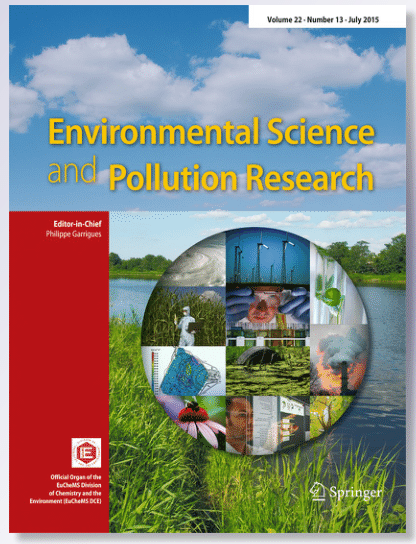
Environmental Science and Pollution Research (ESPR) serves the international community in all areas of Environmental Science and related subjects with emphasis on chemical compounds. This includes:
- Terrestrial Biology and Ecology
- Aquatic Biology and Ecology
- Atmospheric Chemistry
- Environmental Microbiology/Biobased Energy Sources
- Phytoremediation and Ecosystem Restoration
- Environmental Analyses and Monitoring
- Assessment of Risks and Interactions of Pollutants in the Environment
- Conservation Biology and Sustainable Agriculture
- Impact of Chemicals/Pollutants on Human and Animal Health
It reports from a broad interdisciplinary outlook.



 京公网安备 11010802042870号
京ICP备2023020795号-1
京公网安备 11010802042870号
京ICP备2023020795号-1

 分享
分享
 求助内容:
求助内容: 应助结果提醒方式:
 扫码关注我们
