Juul Koene, Susan Zyto, Jaap van der Stel, Natasja van Lang, Marion Ammeraal, Ralph W Kupka, Jaap van Weeghel
{"title":"The relations between executive functions and occupational functioning in individuals with bipolar disorder: a scoping review.","authors":"Juul Koene, Susan Zyto, Jaap van der Stel, Natasja van Lang, Marion Ammeraal, Ralph W Kupka, Jaap van Weeghel","doi":"10.1186/s40345-022-00255-7","DOIUrl":null,"url":null,"abstract":"<p><strong>Background: </strong>Patients with bipolar disorder experience impairments in their occupational functioning, despite remission of symptoms. Previous research has shown that neurocognitive deficits, especially deficits in executive functions, may persist during euthymia and are associated with diminished occupational functioning.</p><p><strong>Objectives: </strong>The aim of this scoping review was to identify published studies that report on the relationships between executive functions and occupational functioning in BD to review current knowledge and identify knowledge gaps. In addition to traditional neuropsychological approaches, we aimed to describe executive functioning from a self-regulation perspective, including emotion regulation.</p><p><strong>Methods: </strong>We applied the methodological framework as described by Arksey and O'Malley (Int J Soc Res Methodol Theory Pract 8:19-32, 2005) and Levac et al. (Implement Sci 5:1-9, 2010). We searched PubMed and psycINFO for literature up to November 2021, after which we screened papers based on inclusion criteria. Two reviewers independently performed the screening process, data charting process, and synthesis of results.</p><p><strong>Results: </strong>The search yielded 1202 references after deduplication, of which 222 remained after initial screening. The screening and inclusion process yielded 82 eligible papers in which relationships between executive functions and occupational functioning are examined.</p><p><strong>Conclusion: </strong>Neurocognitive deficits, including in executive functions and self-regulation, are associated with and predictive of diminished occupational functioning. Definitions and measurements for neurocognitive functions and occupational functioning differ greatly between studies, which complicates comparisons. Studies on functional remediation show promising results for improving occupational functioning in patients with BD. In research and clinical practice more attention is needed towards the quality of work functioning and the various contexts in which patients with BD experience deficits.</p>","PeriodicalId":13944,"journal":{"name":"International Journal of Bipolar Disorders","volume":" ","pages":"8"},"PeriodicalIF":3.5000,"publicationDate":"2022-03-14","publicationTypes":"Journal Article","fieldsOfStudy":null,"isOpenAccess":false,"openAccessPdf":"https://www.ncbi.nlm.nih.gov/pmc/articles/PMC8921376/pdf/","citationCount":"0","resultStr":null,"platform":"Semanticscholar","paperid":null,"PeriodicalName":"International Journal of Bipolar Disorders","FirstCategoryId":"3","ListUrlMain":"https://doi.org/10.1186/s40345-022-00255-7","RegionNum":2,"RegionCategory":"医学","ArticlePicture":[],"TitleCN":null,"AbstractTextCN":null,"PMCID":null,"EPubDate":"","PubModel":"","JCR":"Q2","JCRName":"PSYCHIATRY","Score":null,"Total":0}
引用次数: 0
Abstract
Background: Patients with bipolar disorder experience impairments in their occupational functioning, despite remission of symptoms. Previous research has shown that neurocognitive deficits, especially deficits in executive functions, may persist during euthymia and are associated with diminished occupational functioning.
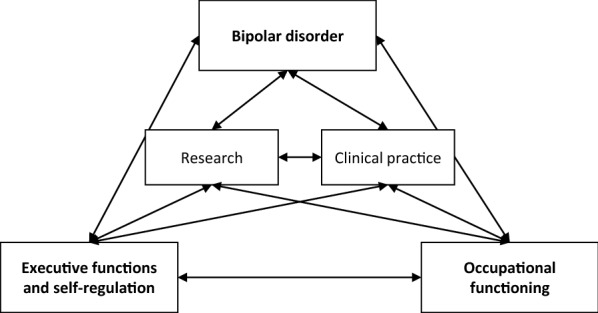
Objectives: The aim of this scoping review was to identify published studies that report on the relationships between executive functions and occupational functioning in BD to review current knowledge and identify knowledge gaps. In addition to traditional neuropsychological approaches, we aimed to describe executive functioning from a self-regulation perspective, including emotion regulation.
Methods: We applied the methodological framework as described by Arksey and O'Malley (Int J Soc Res Methodol Theory Pract 8:19-32, 2005) and Levac et al. (Implement Sci 5:1-9, 2010). We searched PubMed and psycINFO for literature up to November 2021, after which we screened papers based on inclusion criteria. Two reviewers independently performed the screening process, data charting process, and synthesis of results.
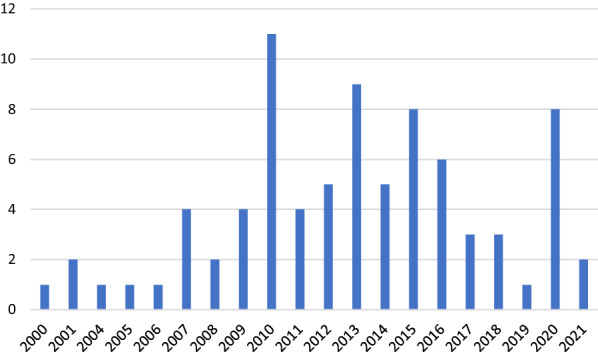
Results: The search yielded 1202 references after deduplication, of which 222 remained after initial screening. The screening and inclusion process yielded 82 eligible papers in which relationships between executive functions and occupational functioning are examined.
Conclusion: Neurocognitive deficits, including in executive functions and self-regulation, are associated with and predictive of diminished occupational functioning. Definitions and measurements for neurocognitive functions and occupational functioning differ greatly between studies, which complicates comparisons. Studies on functional remediation show promising results for improving occupational functioning in patients with BD. In research and clinical practice more attention is needed towards the quality of work functioning and the various contexts in which patients with BD experience deficits.
背景:双相情感障碍患者经历他们的职业功能受损,尽管症状缓解。先前的研究表明,神经认知缺陷,特别是执行功能的缺陷,可能在精神状态期间持续存在,并与职业功能减退有关。目的:本综述的目的是确定已发表的关于双相障碍中执行功能和职业功能之间关系的研究,以回顾当前的知识并确定知识差距。除了传统的神经心理学方法,我们旨在从自我调节的角度来描述执行功能,包括情绪调节。方法:采用Arksey和O'Malley (Int J Soc Res methodology Theory practice 8:19-32, 2005)和Levac et al. (implementation Sci 5:1-9, 2010)所描述的方法框架。我们检索了PubMed和psycINFO截至2021年11月的文献,之后我们根据纳入标准筛选论文。两名审稿人独立进行筛选过程、数据制图过程和结果综合。结果:重删后检索到文献1202篇,初步筛选后保留文献222篇。筛选和纳入过程产生了82篇合格的论文,其中检查了执行功能和职业功能之间的关系。结论:包括执行功能和自我调节在内的神经认知缺陷与职业功能减退有关,并预示着职业功能减退。神经认知功能和职业功能的定义和测量在不同的研究中差异很大,这使得比较变得复杂。功能修复的研究在改善双相障碍患者的职业功能方面显示出良好的结果。在研究和临床实践中,需要更多地关注工作功能的质量以及双相障碍患者经历缺陷的各种环境。
期刊介绍:
The International Journal of Bipolar Disorders is a peer-reviewed, open access online journal published under the SpringerOpen brand. It publishes contributions from the broad range of clinical, psychological and biological research in bipolar disorders. It is the official journal of the ECNP-ENBREC (European Network of Bipolar Research Expert Centres ) Bipolar Disorders Network, the International Group for the study of Lithium Treated Patients (IGSLi) and the Deutsche Gesellschaft für Bipolare Störungen (DGBS) and invites clinicians and researchers from around the globe to submit original research papers, short research communications, reviews, guidelines, case reports and letters to the editor that help to enhance understanding of bipolar disorders.





 京公网安备 11010802042870号
京ICP备2023020795号-1
京公网安备 11010802042870号
京ICP备2023020795号-1

 分享
分享
 求助内容:
求助内容: 应助结果提醒方式:
 扫码关注我们
