Marwa M Seyam, Noha E Esheba, Manal A Eid, Mamdouh A Gabr
{"title":"Red cell distribution width, neutrophil lymphocyte ratio and interleukin 10 are good prognostic markers in multiple myeloma.","authors":"Marwa M Seyam, Noha E Esheba, Manal A Eid, Mamdouh A Gabr","doi":"10.37796/2211-8039.1405","DOIUrl":null,"url":null,"abstract":"Background Multiple myeloma (MM) is still an incurable disease so we need to continue developing new diagnostic and prognostic options for its management. There are multiple prognostic factors for MM, but most of them are costly and time consuming. Hence comes the urge to identify bed side and low cost prognostic tools, that is why this study was aiming to identify in Egyptian MM patients. Materials and methods The study was carried on 60 newly diagnosed multiple myeloma patients and 20 age and sex matched healthy individuals as controls. Studied subjects were subdivided into two groups: Group I: 60 multiple myeloma patients which were subdivided into three subgroups: Stage I: 10 patients, Stage II: 17 patients, Stage III: 33 patients, Group II: 20 healthy controls. Results A progressive significant increase in IL-10, RDW, NLR, and beta2 microglobulin (β2M) with disease progression from stage I towards stage III as compared to the control group. However, IL-10, RDW, and NLR have the best prognostic efficiency value regarding to sensitivity, specificity and positive predictive value when compared with β2M. Conclusions IL-10, RDW, and NLR are simple, easy and bedside tests (in the case of RDW, and NLR). They have high sensitivity and specificity when compared to β2M, which is a well-established prognostic factor that highlights the valuable role they play as prognostic markers in MM.","PeriodicalId":2,"journal":{"name":"ACS Applied Bio Materials","volume":" ","pages":"34-39"},"PeriodicalIF":4.7000,"publicationDate":"2023-06-01","publicationTypes":"Journal Article","fieldsOfStudy":null,"isOpenAccess":false,"openAccessPdf":"https://www.ncbi.nlm.nih.gov/pmc/articles/PMC10627206/pdf/","citationCount":"0","resultStr":null,"platform":"Semanticscholar","paperid":null,"PeriodicalName":"ACS Applied Bio Materials","FirstCategoryId":"1085","ListUrlMain":"https://doi.org/10.37796/2211-8039.1405","RegionNum":0,"RegionCategory":null,"ArticlePicture":[],"TitleCN":null,"AbstractTextCN":null,"PMCID":null,"EPubDate":"2023/1/1 0:00:00","PubModel":"eCollection","JCR":"Q2","JCRName":"MATERIALS SCIENCE, BIOMATERIALS","Score":null,"Total":0}
引用次数: 0
Abstract
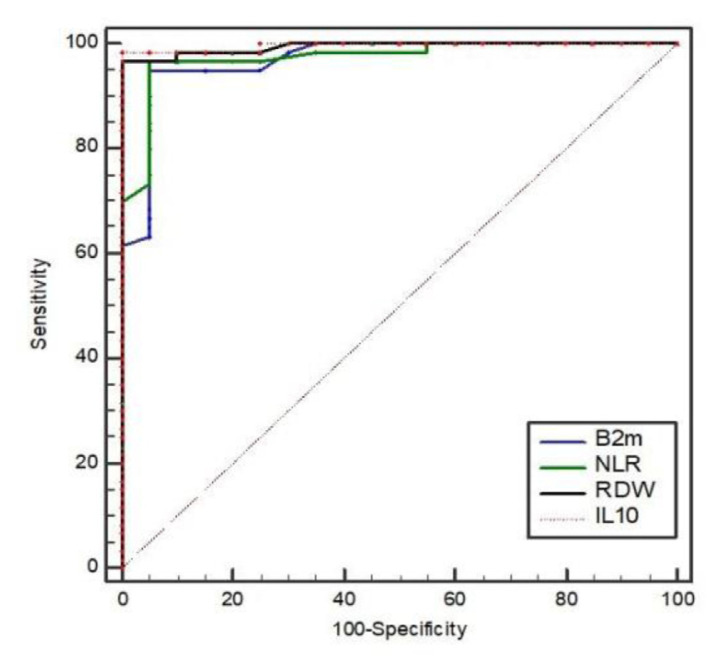
Background Multiple myeloma (MM) is still an incurable disease so we need to continue developing new diagnostic and prognostic options for its management. There are multiple prognostic factors for MM, but most of them are costly and time consuming. Hence comes the urge to identify bed side and low cost prognostic tools, that is why this study was aiming to identify in Egyptian MM patients. Materials and methods The study was carried on 60 newly diagnosed multiple myeloma patients and 20 age and sex matched healthy individuals as controls. Studied subjects were subdivided into two groups: Group I: 60 multiple myeloma patients which were subdivided into three subgroups: Stage I: 10 patients, Stage II: 17 patients, Stage III: 33 patients, Group II: 20 healthy controls. Results A progressive significant increase in IL-10, RDW, NLR, and beta2 microglobulin (β2M) with disease progression from stage I towards stage III as compared to the control group. However, IL-10, RDW, and NLR have the best prognostic efficiency value regarding to sensitivity, specificity and positive predictive value when compared with β2M. Conclusions IL-10, RDW, and NLR are simple, easy and bedside tests (in the case of RDW, and NLR). They have high sensitivity and specificity when compared to β2M, which is a well-established prognostic factor that highlights the valuable role they play as prognostic markers in MM.
期刊介绍:
ACS Applied Bio Materials is an interdisciplinary journal publishing original research covering all aspects of biomaterials and biointerfaces including and beyond the traditional biosensing, biomedical and therapeutic applications.
The journal is devoted to reports of new and original experimental and theoretical research of an applied nature that integrates knowledge in the areas of materials, engineering, physics, bioscience, and chemistry into important bio applications. The journal is specifically interested in work that addresses the relationship between structure and function and assesses the stability and degradation of materials under relevant environmental and biological conditions.




 京公网安备 11010802042870号
京ICP备2023020795号-1
京公网安备 11010802042870号
京ICP备2023020795号-1

 分享
分享
 求助内容:
求助内容: 应助结果提醒方式:
 扫码关注我们
