{"title":"Stable Möbius Bands from Isometrically Deformed Circular Helicoids","authors":"Vikash Chaurasia, Eliot Fried","doi":"10.1007/s10659-023-10008-x","DOIUrl":null,"url":null,"abstract":"<div><p>We consider the problem of producing a ruled Möbius band by subjecting an unstretchable, homogeneous, isotropic, elastic material surface material surface in a circular helicoidal reference configuration to a deformation that is isometric and chirality preserving. We find that such a Möbius band is completely determined by the unit binormal of the Frenet frame of its midline, which must be a geodesic and must have uniform torsion inversely proportional to the pitch of the helicoidal reference configuration. Granted that the energy density of the material surface depends quadratically on the mean curvature of its deformed configuration, we show that the total energy stored in producing a ruled Möbius band as described reduces, in closed form and without approximation, to an integral over the midline of the Möbius band. We formulate and numerically solve a constrained variational problem for finding relative minima of the dimensionally reduced bending energy and construct corresponding stable Möbius bands. The only input parameter entering our variational problem is the number <span>\\(\\nu \\)</span> of turns in a helicoidal reference configuration. We only find solutions if <span>\\(\\nu \\)</span> exceeds a certain threshold, which we compute to machine precision. Above that threshold, an interplay between the operative constraints leads to a multiplicity of coexisting stable solutions with <span>\\(n\\ge 3\\)</span> half twists. For each <span>\\(n\\ge 3\\)</span>, we construct an energetically optimal Möbius band which exhibits <span>\\(n\\)</span>-fold rotational symmetry. All other energy minima yield Möbius bands which lack symmetry. To our knowledge, this study contains the first examples of stable Möbius bands produced by isometrically deforming reference configurations that are not flat.</p></div>","PeriodicalId":624,"journal":{"name":"Journal of Elasticity","volume":"155 1-5","pages":"601 - 636"},"PeriodicalIF":1.4000,"publicationDate":"2023-03-21","publicationTypes":"Journal Article","fieldsOfStudy":null,"isOpenAccess":false,"openAccessPdf":"https://link.springer.com/content/pdf/10.1007/s10659-023-10008-x.pdf","citationCount":"0","resultStr":null,"platform":"Semanticscholar","paperid":null,"PeriodicalName":"Journal of Elasticity","FirstCategoryId":"5","ListUrlMain":"https://link.springer.com/article/10.1007/s10659-023-10008-x","RegionNum":3,"RegionCategory":"工程技术","ArticlePicture":[],"TitleCN":null,"AbstractTextCN":null,"PMCID":null,"EPubDate":"","PubModel":"","JCR":"Q2","JCRName":"ENGINEERING, MULTIDISCIPLINARY","Score":null,"Total":0}
引用次数: 0
Abstract
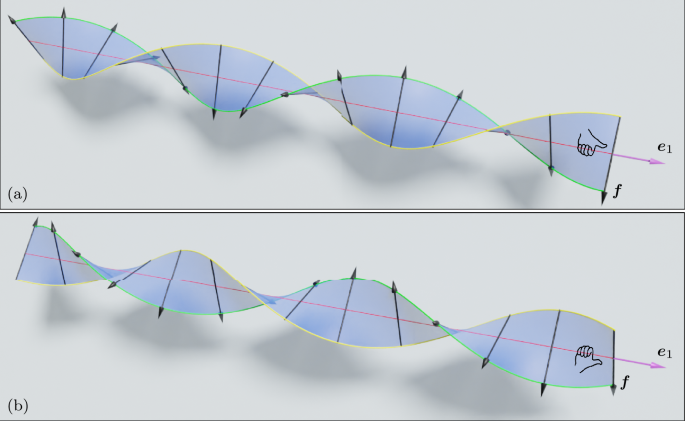
We consider the problem of producing a ruled Möbius band by subjecting an unstretchable, homogeneous, isotropic, elastic material surface material surface in a circular helicoidal reference configuration to a deformation that is isometric and chirality preserving. We find that such a Möbius band is completely determined by the unit binormal of the Frenet frame of its midline, which must be a geodesic and must have uniform torsion inversely proportional to the pitch of the helicoidal reference configuration. Granted that the energy density of the material surface depends quadratically on the mean curvature of its deformed configuration, we show that the total energy stored in producing a ruled Möbius band as described reduces, in closed form and without approximation, to an integral over the midline of the Möbius band. We formulate and numerically solve a constrained variational problem for finding relative minima of the dimensionally reduced bending energy and construct corresponding stable Möbius bands. The only input parameter entering our variational problem is the number \(\nu \) of turns in a helicoidal reference configuration. We only find solutions if \(\nu \) exceeds a certain threshold, which we compute to machine precision. Above that threshold, an interplay between the operative constraints leads to a multiplicity of coexisting stable solutions with \(n\ge 3\) half twists. For each \(n\ge 3\), we construct an energetically optimal Möbius band which exhibits \(n\)-fold rotational symmetry. All other energy minima yield Möbius bands which lack symmetry. To our knowledge, this study contains the first examples of stable Möbius bands produced by isometrically deforming reference configurations that are not flat.
期刊介绍:
The Journal of Elasticity was founded in 1971 by Marvin Stippes (1922-1979), with its main purpose being to report original and significant discoveries in elasticity. The Journal has broadened in scope over the years to include original contributions in the physical and mathematical science of solids. The areas of rational mechanics, mechanics of materials, including theories of soft materials, biomechanics, and engineering sciences that contribute to fundamental advancements in understanding and predicting the complex behavior of solids are particularly welcomed. The role of elasticity in all such behavior is well recognized and reporting significant discoveries in elasticity remains important to the Journal, as is its relation to thermal and mass transport, electromagnetism, and chemical reactions. Fundamental research that applies the concepts of physics and elements of applied mathematical science is of particular interest. Original research contributions will appear as either full research papers or research notes. Well-documented historical essays and reviews also are welcomed. Materials that will prove effective in teaching will appear as classroom notes. Computational and/or experimental investigations that emphasize relationships to the modeling of the novel physical behavior of solids at all scales are of interest. Guidance principles for content are to be found in the current interests of the Editorial Board.



 京公网安备 11010802042870号
京ICP备2023020795号-1
京公网安备 11010802042870号
京ICP备2023020795号-1

 分享
分享
 求助内容:
求助内容: 应助结果提醒方式:
 扫码关注我们
