Children with special needs and their access to rehabilitation services in the Philippines: A Q methodology study on perceived barriers by family members.
Irish Mae C Chiu, Michael P Sy, Myra D P Oruga, Sheila R Bonito
{"title":"Children with special needs and their access to rehabilitation services in the Philippines: A Q methodology study on perceived barriers by family members.","authors":"Irish Mae C Chiu, Michael P Sy, Myra D P Oruga, Sheila R Bonito","doi":"10.1002/puh2.79","DOIUrl":null,"url":null,"abstract":"<p><strong>Background: </strong>Childhood disability remains a lowly prioritized and funded international health concern in the world today. Exacerbated by poverty, a lack of bureaucratic support, and societal discrimination, rehabilitation services are not readily accessible for Filipino families who happen to have a child with disability. This article intends to determine the perceived barriers of Filipino service users when it comes to accessing rehabilitation services for children with special needs in Cagayan de Oro City and to propose suggestions to improve the access to rehabilitation services from an international health perspective.</p><p><strong>Methods: </strong>The study utilized the four-phased Q methodology, a mixed-method research design with an exploratory sequential approach: (1) creating and validating the Q-sort statements, (2) Q-sorting administration, (3) factor analysis, and (4) interpreting factors.</p><p><strong>Results: </strong>After going through the four phases of Q methodology, the following factors, called \"viewpoints\" emerged: systemic discrimination based on differences in culture and ethnicity (Viewpoint 1), socioeconomic factors such as affordability and accessibility (Viewpoint 2), and predisposed health beliefs and lack of trust to health professionals (Viewpoint 3).</p><p><strong>Discussion: </strong>Barriers to accessing rehabilitation services in the Philippines go beyond the lack of individual resources. These perceived barriers can be mitigated by employing participatory and collaborative approaches in developing rehabilitation programs for children and their families, viable strategies such as integrating telehealth in the rehabilitation process, and cultural competence in recognizing folkloric beliefs as a way to build trust toward health-care professionals.</p><p><strong>Conclusion: </strong>This article determined contextualized barriers when accessing health and rehabilitation services based on service users themselves, which in turn hopes to promote inclusive, justice-oriented, and culturally focused rehabilitation services underpinned by international health principles.</p>","PeriodicalId":74613,"journal":{"name":"Public health challenges","volume":"1 1","pages":"e79"},"PeriodicalIF":0.0000,"publicationDate":"2023-04-04","publicationTypes":"Journal Article","fieldsOfStudy":null,"isOpenAccess":false,"openAccessPdf":"https://www.ncbi.nlm.nih.gov/pmc/articles/PMC12039578/pdf/","citationCount":"0","resultStr":null,"platform":"Semanticscholar","paperid":null,"PeriodicalName":"Public health challenges","FirstCategoryId":"1085","ListUrlMain":"https://doi.org/10.1002/puh2.79","RegionNum":0,"RegionCategory":null,"ArticlePicture":[],"TitleCN":null,"AbstractTextCN":null,"PMCID":null,"EPubDate":"2023/6/1 0:00:00","PubModel":"eCollection","JCR":"","JCRName":"","Score":null,"Total":0}
引用次数: 0
Abstract
Background: Childhood disability remains a lowly prioritized and funded international health concern in the world today. Exacerbated by poverty, a lack of bureaucratic support, and societal discrimination, rehabilitation services are not readily accessible for Filipino families who happen to have a child with disability. This article intends to determine the perceived barriers of Filipino service users when it comes to accessing rehabilitation services for children with special needs in Cagayan de Oro City and to propose suggestions to improve the access to rehabilitation services from an international health perspective.
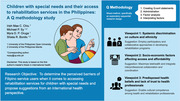
Methods: The study utilized the four-phased Q methodology, a mixed-method research design with an exploratory sequential approach: (1) creating and validating the Q-sort statements, (2) Q-sorting administration, (3) factor analysis, and (4) interpreting factors.
Results: After going through the four phases of Q methodology, the following factors, called "viewpoints" emerged: systemic discrimination based on differences in culture and ethnicity (Viewpoint 1), socioeconomic factors such as affordability and accessibility (Viewpoint 2), and predisposed health beliefs and lack of trust to health professionals (Viewpoint 3).
Discussion: Barriers to accessing rehabilitation services in the Philippines go beyond the lack of individual resources. These perceived barriers can be mitigated by employing participatory and collaborative approaches in developing rehabilitation programs for children and their families, viable strategies such as integrating telehealth in the rehabilitation process, and cultural competence in recognizing folkloric beliefs as a way to build trust toward health-care professionals.
Conclusion: This article determined contextualized barriers when accessing health and rehabilitation services based on service users themselves, which in turn hopes to promote inclusive, justice-oriented, and culturally focused rehabilitation services underpinned by international health principles.



 京公网安备 11010802042870号
京ICP备2023020795号-1
京公网安备 11010802042870号
京ICP备2023020795号-1

 分享
分享

 求助内容:
求助内容: 应助结果提醒方式:
 扫码关注我们
