{"title":"The Microbiome in Osteoarthritis: a Narrative Review of Recent Human and Animal Model Literature.","authors":"Christopher M Dunn, Matlock A Jeffries","doi":"10.1007/s11926-022-01066-6","DOIUrl":null,"url":null,"abstract":"<p><strong>Purpose of the review: </strong>The microbiome has recently emerged as a powerful contributor to health and illness in chronic, systemic disorders. Furthermore, new microbiome niches beyond traditional gut locations are frequently being described. Over the past 5 years, numerous pivotal studies have demonstrated associations between changes in various microbiome niches and the development of osteoarthritis (OA). Herein, we review the most impactful recent literature, including microbiome associations with disease and the potential therapeutic value of microbiome manipulation.</p><p><strong>Recent findings: </strong>The gut microbiome of human OA patients is enriched in specific bacterial clades, most notably Streptococcus, which correlates with OA pain, Firmicutes, and others. Most studies have focused on knee OA, although one publication demonstrated positive associations with 3 gut microbiome clades in hand OA. OA can be easily distinguished from RA by evaluating differences in oral microbiome composition. Most studies have also demonstrated a reduction in richness of the gut microbiome (alpha diversity) associated with OA. Several studies have identified bacterial signatures within human knee and hip cartilage, synovial fluid, and synovial tissue and have described changes in these patterns occurring with the development of OA. In animal models of OA, high-fat diet-induced obesity has been the most well-studied OA risk factor associated with changes in the microbiome, with numerous bacterial clades changed within the gut microbiome and associated with OA. Also in animal models, various oral supplementations, including dietary fiber, probiotics including Lactobacillus species, and cecal microbiome transplantation have all shown improvements in OA histopathology or cartilage healing. Microbiome changes are strongly associated with the OA disease process and with individual OA risk factors related to both the gut microbiome and the microbial DNA patterns in the joint. Microbiome-directed interventions have the potential to prevent or reduce the progression of OA. Future studies should investigate the mechanistic underpinnings of these microbiome associations and further define the therapeutic potential of microbiome augmentation.</p>","PeriodicalId":10761,"journal":{"name":"Current Rheumatology Reports","volume":"24 1","pages":"139-148"},"PeriodicalIF":3.9000,"publicationDate":"2022-05-01","publicationTypes":"Journal Article","fieldsOfStudy":null,"isOpenAccess":false,"openAccessPdf":"https://www.ncbi.nlm.nih.gov/pmc/articles/PMC11627155/pdf/","citationCount":"0","resultStr":null,"platform":"Semanticscholar","paperid":null,"PeriodicalName":"Current Rheumatology Reports","FirstCategoryId":"3","ListUrlMain":"https://doi.org/10.1007/s11926-022-01066-6","RegionNum":2,"RegionCategory":"医学","ArticlePicture":[],"TitleCN":null,"AbstractTextCN":null,"PMCID":null,"EPubDate":"2022/4/7 0:00:00","PubModel":"Epub","JCR":"Q1","JCRName":"RHEUMATOLOGY","Score":null,"Total":0}
引用次数: 0
Abstract
Purpose of the review: The microbiome has recently emerged as a powerful contributor to health and illness in chronic, systemic disorders. Furthermore, new microbiome niches beyond traditional gut locations are frequently being described. Over the past 5 years, numerous pivotal studies have demonstrated associations between changes in various microbiome niches and the development of osteoarthritis (OA). Herein, we review the most impactful recent literature, including microbiome associations with disease and the potential therapeutic value of microbiome manipulation.
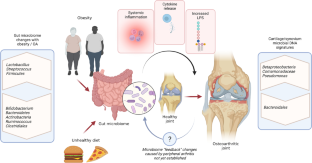
Recent findings: The gut microbiome of human OA patients is enriched in specific bacterial clades, most notably Streptococcus, which correlates with OA pain, Firmicutes, and others. Most studies have focused on knee OA, although one publication demonstrated positive associations with 3 gut microbiome clades in hand OA. OA can be easily distinguished from RA by evaluating differences in oral microbiome composition. Most studies have also demonstrated a reduction in richness of the gut microbiome (alpha diversity) associated with OA. Several studies have identified bacterial signatures within human knee and hip cartilage, synovial fluid, and synovial tissue and have described changes in these patterns occurring with the development of OA. In animal models of OA, high-fat diet-induced obesity has been the most well-studied OA risk factor associated with changes in the microbiome, with numerous bacterial clades changed within the gut microbiome and associated with OA. Also in animal models, various oral supplementations, including dietary fiber, probiotics including Lactobacillus species, and cecal microbiome transplantation have all shown improvements in OA histopathology or cartilage healing. Microbiome changes are strongly associated with the OA disease process and with individual OA risk factors related to both the gut microbiome and the microbial DNA patterns in the joint. Microbiome-directed interventions have the potential to prevent or reduce the progression of OA. Future studies should investigate the mechanistic underpinnings of these microbiome associations and further define the therapeutic potential of microbiome augmentation.
综述的目的:微生物组近来已成为慢性、全身性疾病中影响健康和疾病的重要因素。此外,除传统肠道位置外,新的微生物组龛位也经常被描述出来。在过去 5 年中,许多关键性研究证明了各种微生物组生态位的变化与骨关节炎(OA)发病之间的关联。在此,我们回顾了近期最具影响力的文献,包括微生物组与疾病的关联以及微生物组操作的潜在治疗价值:最近的发现:人类 OA 患者的肠道微生物组富含特定的细菌支系,其中最主要的是链球菌(与 OA 疼痛相关)、真菌等。大多数研究都集中在膝关节 OA 上,但有一份出版物显示,手部 OA 与肠道微生物组中的 3 个支系存在正相关。通过评估口腔微生物组组成的差异,可以很容易地将 OA 与 RA 区分开来。大多数研究还表明,与 OA 相关的肠道微生物组的丰富度(α 多样性)降低。一些研究已经确定了人类膝关节和髋关节软骨、滑膜液和滑膜组织中的细菌特征,并描述了这些模式随着 OA 的发展而发生的变化。在 OA 动物模型中,高脂饮食引起的肥胖是与微生物组变化相关的 OA 风险因素中研究最深入的一种,肠道微生物组中的许多细菌支系都发生了变化,并与 OA 相关。此外,在动物模型中,各种口服补充剂,包括膳食纤维、益生菌(包括乳酸杆菌)和盲肠微生物组移植,都显示 OA 组织病理学或软骨愈合有所改善。微生物组的变化与 OA 疾病过程以及与肠道微生物组和关节中微生物 DNA 模式相关的个体 OA 风险因素密切相关。以微生物组为导向的干预措施有可能预防或减少 OA 的恶化。未来的研究应调查这些微生物组关联的机理基础,并进一步确定微生物组增强的治疗潜力。
期刊介绍:
This journal aims to review the most important, recently published research in the field of rheumatology. By providing clear, insightful, balanced contributions by international experts, the journal intends to serve all those involved in the care and prevention of rheumatologic conditions.
We accomplish this aim by appointing international authorities to serve as Section Editors in key subject areas such as the many forms of arthritis, osteoporosis and metabolic bone disease, and systemic lupus erythematosus. Section Editors, in turn, select topics for which leading experts contribute comprehensive review articles that emphasize new developments and recently published papers of major importance, highlighted by annotated reference lists. An international Editorial Board reviews the annual table of contents, suggests articles of special interest to their country/region, and ensures that topics are current and include emerging research. Commentaries from well-known figures in the field are also occasionally provided.



 京公网安备 11010802042870号
京ICP备2023020795号-1
京公网安备 11010802042870号
京ICP备2023020795号-1

 分享
分享
 求助内容:
求助内容: 应助结果提醒方式:
 扫码关注我们
