Amanda L Forster, Dennis D Leber, Amy Engelbrecht-Wiggans, Virginie Landais, Allen Chang, Emilien Guigues, Guillaume Messin, Michael A Riley
{"title":"Linking Theory to Practice: Predicting Ballistic Performance from Mechanical Properties of Aged Body Armor.","authors":"Amanda L Forster, Dennis D Leber, Amy Engelbrecht-Wiggans, Virginie Landais, Allen Chang, Emilien Guigues, Guillaume Messin, Michael A Riley","doi":"10.6028/jres.125.026","DOIUrl":null,"url":null,"abstract":"<p><p>It has long been a goal of the body armor testing community to establish an individualized, scientific-based protocol for predicting the ballistic performance end of life for fielded body armor. A major obstacle in achieving this goal is the test methods used to ascertain ballistic performance, which are destructive in nature and require large sample sizes. In this work, using both the Cunniff and Phoenix-Porwal models, we derived two separate but similar theoretical relationships between the observed degradation in mechanical properties of aged body armor and its decreased ballistic performance. We present two studies used to validate the derived functions. The first correlates the degradation in mechanical properties of fielded body armor to the degradation produced by a laboratory accelerated-aging protocol. The second examines the ballistic resistance and the extracted-yarn mechanical properties of new and laboratory-aged body armor made from poly(p-phenylene-2,6-benzobisoxazole), or PBO, and poly(p-phenylene terephthalamide), or PPTA. We present correlations found between the tensile strengths of yarns extracted from armor and the ballistic limit (V50) when significant degradation of the mechanical properties of the extracted yarns was observed. These studies provided the basis for a validation data set in which we compared the experimentally measured V50 ballistic limit results to the theoretically predicted V50 results. The theoretical estimates were generally shown to provide a conservative prediction of the ballistic performance of the armor. This approach is promising for the development of a tool for fielded armor performance surveillance relying upon mechanical testing of armor coupon samples.</p>","PeriodicalId":1,"journal":{"name":"Accounts of Chemical Research","volume":" ","pages":"125026"},"PeriodicalIF":17.7000,"publicationDate":"2020-08-24","publicationTypes":"Journal Article","fieldsOfStudy":null,"isOpenAccess":false,"openAccessPdf":"https://www.ncbi.nlm.nih.gov/pmc/articles/PMC10883353/pdf/","citationCount":"0","resultStr":null,"platform":"Semanticscholar","paperid":null,"PeriodicalName":"Accounts of Chemical Research","FirstCategoryId":"5","ListUrlMain":"https://doi.org/10.6028/jres.125.026","RegionNum":1,"RegionCategory":"化学","ArticlePicture":[],"TitleCN":null,"AbstractTextCN":null,"PMCID":null,"EPubDate":"2020/1/1 0:00:00","PubModel":"eCollection","JCR":"Q1","JCRName":"CHEMISTRY, MULTIDISCIPLINARY","Score":null,"Total":0}
引用次数: 0
Abstract
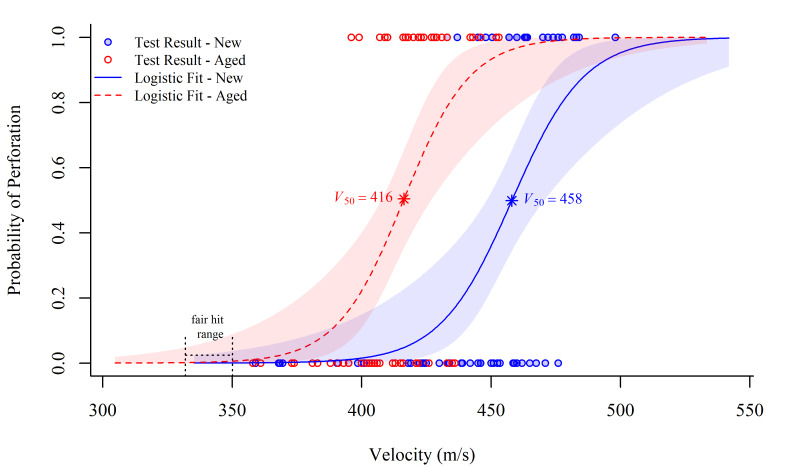
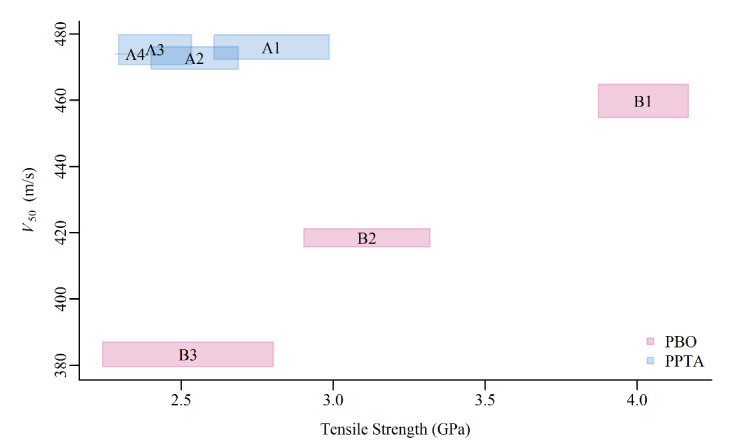
It has long been a goal of the body armor testing community to establish an individualized, scientific-based protocol for predicting the ballistic performance end of life for fielded body armor. A major obstacle in achieving this goal is the test methods used to ascertain ballistic performance, which are destructive in nature and require large sample sizes. In this work, using both the Cunniff and Phoenix-Porwal models, we derived two separate but similar theoretical relationships between the observed degradation in mechanical properties of aged body armor and its decreased ballistic performance. We present two studies used to validate the derived functions. The first correlates the degradation in mechanical properties of fielded body armor to the degradation produced by a laboratory accelerated-aging protocol. The second examines the ballistic resistance and the extracted-yarn mechanical properties of new and laboratory-aged body armor made from poly(p-phenylene-2,6-benzobisoxazole), or PBO, and poly(p-phenylene terephthalamide), or PPTA. We present correlations found between the tensile strengths of yarns extracted from armor and the ballistic limit (V50) when significant degradation of the mechanical properties of the extracted yarns was observed. These studies provided the basis for a validation data set in which we compared the experimentally measured V50 ballistic limit results to the theoretically predicted V50 results. The theoretical estimates were generally shown to provide a conservative prediction of the ballistic performance of the armor. This approach is promising for the development of a tool for fielded armor performance surveillance relying upon mechanical testing of armor coupon samples.
期刊介绍:
Accounts of Chemical Research presents short, concise and critical articles offering easy-to-read overviews of basic research and applications in all areas of chemistry and biochemistry. These short reviews focus on research from the author’s own laboratory and are designed to teach the reader about a research project. In addition, Accounts of Chemical Research publishes commentaries that give an informed opinion on a current research problem. Special Issues online are devoted to a single topic of unusual activity and significance.
Accounts of Chemical Research replaces the traditional article abstract with an article "Conspectus." These entries synopsize the research affording the reader a closer look at the content and significance of an article. Through this provision of a more detailed description of the article contents, the Conspectus enhances the article's discoverability by search engines and the exposure for the research.





 京公网安备 11010802042870号
京ICP备2023020795号-1
京公网安备 11010802042870号
京ICP备2023020795号-1

 分享
分享
 求助内容:
求助内容: 应助结果提醒方式:
 扫码关注我们
