{"title":"A Genetically Modified Skin Graft for Treating Alcohol Use Disorder and/or Polysubstance Abuse With Cocaine.","authors":"Qingyao Kong, Xiaoyang Wu, Ming Xu","doi":"10.3389/adar.2021.10007","DOIUrl":null,"url":null,"abstract":"<p><p>Alcohol use disorder (AUD) is one of the foremost public health problems. Alcohol is also frequently co-abused with cocaine. There is a huge unmet need for the treatment of AUD and/or cocaine co-abuse. We have developed and used a skin stem cell-based gene delivery platform and found that production of the glucagon-like peptide-1 (GLP1) from the grafted genetically modified skin reduced development and reinstatement of alcohol-induced drug-taking and seeking, voluntary oral alcohol consumption and alcohol-induced increase in dopamine (DA) levels in the nucleus accumbens (NAc). Moreover, we have developed a novel co-grafting procedure for both modified human butyrylcholinesterase (hBChE)- and GLP1-expressing cells. Skin grafts-derived hBChE and GLP1 reduced acquisition of drug-taking and toxicity induced by concurrent alcohol and cocaine injections. These results imply that gene delivery through skin transplants may add a new option to treat drug abuse and co-abuse.</p>","PeriodicalId":72092,"journal":{"name":"Advances in drug and alcohol research","volume":"1 1","pages":"10007"},"PeriodicalIF":0.0000,"publicationDate":"2021-06-18","publicationTypes":"Journal Article","fieldsOfStudy":null,"isOpenAccess":false,"openAccessPdf":"https://www.ncbi.nlm.nih.gov/pmc/articles/PMC10880775/pdf/","citationCount":"0","resultStr":null,"platform":"Semanticscholar","paperid":null,"PeriodicalName":"Advances in drug and alcohol research","FirstCategoryId":"1085","ListUrlMain":"https://doi.org/10.3389/adar.2021.10007","RegionNum":0,"RegionCategory":null,"ArticlePicture":[],"TitleCN":null,"AbstractTextCN":null,"PMCID":null,"EPubDate":"2021/1/1 0:00:00","PubModel":"eCollection","JCR":"","JCRName":"","Score":null,"Total":0}
引用次数: 0
Abstract
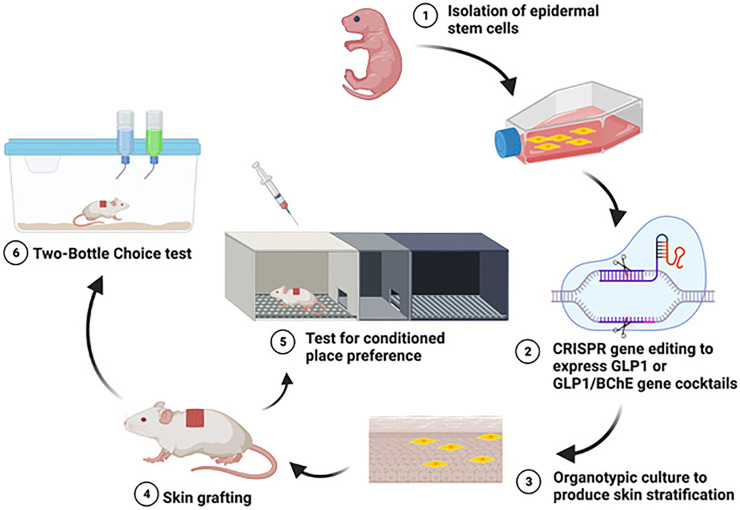
Alcohol use disorder (AUD) is one of the foremost public health problems. Alcohol is also frequently co-abused with cocaine. There is a huge unmet need for the treatment of AUD and/or cocaine co-abuse. We have developed and used a skin stem cell-based gene delivery platform and found that production of the glucagon-like peptide-1 (GLP1) from the grafted genetically modified skin reduced development and reinstatement of alcohol-induced drug-taking and seeking, voluntary oral alcohol consumption and alcohol-induced increase in dopamine (DA) levels in the nucleus accumbens (NAc). Moreover, we have developed a novel co-grafting procedure for both modified human butyrylcholinesterase (hBChE)- and GLP1-expressing cells. Skin grafts-derived hBChE and GLP1 reduced acquisition of drug-taking and toxicity induced by concurrent alcohol and cocaine injections. These results imply that gene delivery through skin transplants may add a new option to treat drug abuse and co-abuse.




 京公网安备 11010802042870号
京ICP备2023020795号-1
京公网安备 11010802042870号
京ICP备2023020795号-1

 分享
分享

 求助内容:
求助内容: 应助结果提醒方式:
 扫码关注我们
