Jan Stock , Felix Arjuna , André Xhonneux , Dirk Müller
{"title":"Modelling of waste heat integration into an existing district heating network operating at different supply temperatures","authors":"Jan Stock , Felix Arjuna , André Xhonneux , Dirk Müller","doi":"10.1016/j.segy.2023.100104","DOIUrl":null,"url":null,"abstract":"<div><p>A promising way to make use of waste heat sources is to distribute the heat to nearby buildings via district heating systems to cover the heat demands of the buildings. The integration of a waste heat source into an existing district heating system must be studied in advance to avoid difficulties in network operation and to ensure the required heat supply to all connected buildings. Simultaneously, supply temperature reduction can improve the overall system efficiency and should also be considered for a sustainable transformation of existing district heating systems.</p><p>In this paper, we develop a district heating model with multiple supplying heat sources to study the influence of an additional integrated heat source and the effects of reduced supply temperatures on the network conditions. With the developed model, we investigate the waste heat integration into an existing district heating system at a German research facility campus. Therefore, we test different integrated waste heat shares to identify arising bottlenecks and to check for the sufficient heat supply to the connected consumers. Furthermore, we test the opportunity to additionally lowering the supply temperatures in the district heating network. The simulation results show that waste heat integration is possible at the investigated district heating system up to 40%. However, simultaneously lowering the supply temperature leads to greater challenges as more bottlenecks arise and additional buildings are affected by insufficient supply.</p></div>","PeriodicalId":34738,"journal":{"name":"Smart Energy","volume":"10 ","pages":"Article 100104"},"PeriodicalIF":5.0000,"publicationDate":"2023-05-01","publicationTypes":"Journal Article","fieldsOfStudy":null,"isOpenAccess":false,"openAccessPdf":"","citationCount":"2","resultStr":null,"platform":"Semanticscholar","paperid":null,"PeriodicalName":"Smart Energy","FirstCategoryId":"1085","ListUrlMain":"https://www.sciencedirect.com/science/article/pii/S2666955223000114","RegionNum":0,"RegionCategory":null,"ArticlePicture":[],"TitleCN":null,"AbstractTextCN":null,"PMCID":null,"EPubDate":"","PubModel":"","JCR":"Q2","JCRName":"ENERGY & FUELS","Score":null,"Total":0}
引用次数: 2
Abstract
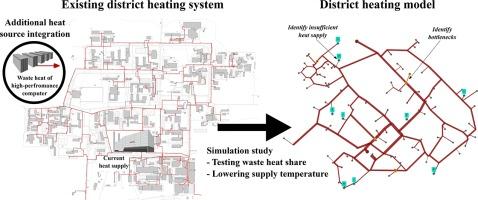
A promising way to make use of waste heat sources is to distribute the heat to nearby buildings via district heating systems to cover the heat demands of the buildings. The integration of a waste heat source into an existing district heating system must be studied in advance to avoid difficulties in network operation and to ensure the required heat supply to all connected buildings. Simultaneously, supply temperature reduction can improve the overall system efficiency and should also be considered for a sustainable transformation of existing district heating systems.
In this paper, we develop a district heating model with multiple supplying heat sources to study the influence of an additional integrated heat source and the effects of reduced supply temperatures on the network conditions. With the developed model, we investigate the waste heat integration into an existing district heating system at a German research facility campus. Therefore, we test different integrated waste heat shares to identify arising bottlenecks and to check for the sufficient heat supply to the connected consumers. Furthermore, we test the opportunity to additionally lowering the supply temperatures in the district heating network. The simulation results show that waste heat integration is possible at the investigated district heating system up to 40%. However, simultaneously lowering the supply temperature leads to greater challenges as more bottlenecks arise and additional buildings are affected by insufficient supply.



 京公网安备 11010802042870号
京ICP备2023020795号-1
京公网安备 11010802042870号
京ICP备2023020795号-1

 分享
分享
 求助内容:
求助内容: 应助结果提醒方式:
 扫码关注我们
