{"title":"Livelihood Functions of Capture Fisheries in Sub-Saharan Africa: Food Security, Nutritional, and Economic Implications","authors":"M. Temesgen, A. Getahun, B. Lemma","doi":"10.1080/23308249.2019.1565754","DOIUrl":null,"url":null,"abstract":"Abstract The objective of this review was to investigate the livelihood functions of capture fisheries (food security, nutritional, and economic implications) in Sub-Saharan Africa. Published and unpublished sources were used to obtain appropriate data. Capture fishery is the most important livelihood activity in the region. The contribution of capture fishery is however not visible in food security, nutritional security, and economy of the poor society. This is because over half of the production is from small-scale artisanal fisheries. Marginalization and exclusion, inadequate public service provision, low level of education, poor political organization, open-access nature of the resources, overexploitation, and unequal access to land or resources are also widely affecting the fishing communities. Poor quality of fish products due to poor handling, processing, and transportation, climate change, poor organizational structures in fishery governance, gender inequality, and lack of access to health services are also affecting the sector. These problems led to misrepresentation and undermine the role of capture fisheries in the livelihood of poor societies of the region. Therefore, effective management and follow up is very important in order to improve the benefit from the capture fishery sector, in addition to encouraging the development of aquaculture.","PeriodicalId":21183,"journal":{"name":"Reviews in Fisheries Science & Aquaculture","volume":"27 1","pages":"215 - 225"},"PeriodicalIF":5.3000,"publicationDate":"2019-01-30","publicationTypes":"Journal Article","fieldsOfStudy":null,"isOpenAccess":false,"openAccessPdf":"https://sci-hub-pdf.com/10.1080/23308249.2019.1565754","citationCount":"11","resultStr":null,"platform":"Semanticscholar","paperid":null,"PeriodicalName":"Reviews in Fisheries Science & Aquaculture","FirstCategoryId":"97","ListUrlMain":"https://doi.org/10.1080/23308249.2019.1565754","RegionNum":1,"RegionCategory":"农林科学","ArticlePicture":[],"TitleCN":null,"AbstractTextCN":null,"PMCID":null,"EPubDate":"","PubModel":"","JCR":"Q1","JCRName":"FISHERIES","Score":null,"Total":0}
引用次数: 11
Abstract
Abstract The objective of this review was to investigate the livelihood functions of capture fisheries (food security, nutritional, and economic implications) in Sub-Saharan Africa. Published and unpublished sources were used to obtain appropriate data. Capture fishery is the most important livelihood activity in the region. The contribution of capture fishery is however not visible in food security, nutritional security, and economy of the poor society. This is because over half of the production is from small-scale artisanal fisheries. Marginalization and exclusion, inadequate public service provision, low level of education, poor political organization, open-access nature of the resources, overexploitation, and unequal access to land or resources are also widely affecting the fishing communities. Poor quality of fish products due to poor handling, processing, and transportation, climate change, poor organizational structures in fishery governance, gender inequality, and lack of access to health services are also affecting the sector. These problems led to misrepresentation and undermine the role of capture fisheries in the livelihood of poor societies of the region. Therefore, effective management and follow up is very important in order to improve the benefit from the capture fishery sector, in addition to encouraging the development of aquaculture.
期刊介绍:
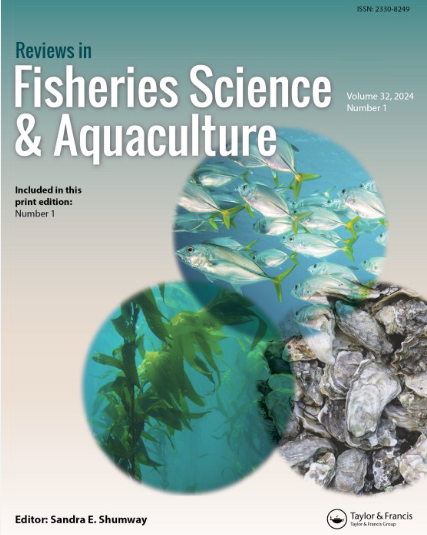
Reviews in Fisheries Science & Aquaculture provides an important forum for the publication of up-to-date reviews covering a broad range of subject areas including management, aquaculture, taxonomy, behavior, stock identification, genetics, nutrition, and physiology. Issues concerning finfish and aquatic invertebrates prized for their economic or recreational importance, their value as indicators of environmental health, or their natural beauty are addressed. An important resource that keeps you apprised of the latest changes in the field, each issue of Reviews in Fisheries Science & Aquaculture presents useful information to fisheries and aquaculture scientists in academia, state and federal natural resources agencies, and the private sector.



 京公网安备 11010802042870号
京ICP备2023020795号-1
京公网安备 11010802042870号
京ICP备2023020795号-1

 分享
分享
 求助内容:
求助内容: 应助结果提醒方式:
 扫码关注我们
