C K Chan, Chi Fai Ng, Steffi K K Yuen, B S Y Lau, C H Yee, J Y C Teoh, P K F Chiu, S W Kwok
{"title":"Nocturia is associated with stiffer central artery and more likely development of major adverse cardiovascular events in men.","authors":"C K Chan, Chi Fai Ng, Steffi K K Yuen, B S Y Lau, C H Yee, J Y C Teoh, P K F Chiu, S W Kwok","doi":"10.3389/fruro.2023.1113054","DOIUrl":null,"url":null,"abstract":"<p><strong>Objectives: </strong>To study the association between nocturia and brachial-ankle pulse wave velocity (baPWV) [surrogate of central arterial stiffness (CAS)] in men and to explore this association on predicting major adverse cardiovascular events (MACE).</p><p><strong>Methods: </strong>246 consecutive men (mean age:68.1 ± 8.4, range 36-88) newly referred to urology clinic for male-lower urinary tract symptoms(mLUTS)/nocturia were recruited. Their bilateral baPWV were measured by automatic pulse waveform analyzer. The associations between baseline characteristics, mLUTS/nocturia and baPWV(>1800cm/sec) [significant CAS] were analyzed by multivariate logistic regression. We followed the cohort for a median period of 27.5 months. Cox proportional hazard regression analysis and Kaplan-Meier method were used to study factors predicting MACE.</p><p><strong>Results: </strong>The mean ( ± SE) baPWV of our cohort was 1820 ± 16cm/sec. For comparison, the reported value of the general population of similar age structure was~1650cm/sec. IPSS (total) was not associated with baPWV, whereas IPSS-Question.7(nocturia) was significantly increased with baPWV in men<70yo [nocturia=1.6 ± 1.14, 2.1 ± 1.08, 2.67 ± 1.33) for baPWV(cm/sec) <1400, 1400-1800, >1800 respectively] (P-trend=0.002). Age≥70yo (OR:2.70, 95%CI:1.52-4.76), diabetes mellitus (OR:2.26, 95%CI:1.06-4.83), hypertension (OR:1.95, 95%CI:1.10-3.45) and nocturia≥3x/night (OR:1.75, 95%CI:1.02-3.12) independently determined baPWV>1800cm/sec. The cumulative incidence rate of MACE was 46.8/1000 man-years(95%CI:30.96-68.16/1000). The addition of nocturia≥3x/night and baPWV>1800 cm/sec to the basic model improved the prediction of the development of MACE (difference in -2 log likelihood value: 11.219, p<0.001). Past history of ischemic heart (HR:5.67, 95%CI:2.02-15.88), nocturia≥3x/night (HR:2.87, 95%CI: 0.94-8.76) and baPWV>1800cm/sec (HR:5.16, 95%CI:1.79-14.90) independently predicted MACE in men.</p><p><strong>Conclusion: </strong>Men attending the urology clinic for male-LUTS/nocturia had higher baPWV. This association was more pronounced in men<70yo. Men presented with both nocturia≥3x/night and baPWV>1800cm/sec showed significant predilection for developing MACE.</p>","PeriodicalId":73113,"journal":{"name":"Frontiers in urology","volume":" ","pages":"1113054"},"PeriodicalIF":1.1000,"publicationDate":"2023-01-26","publicationTypes":"Journal Article","fieldsOfStudy":null,"isOpenAccess":false,"openAccessPdf":"https://www.ncbi.nlm.nih.gov/pmc/articles/PMC12327344/pdf/","citationCount":"0","resultStr":null,"platform":"Semanticscholar","paperid":null,"PeriodicalName":"Frontiers in urology","FirstCategoryId":"1085","ListUrlMain":"https://doi.org/10.3389/fruro.2023.1113054","RegionNum":0,"RegionCategory":null,"ArticlePicture":[],"TitleCN":null,"AbstractTextCN":null,"PMCID":null,"EPubDate":"2023/1/1 0:00:00","PubModel":"eCollection","JCR":"","JCRName":"","Score":null,"Total":0}
引用次数: 0
Abstract
Objectives: To study the association between nocturia and brachial-ankle pulse wave velocity (baPWV) [surrogate of central arterial stiffness (CAS)] in men and to explore this association on predicting major adverse cardiovascular events (MACE).
Methods: 246 consecutive men (mean age:68.1 ± 8.4, range 36-88) newly referred to urology clinic for male-lower urinary tract symptoms(mLUTS)/nocturia were recruited. Their bilateral baPWV were measured by automatic pulse waveform analyzer. The associations between baseline characteristics, mLUTS/nocturia and baPWV(>1800cm/sec) [significant CAS] were analyzed by multivariate logistic regression. We followed the cohort for a median period of 27.5 months. Cox proportional hazard regression analysis and Kaplan-Meier method were used to study factors predicting MACE.
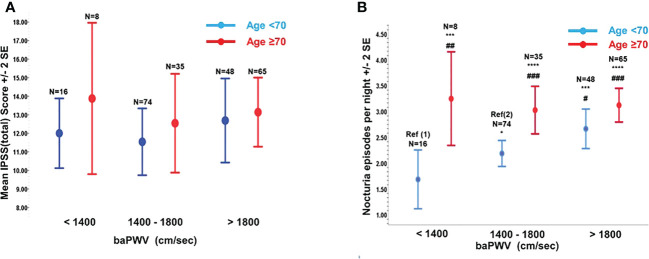
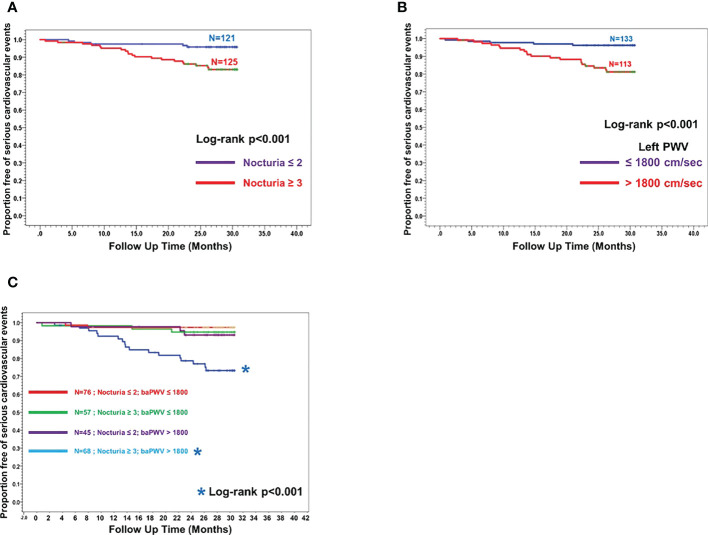
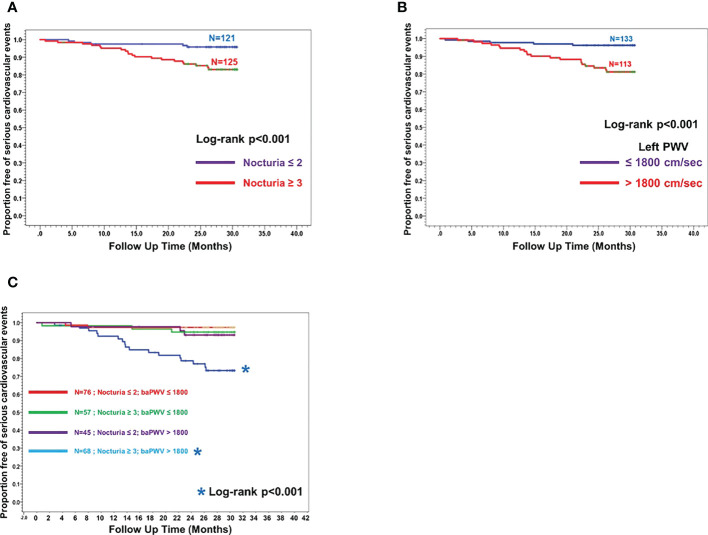
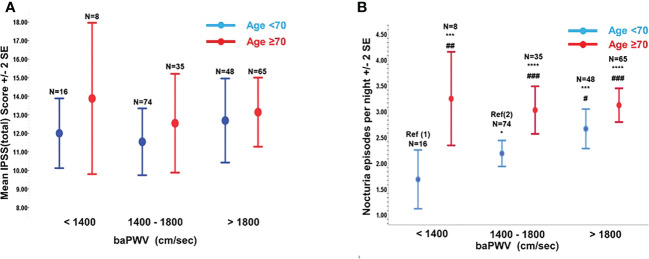
Results: The mean ( ± SE) baPWV of our cohort was 1820 ± 16cm/sec. For comparison, the reported value of the general population of similar age structure was~1650cm/sec. IPSS (total) was not associated with baPWV, whereas IPSS-Question.7(nocturia) was significantly increased with baPWV in men<70yo [nocturia=1.6 ± 1.14, 2.1 ± 1.08, 2.67 ± 1.33) for baPWV(cm/sec) <1400, 1400-1800, >1800 respectively] (P-trend=0.002). Age≥70yo (OR:2.70, 95%CI:1.52-4.76), diabetes mellitus (OR:2.26, 95%CI:1.06-4.83), hypertension (OR:1.95, 95%CI:1.10-3.45) and nocturia≥3x/night (OR:1.75, 95%CI:1.02-3.12) independently determined baPWV>1800cm/sec. The cumulative incidence rate of MACE was 46.8/1000 man-years(95%CI:30.96-68.16/1000). The addition of nocturia≥3x/night and baPWV>1800 cm/sec to the basic model improved the prediction of the development of MACE (difference in -2 log likelihood value: 11.219, p<0.001). Past history of ischemic heart (HR:5.67, 95%CI:2.02-15.88), nocturia≥3x/night (HR:2.87, 95%CI: 0.94-8.76) and baPWV>1800cm/sec (HR:5.16, 95%CI:1.79-14.90) independently predicted MACE in men.
Conclusion: Men attending the urology clinic for male-LUTS/nocturia had higher baPWV. This association was more pronounced in men<70yo. Men presented with both nocturia≥3x/night and baPWV>1800cm/sec showed significant predilection for developing MACE.



 京公网安备 11010802042870号
京ICP备2023020795号-1
京公网安备 11010802042870号
京ICP备2023020795号-1

 分享
分享

 求助内容:
求助内容: 应助结果提醒方式:
 扫码关注我们
