Simon St-Georges, Vincent Arel-Bundock, André Blais, Marco Mendoza Aviña
{"title":"Jobs and Punishment: Public Opinion on Leniency for White-Collar Crime.","authors":"Simon St-Georges, Vincent Arel-Bundock, André Blais, Marco Mendoza Aviña","doi":"10.1177/10659129231176211","DOIUrl":null,"url":null,"abstract":"<p><p>Governments routinely offer deals to companies accused of white-collar crimes, allowing them to escape criminal charges in exchange for fines or penalties. This lets prosecutors avoid costly litigation and protects companies' right to bid on lucrative public contracts, which can reduce the likelihood of bankruptcies or layoffs. Striking deals with white-collar criminals can be risky for governments because it could affect the perceived legitimacy of the legal system. This article explores the conditions under which the general public supports leniency agreements. Building on theoretical intuitions from the literature, we identify three characteristics that could affect mass attitudes: home bias, economic incentives, and retribution. We conduct a survey experiment in the United States and find moderate support for leniency agreements. Whether the crime occurs on US soil or abroad does not affect public opinion, and the number of jobs that would be jeopardized by criminal prosecution only has a small effect. Instead, survey respondents become much more supportive of a deal when it includes criminal charges for the corporate managers who were personally involved in the alleged wrongdoing. In the court of public opinion, punishing a handful of individuals appears to matter more than saving thousands of jobs.</p>","PeriodicalId":1,"journal":{"name":"Accounts of Chemical Research","volume":" ","pages":"1751-1763"},"PeriodicalIF":17.7000,"publicationDate":"2023-12-01","publicationTypes":"Journal Article","fieldsOfStudy":null,"isOpenAccess":false,"openAccessPdf":"https://www.ncbi.nlm.nih.gov/pmc/articles/PMC10615619/pdf/","citationCount":"0","resultStr":null,"platform":"Semanticscholar","paperid":null,"PeriodicalName":"Accounts of Chemical Research","FirstCategoryId":"90","ListUrlMain":"https://doi.org/10.1177/10659129231176211","RegionNum":1,"RegionCategory":"化学","ArticlePicture":[],"TitleCN":null,"AbstractTextCN":null,"PMCID":null,"EPubDate":"2023/5/19 0:00:00","PubModel":"Epub","JCR":"Q1","JCRName":"CHEMISTRY, MULTIDISCIPLINARY","Score":null,"Total":0}
引用次数: 0
Abstract
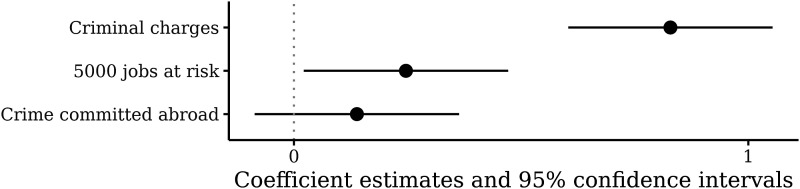
Governments routinely offer deals to companies accused of white-collar crimes, allowing them to escape criminal charges in exchange for fines or penalties. This lets prosecutors avoid costly litigation and protects companies' right to bid on lucrative public contracts, which can reduce the likelihood of bankruptcies or layoffs. Striking deals with white-collar criminals can be risky for governments because it could affect the perceived legitimacy of the legal system. This article explores the conditions under which the general public supports leniency agreements. Building on theoretical intuitions from the literature, we identify three characteristics that could affect mass attitudes: home bias, economic incentives, and retribution. We conduct a survey experiment in the United States and find moderate support for leniency agreements. Whether the crime occurs on US soil or abroad does not affect public opinion, and the number of jobs that would be jeopardized by criminal prosecution only has a small effect. Instead, survey respondents become much more supportive of a deal when it includes criminal charges for the corporate managers who were personally involved in the alleged wrongdoing. In the court of public opinion, punishing a handful of individuals appears to matter more than saving thousands of jobs.
期刊介绍:
Accounts of Chemical Research presents short, concise and critical articles offering easy-to-read overviews of basic research and applications in all areas of chemistry and biochemistry. These short reviews focus on research from the author’s own laboratory and are designed to teach the reader about a research project. In addition, Accounts of Chemical Research publishes commentaries that give an informed opinion on a current research problem. Special Issues online are devoted to a single topic of unusual activity and significance.
Accounts of Chemical Research replaces the traditional article abstract with an article "Conspectus." These entries synopsize the research affording the reader a closer look at the content and significance of an article. Through this provision of a more detailed description of the article contents, the Conspectus enhances the article's discoverability by search engines and the exposure for the research.





 京公网安备 11010802042870号
京ICP备2023020795号-1
京公网安备 11010802042870号
京ICP备2023020795号-1

 分享
分享
 求助内容:
求助内容: 应助结果提醒方式:
 扫码关注我们
