Decarbonization of district heating and deep retrofits of buildings as competing or synergetic strategies for the implementation of the efficiency first principle
{"title":"Decarbonization of district heating and deep retrofits of buildings as competing or synergetic strategies for the implementation of the efficiency first principle","authors":"Eftim Popovski , Mario Ragwitz , Heike Brugger","doi":"10.1016/j.segy.2023.100096","DOIUrl":null,"url":null,"abstract":"<div><p>This paper discusses the compatibility of district heating (DH) networks with deep retrofits of buildings under various European climate conditions and city typologies. The study analyses five cities with different DH market shares, climate zones, population densities, and transferability potentials. First, we have forecasted population, heated floor area, and share of floor area per construction period until 2050, and then calculated three different heat demand scenarios for varying building refurbishment rates of 1%, 2%, and 3% of the total floor area. Second, future suitable DH regions with min 25 GWh/km<sup>2</sup> networks were identified. By applying a bottom-up GIS model, based on the type of city area, number of buildings, street length, and heat density, the DH distribution capital and operation costs were calculated. Lastly, to compare the total cost of heat supply for each scenario, the cost of individual heat per building type was calculated.</p><p>The results show that even in the scenarios with high refurbishment rates of 3%, high percentage of the built-up areas, between 23% and 68% depending on the city typology, are suitable for DH supply in 2050. The share of DH from the total heat supply varies between 49% and 83%. An increase of the DH price between 14% and 35%, depending on the scenario and case study can be expected due to the reduced heat densities compared to the current ones. Nevertheless, maximizing the DH connection rates in the identified regions leads to lower total cost of heat in almost all the analysed case studies.</p></div>","PeriodicalId":34738,"journal":{"name":"Smart Energy","volume":"10 ","pages":"Article 100096"},"PeriodicalIF":5.0000,"publicationDate":"2023-05-01","publicationTypes":"Journal Article","fieldsOfStudy":null,"isOpenAccess":false,"openAccessPdf":"","citationCount":"3","resultStr":null,"platform":"Semanticscholar","paperid":null,"PeriodicalName":"Smart Energy","FirstCategoryId":"1085","ListUrlMain":"https://www.sciencedirect.com/science/article/pii/S2666955223000035","RegionNum":0,"RegionCategory":null,"ArticlePicture":[],"TitleCN":null,"AbstractTextCN":null,"PMCID":null,"EPubDate":"","PubModel":"","JCR":"Q2","JCRName":"ENERGY & FUELS","Score":null,"Total":0}
引用次数: 3
Abstract
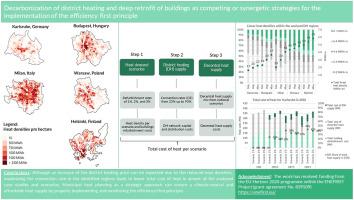
This paper discusses the compatibility of district heating (DH) networks with deep retrofits of buildings under various European climate conditions and city typologies. The study analyses five cities with different DH market shares, climate zones, population densities, and transferability potentials. First, we have forecasted population, heated floor area, and share of floor area per construction period until 2050, and then calculated three different heat demand scenarios for varying building refurbishment rates of 1%, 2%, and 3% of the total floor area. Second, future suitable DH regions with min 25 GWh/km2 networks were identified. By applying a bottom-up GIS model, based on the type of city area, number of buildings, street length, and heat density, the DH distribution capital and operation costs were calculated. Lastly, to compare the total cost of heat supply for each scenario, the cost of individual heat per building type was calculated.
The results show that even in the scenarios with high refurbishment rates of 3%, high percentage of the built-up areas, between 23% and 68% depending on the city typology, are suitable for DH supply in 2050. The share of DH from the total heat supply varies between 49% and 83%. An increase of the DH price between 14% and 35%, depending on the scenario and case study can be expected due to the reduced heat densities compared to the current ones. Nevertheless, maximizing the DH connection rates in the identified regions leads to lower total cost of heat in almost all the analysed case studies.




 京公网安备 11010802042870号
京ICP备2023020795号-1
京公网安备 11010802042870号
京ICP备2023020795号-1

 分享
分享
 求助内容:
求助内容: 应助结果提醒方式:
 扫码关注我们
