Qinda Guo, Maciej Dendzik, Antonija Grubišić-Čabo, Magnus H Berntsen, Cong Li, Wanyu Chen, Bharti Matta, Ulrich Starke, Björn Hessmo, Jonas Weissenrieder, Oscar Tjernberg
{"title":"A narrow bandwidth extreme ultra-violet light source for time- and angle-resolved photoemission spectroscopy.","authors":"Qinda Guo, Maciej Dendzik, Antonija Grubišić-Čabo, Magnus H Berntsen, Cong Li, Wanyu Chen, Bharti Matta, Ulrich Starke, Björn Hessmo, Jonas Weissenrieder, Oscar Tjernberg","doi":"10.1063/4.0000149","DOIUrl":null,"url":null,"abstract":"<p><p>Here, we present a high repetition rate, narrow bandwidth, extreme ultraviolet photon source for time- and angle-resolved photoemission spectroscopy. The narrow bandwidth pulses <math><mrow><mo>Δ</mo> <mi>E</mi> <mo>=</mo> <mn>9</mn> <mo>,</mo> <mo> </mo> <mn>14</mn> <mo>,</mo> <mo> </mo> <mtext>and</mtext> <mo> </mo> <mn>18</mn></mrow> </math> meV for photon energies <math><mi>h</mi> <mi>ν</mi> <mo>=</mo> <mn>10.8</mn> <mo>,</mo> <mo> </mo> <mn>18.1</mn> <mo>,</mo> <mo> </mo> <mtext>and</mtext> <mo> </mo> <mn>25.3</mn></math> eV are generated through high harmonic generation using ultra-violet drive pulses with relatively long pulse lengths (461 fs). The high harmonic generation setup employs an annular drive beam in tight focusing geometry at a repetition rate of 250 kHz. Photon energy selection is provided by a series of selectable multilayer bandpass mirrors and thin film filters, thus avoiding any time broadening introduced by single grating monochromators. A two stage optical-parametric amplifier provides < 100 fs tunable pump pulses from 0.65 μm to 9 <i>μ</i>m. The narrow bandwidth performance of the light source is demonstrated through angle-resolved photoemission measurements on a series of quantum materials, including high-temperature superconductor Bi-2212, WSe<sub>2</sub>, and graphene.</p>","PeriodicalId":2,"journal":{"name":"ACS Applied Bio Materials","volume":" ","pages":"024304"},"PeriodicalIF":4.7000,"publicationDate":"2022-04-28","publicationTypes":"Journal Article","fieldsOfStudy":null,"isOpenAccess":false,"openAccessPdf":"https://www.ncbi.nlm.nih.gov/pmc/articles/PMC9054270/pdf/","citationCount":"0","resultStr":null,"platform":"Semanticscholar","paperid":null,"PeriodicalName":"ACS Applied Bio Materials","FirstCategoryId":"101","ListUrlMain":"https://doi.org/10.1063/4.0000149","RegionNum":0,"RegionCategory":null,"ArticlePicture":[],"TitleCN":null,"AbstractTextCN":null,"PMCID":null,"EPubDate":"2022/3/1 0:00:00","PubModel":"eCollection","JCR":"Q2","JCRName":"MATERIALS SCIENCE, BIOMATERIALS","Score":null,"Total":0}
引用次数: 0
Abstract
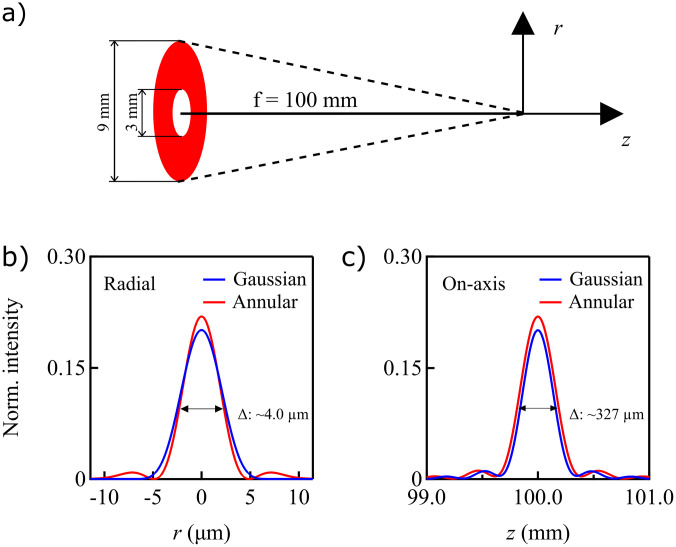
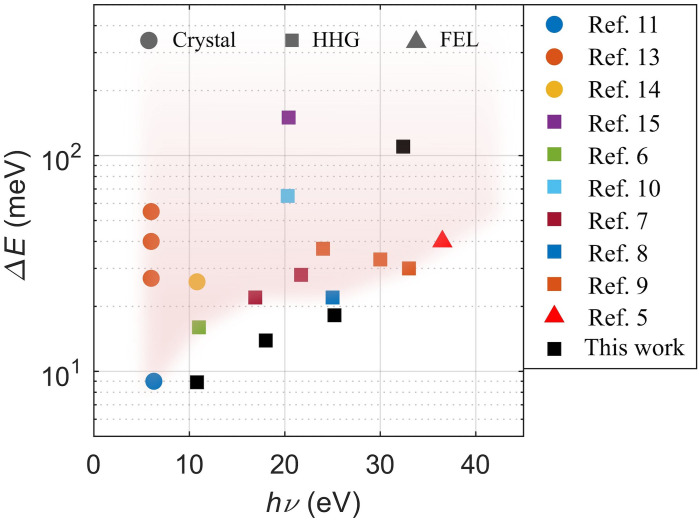
Here, we present a high repetition rate, narrow bandwidth, extreme ultraviolet photon source for time- and angle-resolved photoemission spectroscopy. The narrow bandwidth pulses meV for photon energies eV are generated through high harmonic generation using ultra-violet drive pulses with relatively long pulse lengths (461 fs). The high harmonic generation setup employs an annular drive beam in tight focusing geometry at a repetition rate of 250 kHz. Photon energy selection is provided by a series of selectable multilayer bandpass mirrors and thin film filters, thus avoiding any time broadening introduced by single grating monochromators. A two stage optical-parametric amplifier provides < 100 fs tunable pump pulses from 0.65 μm to 9 μm. The narrow bandwidth performance of the light source is demonstrated through angle-resolved photoemission measurements on a series of quantum materials, including high-temperature superconductor Bi-2212, WSe2, and graphene.
期刊介绍:
ACS Applied Bio Materials is an interdisciplinary journal publishing original research covering all aspects of biomaterials and biointerfaces including and beyond the traditional biosensing, biomedical and therapeutic applications.
The journal is devoted to reports of new and original experimental and theoretical research of an applied nature that integrates knowledge in the areas of materials, engineering, physics, bioscience, and chemistry into important bio applications. The journal is specifically interested in work that addresses the relationship between structure and function and assesses the stability and degradation of materials under relevant environmental and biological conditions.





 京公网安备 11010802042870号
京ICP备2023020795号-1
京公网安备 11010802042870号
京ICP备2023020795号-1

 分享
分享
 求助内容:
求助内容: 应助结果提醒方式:
 扫码关注我们
