{"title":"Ego Depletion and Time Pressure Promote Spontaneous Deception:An Event-Related Potential Study.","authors":"Wei Fan, Ying Yang, Wenjie Zhang, Yiping Zhong","doi":"10.5709/acp-0333-8","DOIUrl":null,"url":null,"abstract":"<p><p>Event-related potentials (ERPs) were used to explore the influence of ego depletion on spontaneous deception under time pressure. The Stroop Color-Word test was used to manipulate the participants' ego depletion in the experiment. A visual perception task was employed to assess the participants' deceptive tendency. The results indicated that the ego-depleted group was more prone to engaging deception and induced a larger P3 amplitude than did the nondepleted group. The no-time pressure group was more likely to deceive and induced a larger P3 amplitude than did the high-time pressure group. These results suggest that individuals with sufficient resources for self-control are more likely to resist temptation and less likely to engage in self-serving deception. Higher time pressure made subjects more likely to cheat. Deception is automatic and spontaneous under certain conditions. Ego depletion and high time pressure promote the occurrence of deception.</p>","PeriodicalId":1,"journal":{"name":"Accounts of Chemical Research","volume":" ","pages":"239-249"},"PeriodicalIF":17.7000,"publicationDate":"2021-09-11","publicationTypes":"Journal Article","fieldsOfStudy":null,"isOpenAccess":false,"openAccessPdf":"https://www.ncbi.nlm.nih.gov/pmc/articles/PMC10708911/pdf/","citationCount":"1","resultStr":null,"platform":"Semanticscholar","paperid":null,"PeriodicalName":"Accounts of Chemical Research","FirstCategoryId":"102","ListUrlMain":"https://doi.org/10.5709/acp-0333-8","RegionNum":1,"RegionCategory":"化学","ArticlePicture":[],"TitleCN":null,"AbstractTextCN":null,"PMCID":null,"EPubDate":"2021/1/1 0:00:00","PubModel":"eCollection","JCR":"Q1","JCRName":"CHEMISTRY, MULTIDISCIPLINARY","Score":null,"Total":0}
引用次数: 1
Abstract
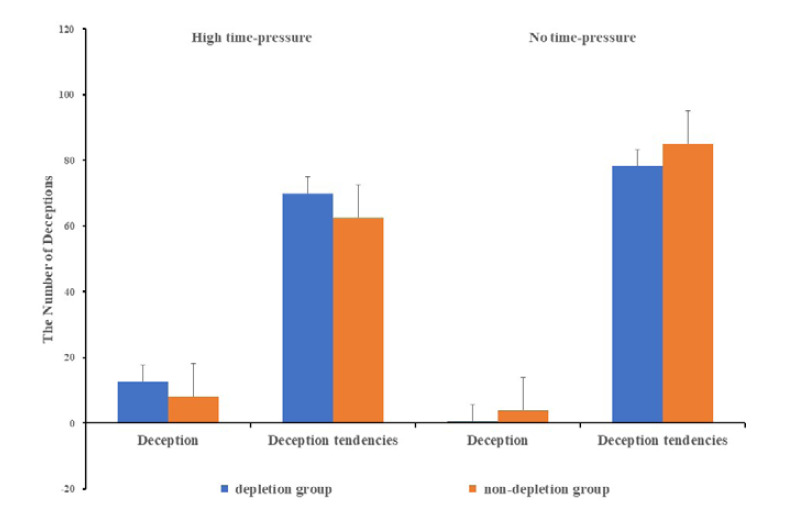
Event-related potentials (ERPs) were used to explore the influence of ego depletion on spontaneous deception under time pressure. The Stroop Color-Word test was used to manipulate the participants' ego depletion in the experiment. A visual perception task was employed to assess the participants' deceptive tendency. The results indicated that the ego-depleted group was more prone to engaging deception and induced a larger P3 amplitude than did the nondepleted group. The no-time pressure group was more likely to deceive and induced a larger P3 amplitude than did the high-time pressure group. These results suggest that individuals with sufficient resources for self-control are more likely to resist temptation and less likely to engage in self-serving deception. Higher time pressure made subjects more likely to cheat. Deception is automatic and spontaneous under certain conditions. Ego depletion and high time pressure promote the occurrence of deception.
期刊介绍:
Accounts of Chemical Research presents short, concise and critical articles offering easy-to-read overviews of basic research and applications in all areas of chemistry and biochemistry. These short reviews focus on research from the author’s own laboratory and are designed to teach the reader about a research project. In addition, Accounts of Chemical Research publishes commentaries that give an informed opinion on a current research problem. Special Issues online are devoted to a single topic of unusual activity and significance.
Accounts of Chemical Research replaces the traditional article abstract with an article "Conspectus." These entries synopsize the research affording the reader a closer look at the content and significance of an article. Through this provision of a more detailed description of the article contents, the Conspectus enhances the article's discoverability by search engines and the exposure for the research.






 京公网安备 11010802042870号
京ICP备2023020795号-1
京公网安备 11010802042870号
京ICP备2023020795号-1

 分享
分享
 求助内容:
求助内容: 应助结果提醒方式:
 扫码关注我们
