{"title":"Innovating teaching and instruction in turbulent times: The dynamics of principals' exploration and exploitation activities.","authors":"Marcus Pietsch, Pierre Tulowitzki, Colin Cramer","doi":"10.1007/s10833-022-09458-2","DOIUrl":null,"url":null,"abstract":"<p><p>In turbulent environments, schools have to adapt to constantly changing conditions. According to ambidexterity theory, whether they are successful in this primarily depends on their leaders and how they manage the tension between the use of current knowledge (exploitation) and the search for new knowledge (exploration). Through unique top-down and bottom-up pathways, they thus influence the innovation outcome of a school. However, it is so far unclear whether these assumptions are correct. Using data from a panel of principals who are representative of Germany and were surveyed before and during the COVID-19 pandemic, we therefore investigate if and how school leaders adapted to the turbulent environment caused by the pandemic and evaluate the extent to which this had an impact on their schools' innovations in teaching and instruction. The results demonstrate that principals' exploration activities increased markedly during the pandemic, while their exploitation activities decreased noticeably. Further, a focus on the use and refinement of existing knowledge in comparatively predictable (pre-COVID-19) environments harmed principals' readiness to explore new knowledge in increasingly uncertain environments. Nevertheless, exploitation had positive consequences for the innovativeness of schools, and exploration goes along with more radical innovations in teaching and instruction. Our research suggests that schools that innovatively addressed the COVID-19 pandemic had school leaders who were able to quickly shift between the two modes of exploitation and exploration. A capacity to transition seamlessly between these modes of thinking and working thus appears to be vital for the longevity of schools.</p>","PeriodicalId":47376,"journal":{"name":"Journal of Educational Change","volume":"1 1","pages":"1-33"},"PeriodicalIF":2.9000,"publicationDate":"2022-05-24","publicationTypes":"Journal Article","fieldsOfStudy":null,"isOpenAccess":false,"openAccessPdf":"https://www.ncbi.nlm.nih.gov/pmc/articles/PMC9127291/pdf/","citationCount":"0","resultStr":null,"platform":"Semanticscholar","paperid":null,"PeriodicalName":"Journal of Educational Change","FirstCategoryId":"95","ListUrlMain":"https://doi.org/10.1007/s10833-022-09458-2","RegionNum":2,"RegionCategory":"教育学","ArticlePicture":[],"TitleCN":null,"AbstractTextCN":null,"PMCID":null,"EPubDate":"","PubModel":"","JCR":"Q1","JCRName":"EDUCATION & EDUCATIONAL RESEARCH","Score":null,"Total":0}
引用次数: 0
Abstract
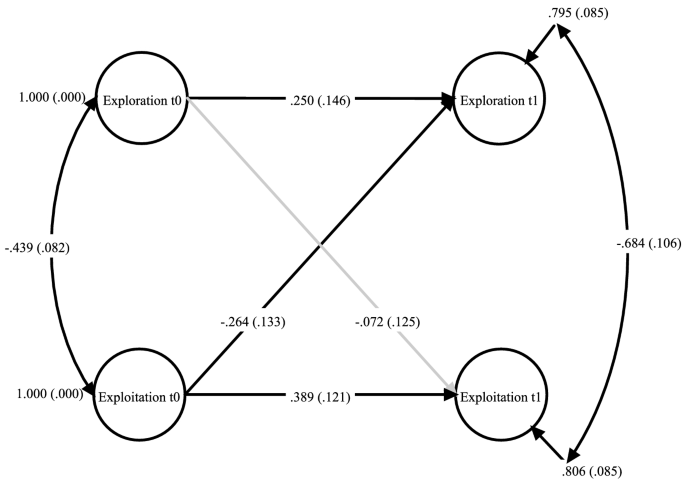
In turbulent environments, schools have to adapt to constantly changing conditions. According to ambidexterity theory, whether they are successful in this primarily depends on their leaders and how they manage the tension between the use of current knowledge (exploitation) and the search for new knowledge (exploration). Through unique top-down and bottom-up pathways, they thus influence the innovation outcome of a school. However, it is so far unclear whether these assumptions are correct. Using data from a panel of principals who are representative of Germany and were surveyed before and during the COVID-19 pandemic, we therefore investigate if and how school leaders adapted to the turbulent environment caused by the pandemic and evaluate the extent to which this had an impact on their schools' innovations in teaching and instruction. The results demonstrate that principals' exploration activities increased markedly during the pandemic, while their exploitation activities decreased noticeably. Further, a focus on the use and refinement of existing knowledge in comparatively predictable (pre-COVID-19) environments harmed principals' readiness to explore new knowledge in increasingly uncertain environments. Nevertheless, exploitation had positive consequences for the innovativeness of schools, and exploration goes along with more radical innovations in teaching and instruction. Our research suggests that schools that innovatively addressed the COVID-19 pandemic had school leaders who were able to quickly shift between the two modes of exploitation and exploration. A capacity to transition seamlessly between these modes of thinking and working thus appears to be vital for the longevity of schools.
期刊介绍:
The Journal of Educational Change is an international, professionally refereed, state-of-the-art scholarly journal, reflecting the most important ideas and evidence of educational change. The journal brings together some of the most influential thinkers and writers as well as emerging scholars on educational change. It deals with issues like educational innovation, reform and restructuring, school improvement and effectiveness, culture-building, inspection, school-review, and change management. It examines why some people resist change and what their resistance means. It looks at how men and women, older teachers and younger teachers, students, parents and others experience change differently. It looks at the positive aspects of change but does not hesitate to raise uncomfortable questions about many aspects of educational change either. It looks critically and controversially at the social, economic, cultural and political forces that are driving educational change. The Journal of Educational Change welcomes and supports contributions from a range of disciplines, including history, psychology, political science, sociology, anthropology, philosophy and administrative and organizational theory, and from a broad spectrum of methodologies including quantitative and qualitative approaches, documentary study, action research and conceptual development. School leaders, system administrators, teacher leaders, consultants, facilitators, educational researchers, staff developers and change agents of all kinds will find this journal an indispensable resource for guiding them to both classic and cutting-edge understandings of educational change. No other journal provides such comprehensive coverage of the field of educational change.



 京公网安备 11010802042870号
京ICP备2023020795号-1
京公网安备 11010802042870号
京ICP备2023020795号-1

 分享
分享
 求助内容:
求助内容: 应助结果提醒方式:
 扫码关注我们
