Nahideh Nazdikbin Yamchi, Farhad Amjadi, Rahim Beheshti, Mehdi Hassanpour, Reza Shirazi, Amin Tamadon, Reza Rahbarghazi, Mahdi Mahdipour
{"title":"Comparison the therapeutic effects of bone marrow CD144<sup>+</sup> endothelial cells and CD146<sup>+</sup> mesenchymal stem cells in POF rats.","authors":"Nahideh Nazdikbin Yamchi, Farhad Amjadi, Rahim Beheshti, Mehdi Hassanpour, Reza Shirazi, Amin Tamadon, Reza Rahbarghazi, Mahdi Mahdipour","doi":"10.34172/bi.2023.27781","DOIUrl":null,"url":null,"abstract":"<p><p></p><p><strong>Introduction: </strong>Premature ovarian insufficiency (POI) is a challenging issue in terms of reproduction biology. In this study, therapeutic properties of bone marrow CD146<sup>+</sup> mesenchymal stem cells (MSCs) and CD144<sup>+</sup> endothelial cells (ECs) were separately investigated in rats with POI.</p><p><strong>Methods: </strong>POI rats were classified into control POI, POI + CD146<sup>+</sup> MSCs, and POI + CD144<sup>+</sup> ECs groups. Enriched CD146<sup>+</sup> MSCs and CD144<sup>+</sup> ECs were directly injected into ovarian tissue (15 × 10<sup>4</sup> cells/10 μL) in relevant groups. After 4 weeks, follicle-stimulating hormone (FSH), luteinizing hormone (LH), and estradiol (E<sub>2</sub>) levels were measured in blood samples. Ovarian tissues were collected and subjected to Hematoxylin-Eosin and Masson's trichrome staining. The expression of <i>angp-2, vegfr-2, smad-2, -4, -6,</i> and <i>tgf-β1</i> was studied using qRT-PCR analysis. Histopathological examination indicated an increased pattern of atretic follicles in the POI group related to the control rats (<i>P</i><0.0001).</p><p><strong>Results: </strong>Data indicated that injection of POI + CD146<sup>+</sup> MSCs and CD144<sup>+</sup> ECs in POI rats reduced atretic follicles and increased the number of normal follicles (<i>P</i><0.01). Along with these changes, the content of blue-colored collagen fibers was diminished after cell transplantation. Besides, cell transplantation in POI rats had the potential to reduce increased FSH, and LH levels (<i>P</i><0.05). In contrast, E2 content was increased in POI + CD146<sup>+</sup> MSCs and POI + CD144<sup>+</sup> ECs groups compared to control POI rats, indicating restoration of follicular function. CD144<sup>+</sup> (<i>smad-2</i>, and <i>-4</i>) and CD146<sup>+</sup> (<i>smad-6</i>) cells altered the activity of genes belonging TGF-β signaling pathway. Unlike POI + CD146<sup>+</sup> MSCs, aberrant angiogenesis properties were significantly down-regulated in POI + CD144<sup>+</sup> ECs related to the control POI group (<i>P</i><0.05).</p><p><strong>Conclusion: </strong>The transplantation of bone marrow CD146<sup>+</sup> and CD144<sup>+</sup> cells can lead to the restoration of ovarian tissue function in POI rats via modulating different mechanisms associated with angiogenesis and fibrosis.</p>","PeriodicalId":2,"journal":{"name":"ACS Applied Bio Materials","volume":" ","pages":"495-504"},"PeriodicalIF":4.7000,"publicationDate":"2023-01-01","publicationTypes":"Journal Article","fieldsOfStudy":null,"isOpenAccess":false,"openAccessPdf":"https://www.ncbi.nlm.nih.gov/pmc/articles/PMC10676523/pdf/","citationCount":"0","resultStr":null,"platform":"Semanticscholar","paperid":null,"PeriodicalName":"ACS Applied Bio Materials","FirstCategoryId":"5","ListUrlMain":"https://doi.org/10.34172/bi.2023.27781","RegionNum":0,"RegionCategory":null,"ArticlePicture":[],"TitleCN":null,"AbstractTextCN":null,"PMCID":null,"EPubDate":"2023/7/29 0:00:00","PubModel":"Epub","JCR":"Q2","JCRName":"MATERIALS SCIENCE, BIOMATERIALS","Score":null,"Total":0}
引用次数: 0
Abstract
Introduction: Premature ovarian insufficiency (POI) is a challenging issue in terms of reproduction biology. In this study, therapeutic properties of bone marrow CD146+ mesenchymal stem cells (MSCs) and CD144+ endothelial cells (ECs) were separately investigated in rats with POI.
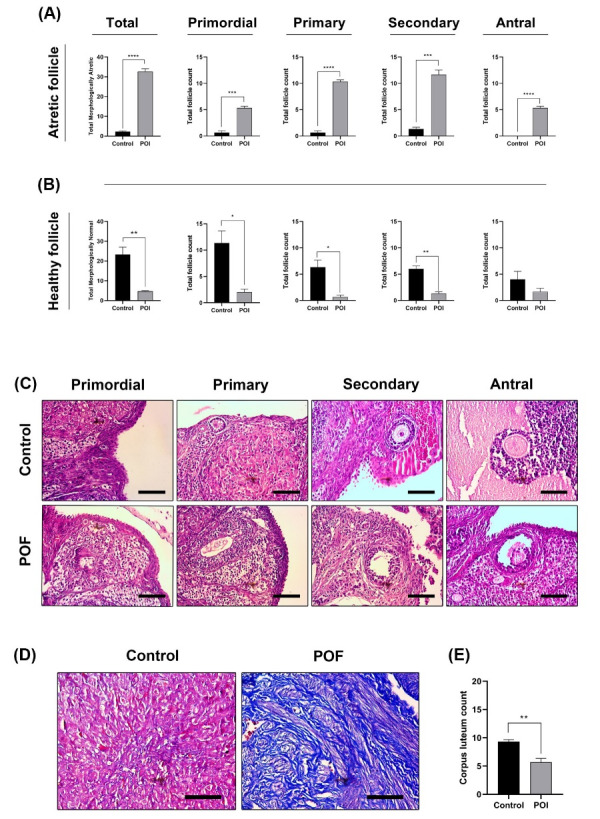
Methods: POI rats were classified into control POI, POI + CD146+ MSCs, and POI + CD144+ ECs groups. Enriched CD146+ MSCs and CD144+ ECs were directly injected into ovarian tissue (15 × 104 cells/10 μL) in relevant groups. After 4 weeks, follicle-stimulating hormone (FSH), luteinizing hormone (LH), and estradiol (E2) levels were measured in blood samples. Ovarian tissues were collected and subjected to Hematoxylin-Eosin and Masson's trichrome staining. The expression of angp-2, vegfr-2, smad-2, -4, -6, and tgf-β1 was studied using qRT-PCR analysis. Histopathological examination indicated an increased pattern of atretic follicles in the POI group related to the control rats (P<0.0001).
Results: Data indicated that injection of POI + CD146+ MSCs and CD144+ ECs in POI rats reduced atretic follicles and increased the number of normal follicles (P<0.01). Along with these changes, the content of blue-colored collagen fibers was diminished after cell transplantation. Besides, cell transplantation in POI rats had the potential to reduce increased FSH, and LH levels (P<0.05). In contrast, E2 content was increased in POI + CD146+ MSCs and POI + CD144+ ECs groups compared to control POI rats, indicating restoration of follicular function. CD144+ (smad-2, and -4) and CD146+ (smad-6) cells altered the activity of genes belonging TGF-β signaling pathway. Unlike POI + CD146+ MSCs, aberrant angiogenesis properties were significantly down-regulated in POI + CD144+ ECs related to the control POI group (P<0.05).
Conclusion: The transplantation of bone marrow CD146+ and CD144+ cells can lead to the restoration of ovarian tissue function in POI rats via modulating different mechanisms associated with angiogenesis and fibrosis.
期刊介绍:
ACS Applied Bio Materials is an interdisciplinary journal publishing original research covering all aspects of biomaterials and biointerfaces including and beyond the traditional biosensing, biomedical and therapeutic applications.
The journal is devoted to reports of new and original experimental and theoretical research of an applied nature that integrates knowledge in the areas of materials, engineering, physics, bioscience, and chemistry into important bio applications. The journal is specifically interested in work that addresses the relationship between structure and function and assesses the stability and degradation of materials under relevant environmental and biological conditions.






 京公网安备 11010802042870号
京ICP备2023020795号-1
京公网安备 11010802042870号
京ICP备2023020795号-1

 分享
分享
 求助内容:
求助内容: 应助结果提醒方式:
 扫码关注我们
