Design and computational analysis of an effective multi-epitope vaccine candidate using subunit B of cholera toxin as a build-in adjuvant against urinary tract infections.
{"title":"Design and computational analysis of an effective multi-epitope vaccine candidate using subunit B of cholera toxin as a build-in adjuvant against urinary tract infections.","authors":"Maryam Rezaei, Mehri Habibi, Parasoo Ehsani, Mohammad Reza Asadi Karam, Saeid Bouzari","doi":"10.34172/bi.2023.27513","DOIUrl":null,"url":null,"abstract":"<p><p></p><p><strong>Introduction: </strong>Urinary tract infection (UTI) is one of the most common infections, usually caused by uropathogenic <i>Escherichia coli</i> (UPEC). However, antibiotics are a usual treatment for UTIs; because of increasing antibiotic-resistant strains, vaccination can be beneficial in controlling UTIs. Using immunoinformatics techniques is an effective and rapid way for vaccine development.</p><p><strong>Methods: </strong>Three conserved protective antigens (FdeC, Hma, and UpaB) were selected to develop a novel multi-epitope vaccine consisting of subunit B of cholera toxin (CTB) as a mucosal build-in adjuvant to enhance the immune responses. Epitopes-predicted B and T cells and suitable linkers were used to separate them and effectively increase the vaccine's immunogenicity. The vaccine protein's primary, secondary, and tertiary structures were evaluated, and the best 3D model was selected. Since CTB is the TLR2 ligand, molecular docking was made between the vaccine protein and TLR2. Molecular dynamic (MD) simulation was employed to evaluate the stability of the vaccine protein-TLR2 complex. The vaccine construct was subjected to <i>in silico</i> cloning.</p><p><strong>Results: </strong>The designed vaccine protein has multiple properties in the analysis. The HADDOCK outcomes show an excellent interaction between vaccine protein and TLR2. The MD results confirm the stability of the vaccine protein- TLR2 complex during the simulation. <i>In silico</i> cloning verified the expression efficiency of our vaccine protein.</p><p><strong>Conclusion: </strong>The results of this study suggest that our designed vaccine protein could be a promising vaccine candidate against UTI, but further <i>in vitro</i> and <i>in vivo</i> studies are needed.</p>","PeriodicalId":2,"journal":{"name":"ACS Applied Bio Materials","volume":" ","pages":"27513"},"PeriodicalIF":4.7000,"publicationDate":"2024-01-01","publicationTypes":"Journal Article","fieldsOfStudy":null,"isOpenAccess":false,"openAccessPdf":"https://www.ncbi.nlm.nih.gov/pmc/articles/PMC10844585/pdf/","citationCount":"0","resultStr":null,"platform":"Semanticscholar","paperid":null,"PeriodicalName":"ACS Applied Bio Materials","FirstCategoryId":"5","ListUrlMain":"https://doi.org/10.34172/bi.2023.27513","RegionNum":0,"RegionCategory":null,"ArticlePicture":[],"TitleCN":null,"AbstractTextCN":null,"PMCID":null,"EPubDate":"2023/8/5 0:00:00","PubModel":"Epub","JCR":"Q2","JCRName":"MATERIALS SCIENCE, BIOMATERIALS","Score":null,"Total":0}
引用次数: 0
Abstract
Introduction: Urinary tract infection (UTI) is one of the most common infections, usually caused by uropathogenic Escherichia coli (UPEC). However, antibiotics are a usual treatment for UTIs; because of increasing antibiotic-resistant strains, vaccination can be beneficial in controlling UTIs. Using immunoinformatics techniques is an effective and rapid way for vaccine development.
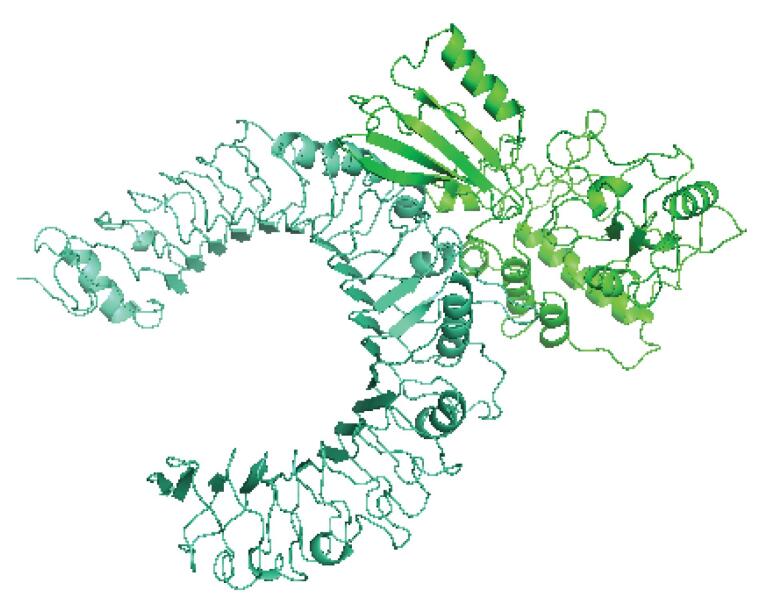
Methods: Three conserved protective antigens (FdeC, Hma, and UpaB) were selected to develop a novel multi-epitope vaccine consisting of subunit B of cholera toxin (CTB) as a mucosal build-in adjuvant to enhance the immune responses. Epitopes-predicted B and T cells and suitable linkers were used to separate them and effectively increase the vaccine's immunogenicity. The vaccine protein's primary, secondary, and tertiary structures were evaluated, and the best 3D model was selected. Since CTB is the TLR2 ligand, molecular docking was made between the vaccine protein and TLR2. Molecular dynamic (MD) simulation was employed to evaluate the stability of the vaccine protein-TLR2 complex. The vaccine construct was subjected to in silico cloning.
Results: The designed vaccine protein has multiple properties in the analysis. The HADDOCK outcomes show an excellent interaction between vaccine protein and TLR2. The MD results confirm the stability of the vaccine protein- TLR2 complex during the simulation. In silico cloning verified the expression efficiency of our vaccine protein.
Conclusion: The results of this study suggest that our designed vaccine protein could be a promising vaccine candidate against UTI, but further in vitro and in vivo studies are needed.
期刊介绍:
ACS Applied Bio Materials is an interdisciplinary journal publishing original research covering all aspects of biomaterials and biointerfaces including and beyond the traditional biosensing, biomedical and therapeutic applications.
The journal is devoted to reports of new and original experimental and theoretical research of an applied nature that integrates knowledge in the areas of materials, engineering, physics, bioscience, and chemistry into important bio applications. The journal is specifically interested in work that addresses the relationship between structure and function and assesses the stability and degradation of materials under relevant environmental and biological conditions.






 京公网安备 11010802042870号
京ICP备2023020795号-1
京公网安备 11010802042870号
京ICP备2023020795号-1

 分享
分享
 求助内容:
求助内容: 应助结果提醒方式:
 扫码关注我们
