{"title":"Deep Learning Method Based on Gated Recurrent Unit and Variational Mode Decomposition for Short-Term Wind Power Interval Prediction","authors":"Ruoheng Wang;Chaoshun Li;Wenlong Fu;Geng Tang","doi":"10.1109/TNNLS.2019.2946414","DOIUrl":null,"url":null,"abstract":"Wind power interval prediction (WPIP) plays an increasingly important role in evaluations of the uncertainty of wind power and becomes necessary for managing and planning power systems. However, the intermittent and fluctuating characteristics of wind power mean that high-quality prediction intervals (PIs) production is a challenging problem. In this article, we propose a novel hybrid model for the WPIP based on the gated recurrent unit (GRU) neural networks and variational mode decomposition (VMD). In the hybrid model, VMD is employed to decompose complex wind power data into simplified modes. Basic GRU prediction models, comprising a GRU input layer, multiple fully connected layers, and a rank-ordered terminal layer, are then trained for each mode to produce PIs, which are combined to obtain final PIs. In addition, an adaptive optimization method based on constructed intervals (CIs) is proposed to build high-quality training labels for supervised learning with the hybrid model. Several numerical experiments were implemented to validate the effectiveness of the proposed method. The results indicate that the proposed method performs better than the traditional interval prediction models with much higher quality PIs, and it requires less training time.","PeriodicalId":13303,"journal":{"name":"IEEE transactions on neural networks and learning systems","volume":"31 10","pages":"3814-3827"},"PeriodicalIF":8.9000,"publicationDate":"2019-11-13","publicationTypes":"Journal Article","fieldsOfStudy":null,"isOpenAccess":false,"openAccessPdf":"https://sci-hub-pdf.com/10.1109/TNNLS.2019.2946414","citationCount":"95","resultStr":null,"platform":"Semanticscholar","paperid":null,"PeriodicalName":"IEEE transactions on neural networks and learning systems","FirstCategoryId":"94","ListUrlMain":"https://ieeexplore.ieee.org/document/8897724/","RegionNum":1,"RegionCategory":"计算机科学","ArticlePicture":[],"TitleCN":null,"AbstractTextCN":null,"PMCID":null,"EPubDate":"","PubModel":"","JCR":"Q1","JCRName":"COMPUTER SCIENCE, ARTIFICIAL INTELLIGENCE","Score":null,"Total":0}
引用次数: 95
Abstract
Wind power interval prediction (WPIP) plays an increasingly important role in evaluations of the uncertainty of wind power and becomes necessary for managing and planning power systems. However, the intermittent and fluctuating characteristics of wind power mean that high-quality prediction intervals (PIs) production is a challenging problem. In this article, we propose a novel hybrid model for the WPIP based on the gated recurrent unit (GRU) neural networks and variational mode decomposition (VMD). In the hybrid model, VMD is employed to decompose complex wind power data into simplified modes. Basic GRU prediction models, comprising a GRU input layer, multiple fully connected layers, and a rank-ordered terminal layer, are then trained for each mode to produce PIs, which are combined to obtain final PIs. In addition, an adaptive optimization method based on constructed intervals (CIs) is proposed to build high-quality training labels for supervised learning with the hybrid model. Several numerical experiments were implemented to validate the effectiveness of the proposed method. The results indicate that the proposed method performs better than the traditional interval prediction models with much higher quality PIs, and it requires less training time.
期刊介绍:
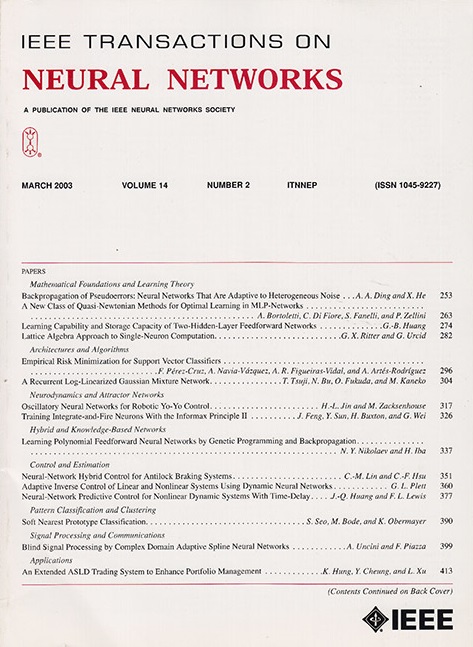
The focus of IEEE Transactions on Neural Networks and Learning Systems is to present scholarly articles discussing the theory, design, and applications of neural networks as well as other learning systems. The journal primarily highlights technical and scientific research in this domain.



 京公网安备 11010802042870号
京ICP备2023020795号-1
京公网安备 11010802042870号
京ICP备2023020795号-1

 分享
分享
 求助内容:
求助内容: 应助结果提醒方式:
 扫码关注我们
