José Bernardo Ferreira, Margarida Cabral, Rita Santos, Marta Ferreira, Rui Fonseca-Pinto, Alexandre Antunes, Filipa Januário
{"title":"Hybrid Cardiac Telerehabilitation After Acute Coronary Syndrome: Self-selection Predictors and Outcomes.","authors":"José Bernardo Ferreira, Margarida Cabral, Rita Santos, Marta Ferreira, Rui Fonseca-Pinto, Alexandre Antunes, Filipa Januário","doi":"10.5195/ijt.2023.6475","DOIUrl":null,"url":null,"abstract":"<p><strong>Aims: </strong>To evaluate the effectiveness of a hybrid cardiac telerehabilitation (HCTR) program after acute coronary syndrome (ACS) on patient quality of life (QoL) and physical activity indices throughout phases 2-3 and establish predictors for hybrid program self-selection.</p><p><strong>Methodology: </strong>This single-centre longitudinal retrospective study included patients who attended a cardiac rehabilitation program (CRP) between 2018-2021. Patients self-selected between two groups: Group 1 - conventional CRP (CCRP); Group 2 - HCTR. Baseline characteristics were registered. EuroQol-5D (EQ-5D) and International Physical Activity Questionnaire (IPAQ) were applied at three times: T0 - phase 2 onset; T1 - phase 3 onset; T2 - 3 months after T1.</p><p><strong>Results: </strong>59 patients participated (Group 1 - 27; Group 2 - 32). We found significant between-group differences regarding occupation (p=0.003). Diabetic patients were less likely to self-select into HCTR (OR=0.21; p<0.05). EQ-5D visual analogue scale and IPAQ result significantly improved between T0-T2 only for HCTR (p=0.001; p=0.021).</p><p><strong>Conclusions: </strong>HCTR was superior to CCRP on physical activity indices and QoL of ACS patients.</p>","PeriodicalId":2,"journal":{"name":"ACS Applied Bio Materials","volume":" ","pages":"e6475"},"PeriodicalIF":4.7000,"publicationDate":"2023-05-11","publicationTypes":"Journal Article","fieldsOfStudy":null,"isOpenAccess":false,"openAccessPdf":"https://www.ncbi.nlm.nih.gov/pmc/articles/PMC10687976/pdf/","citationCount":"0","resultStr":null,"platform":"Semanticscholar","paperid":null,"PeriodicalName":"ACS Applied Bio Materials","FirstCategoryId":"1085","ListUrlMain":"https://doi.org/10.5195/ijt.2023.6475","RegionNum":0,"RegionCategory":null,"ArticlePicture":[],"TitleCN":null,"AbstractTextCN":null,"PMCID":null,"EPubDate":"2023/1/1 0:00:00","PubModel":"eCollection","JCR":"Q2","JCRName":"MATERIALS SCIENCE, BIOMATERIALS","Score":null,"Total":0}
引用次数: 0
Abstract
Aims: To evaluate the effectiveness of a hybrid cardiac telerehabilitation (HCTR) program after acute coronary syndrome (ACS) on patient quality of life (QoL) and physical activity indices throughout phases 2-3 and establish predictors for hybrid program self-selection.
Methodology: This single-centre longitudinal retrospective study included patients who attended a cardiac rehabilitation program (CRP) between 2018-2021. Patients self-selected between two groups: Group 1 - conventional CRP (CCRP); Group 2 - HCTR. Baseline characteristics were registered. EuroQol-5D (EQ-5D) and International Physical Activity Questionnaire (IPAQ) were applied at three times: T0 - phase 2 onset; T1 - phase 3 onset; T2 - 3 months after T1.
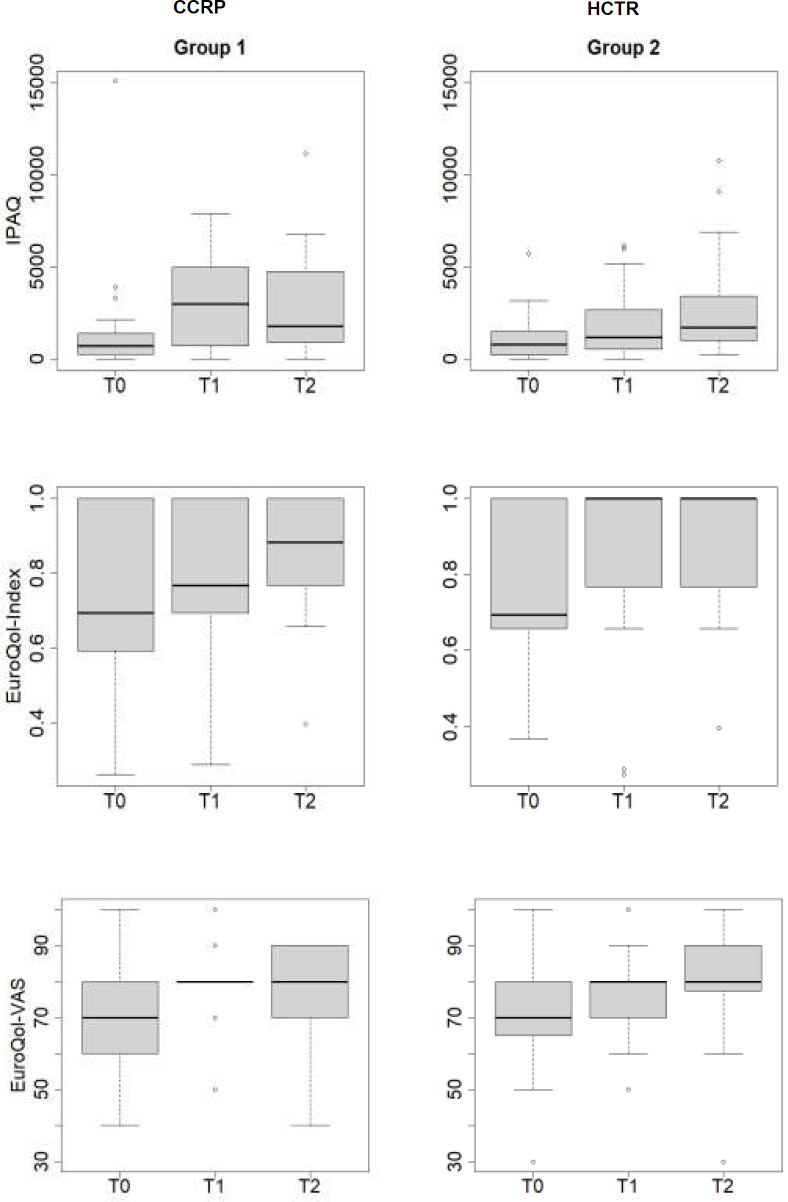
Results: 59 patients participated (Group 1 - 27; Group 2 - 32). We found significant between-group differences regarding occupation (p=0.003). Diabetic patients were less likely to self-select into HCTR (OR=0.21; p<0.05). EQ-5D visual analogue scale and IPAQ result significantly improved between T0-T2 only for HCTR (p=0.001; p=0.021).
Conclusions: HCTR was superior to CCRP on physical activity indices and QoL of ACS patients.
期刊介绍:
ACS Applied Bio Materials is an interdisciplinary journal publishing original research covering all aspects of biomaterials and biointerfaces including and beyond the traditional biosensing, biomedical and therapeutic applications.
The journal is devoted to reports of new and original experimental and theoretical research of an applied nature that integrates knowledge in the areas of materials, engineering, physics, bioscience, and chemistry into important bio applications. The journal is specifically interested in work that addresses the relationship between structure and function and assesses the stability and degradation of materials under relevant environmental and biological conditions.




 京公网安备 11010802042870号
京ICP备2023020795号-1
京公网安备 11010802042870号
京ICP备2023020795号-1

 分享
分享
 求助内容:
求助内容: 应助结果提醒方式:
 扫码关注我们
