Judy Lawrence, Anita Wreford, Paula Blackett, David Hall, Alistair Woodward, Shaun Awatere, Mary E Livingston, Cate Macinnis-Ng, Susan Walker, Joanna Fountain, Mark John Costello, Anne-Gaelle E Ausseil, Michael S Watt, Sam M Dean, Nicholas A Cradock-Henry, Christian Zammit, Taciano L Milfont
{"title":"Climate change adaptation through an integrative lens in Aotearoa New Zealand.","authors":"Judy Lawrence, Anita Wreford, Paula Blackett, David Hall, Alistair Woodward, Shaun Awatere, Mary E Livingston, Cate Macinnis-Ng, Susan Walker, Joanna Fountain, Mark John Costello, Anne-Gaelle E Ausseil, Michael S Watt, Sam M Dean, Nicholas A Cradock-Henry, Christian Zammit, Taciano L Milfont","doi":"10.1080/03036758.2023.2236033","DOIUrl":null,"url":null,"abstract":"<p><p>Climate change is being felt across all human and natural systems in Aotearoa New Zealand and is projected to worsen this decade as impacts compound and cascade through natural system and sectoral dependencies. The effectiveness of adaptation is constrained by how fast greenhouse gas emissions are reduced globally, the pace of change, the frequency and progression of impacts, and the capacity of our natural, societal and political systems to respond. We explore how these systems and sectors interact with existing and projected climate change stressors by categorising climate change impacts (Trends and Events) and consequential thresholds (Thresholds), and by grouping systems and sectors by types (Typologies). This approach has identified commonalities and differences between the typologies which are illustrated with examples. Critical constraints and opportunities for adaptation have been identified to guide sector adaptation decision-making and for ongoing adaptation progress and effectiveness monitoring. Constraints are found across all sectors, and opportunities exist to address them through modelling and projections, monitoring frameworks, decision tools and measures, governance coordination and integration of the Māori worldview of the relationship between humans and nature. However, limits to adaptation exist and will increase over time unless all sectors and all nations urgently reduce their emissions.</p>","PeriodicalId":2,"journal":{"name":"ACS Applied Bio Materials","volume":" ","pages":"491-522"},"PeriodicalIF":4.7000,"publicationDate":"2023-08-17","publicationTypes":"Journal Article","fieldsOfStudy":null,"isOpenAccess":false,"openAccessPdf":"https://www.ncbi.nlm.nih.gov/pmc/articles/PMC11459784/pdf/","citationCount":"0","resultStr":null,"platform":"Semanticscholar","paperid":null,"PeriodicalName":"ACS Applied Bio Materials","FirstCategoryId":"103","ListUrlMain":"https://doi.org/10.1080/03036758.2023.2236033","RegionNum":0,"RegionCategory":null,"ArticlePicture":[],"TitleCN":null,"AbstractTextCN":null,"PMCID":null,"EPubDate":"2024/1/1 0:00:00","PubModel":"eCollection","JCR":"Q2","JCRName":"MATERIALS SCIENCE, BIOMATERIALS","Score":null,"Total":0}
引用次数: 0
Abstract
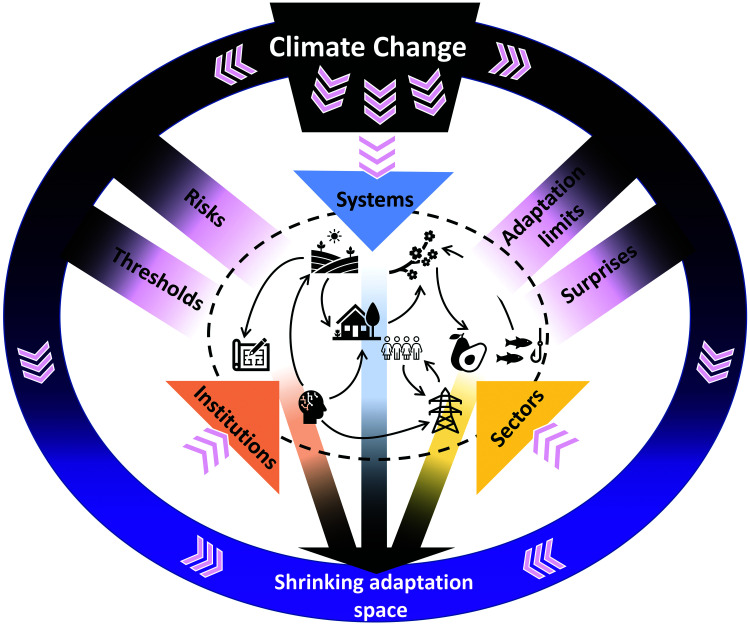
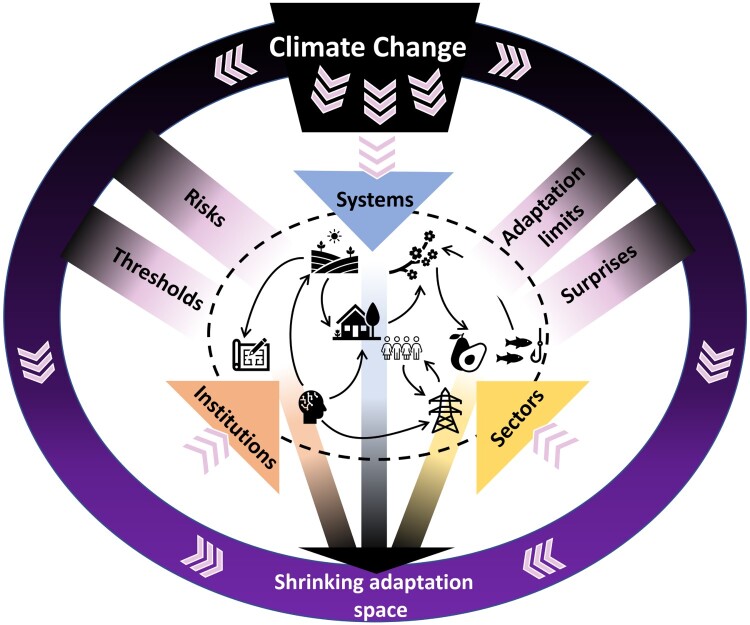
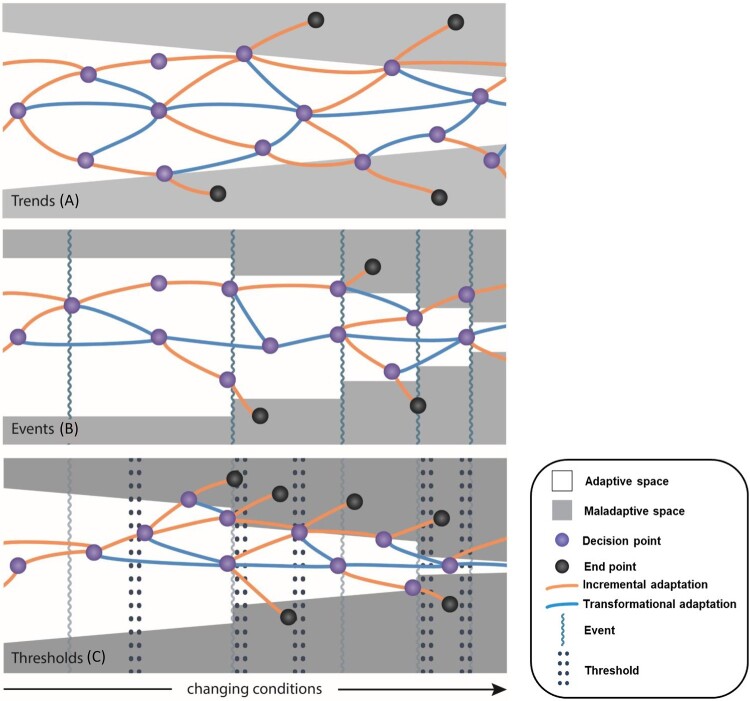
Climate change is being felt across all human and natural systems in Aotearoa New Zealand and is projected to worsen this decade as impacts compound and cascade through natural system and sectoral dependencies. The effectiveness of adaptation is constrained by how fast greenhouse gas emissions are reduced globally, the pace of change, the frequency and progression of impacts, and the capacity of our natural, societal and political systems to respond. We explore how these systems and sectors interact with existing and projected climate change stressors by categorising climate change impacts (Trends and Events) and consequential thresholds (Thresholds), and by grouping systems and sectors by types (Typologies). This approach has identified commonalities and differences between the typologies which are illustrated with examples. Critical constraints and opportunities for adaptation have been identified to guide sector adaptation decision-making and for ongoing adaptation progress and effectiveness monitoring. Constraints are found across all sectors, and opportunities exist to address them through modelling and projections, monitoring frameworks, decision tools and measures, governance coordination and integration of the Māori worldview of the relationship between humans and nature. However, limits to adaptation exist and will increase over time unless all sectors and all nations urgently reduce their emissions.
期刊介绍:
ACS Applied Bio Materials is an interdisciplinary journal publishing original research covering all aspects of biomaterials and biointerfaces including and beyond the traditional biosensing, biomedical and therapeutic applications.
The journal is devoted to reports of new and original experimental and theoretical research of an applied nature that integrates knowledge in the areas of materials, engineering, physics, bioscience, and chemistry into important bio applications. The journal is specifically interested in work that addresses the relationship between structure and function and assesses the stability and degradation of materials under relevant environmental and biological conditions.





 京公网安备 11010802042870号
京ICP备2023020795号-1
京公网安备 11010802042870号
京ICP备2023020795号-1

 分享
分享
 求助内容:
求助内容: 应助结果提醒方式:
 扫码关注我们
