Ahmad Nosratimovafagh, Abolghasem Esmaeili Fereidouni, Felix Krujatz
{"title":"Effect of light spectrum, salinity, and glucose levels on Spirulina morphology","authors":"Ahmad Nosratimovafagh, Abolghasem Esmaeili Fereidouni, Felix Krujatz","doi":"10.1111/jwas.13012","DOIUrl":null,"url":null,"abstract":"<p>This study evaluated how light spectrum, salinity, and glucose level affect <i>Spirulina</i> morphology, using response surface methodology (RSM). A full factorial experiment was conducted including three light conditions with different predominant spectral characteristics (“white”: 100% white; “red”: 80% red, 15% blue, and 5% green; and “yellow”: 80% yellow, 15% blue, and 5% green), four NaCl concentrations (0, 5, 15, 30 g/L), and four glucose levels (0, 1.5, 2, 2.5 g/L). Light spectrum conditions and salinity had significant effects on the filament length, spiral diameter, and screw pitch length. Glucose only had a significant effect in terms of the spiral diameter. The maximum filament length (1274 μm; under 30 g/L NaCl and 2.5 g/L glucose), spiral diameter (47 μm; under 1 g/L NaCl and 2 g/L glucose), and screw pitch length (112 μm; under 1 g/L NaCl and 2 g/L glucose) were attained under yellow light. In line with the simulation, more compacted filaments, that is, with a greater diameter (41 μm) and shorter screw pitches (78 μm), are observed under “red” light (4 g/L NaCl and 2.5 g/L glucose). Because longer but compact filaments are desirable for easier harvesting, we recommend a light spectrum that is predominantly red with a NaCl concentration of 5.8 g/L deprived of glucose, for the cost-effective harvesting of <i>Spirulina</i> biomass.</p>","PeriodicalId":17284,"journal":{"name":"Journal of The World Aquaculture Society","volume":"54 6","pages":"1687-1701"},"PeriodicalIF":3.2000,"publicationDate":"2023-07-18","publicationTypes":"Journal Article","fieldsOfStudy":null,"isOpenAccess":false,"openAccessPdf":"https://onlinelibrary.wiley.com/doi/epdf/10.1111/jwas.13012","citationCount":"0","resultStr":null,"platform":"Semanticscholar","paperid":null,"PeriodicalName":"Journal of The World Aquaculture Society","FirstCategoryId":"97","ListUrlMain":"https://onlinelibrary.wiley.com/doi/10.1111/jwas.13012","RegionNum":3,"RegionCategory":"农林科学","ArticlePicture":[],"TitleCN":null,"AbstractTextCN":null,"PMCID":null,"EPubDate":"","PubModel":"","JCR":"Q2","JCRName":"FISHERIES","Score":null,"Total":0}
引用次数: 0
Abstract
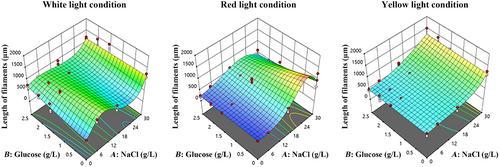
This study evaluated how light spectrum, salinity, and glucose level affect Spirulina morphology, using response surface methodology (RSM). A full factorial experiment was conducted including three light conditions with different predominant spectral characteristics (“white”: 100% white; “red”: 80% red, 15% blue, and 5% green; and “yellow”: 80% yellow, 15% blue, and 5% green), four NaCl concentrations (0, 5, 15, 30 g/L), and four glucose levels (0, 1.5, 2, 2.5 g/L). Light spectrum conditions and salinity had significant effects on the filament length, spiral diameter, and screw pitch length. Glucose only had a significant effect in terms of the spiral diameter. The maximum filament length (1274 μm; under 30 g/L NaCl and 2.5 g/L glucose), spiral diameter (47 μm; under 1 g/L NaCl and 2 g/L glucose), and screw pitch length (112 μm; under 1 g/L NaCl and 2 g/L glucose) were attained under yellow light. In line with the simulation, more compacted filaments, that is, with a greater diameter (41 μm) and shorter screw pitches (78 μm), are observed under “red” light (4 g/L NaCl and 2.5 g/L glucose). Because longer but compact filaments are desirable for easier harvesting, we recommend a light spectrum that is predominantly red with a NaCl concentration of 5.8 g/L deprived of glucose, for the cost-effective harvesting of Spirulina biomass.
期刊介绍:
The Journal of the World Aquaculture Society is an international scientific journal publishing original research on the culture of aquatic plants and animals including:
Nutrition;
Disease;
Genetics and breeding;
Physiology;
Environmental quality;
Culture systems engineering;
Husbandry practices;
Economics and marketing.



 京公网安备 11010802042870号
京ICP备2023020795号-1
京公网安备 11010802042870号
京ICP备2023020795号-1

 分享
分享
 求助内容:
求助内容: 应助结果提醒方式:
 扫码关注我们
